

Photo adjustments
Proportionally resized and converted to WebP without cropping, retouching or changing the photographed subject.
City & district guides
About Nanluoguxiang
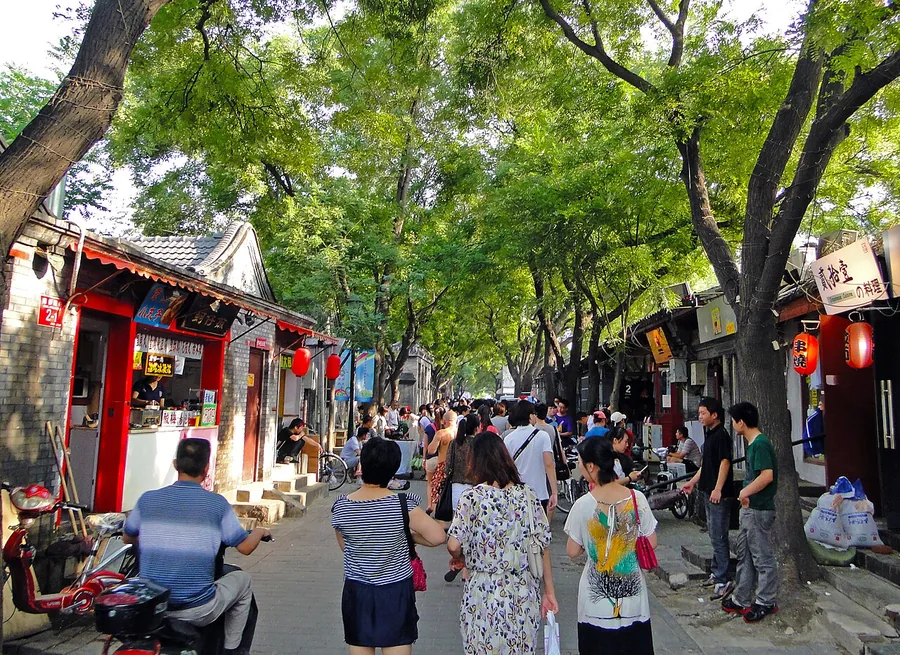
Its older courtyard fabric now sits alongside restaurants, cafes, and souvenir shops, giving the main lane a strongly commercial character. The surrounding side lanes help explain the neighborhood’s traditional hutong layout and siheyuan courtyard form. Walk the main spine for orientation, then choose a small number of side streets that remain publicly accessible; a residential courtyard doorway is a boundary, not an invitation to enter.
In the Ming dynasty the lane belonged to Zhaohui Jinggong precinct and was called Luoguo Xiang (锣锅巷); in Beijing dialect luoguor means a hunchback, and the lane, low at both ends and higher in the middle like a hunchback's spine, was named for this shape. Under the Qing it belonged to the Bordered Yellow Banner and was renamed Nanluoguxiang, a name confirmed on the 1750 map Jingcheng Quantu (京城全图). The name continued after the founding of the Republic of China, and although briefly changed to Huihuang Jie during the Cultural Revolution, it was later restored.
Nanluoguxiang had long been a quiet traditional residential area; in the 1990s the only eatery was a small restaurant outside the Central Academy of Drama (中央戏剧学院). In 1999 the bar Guoke (过客) opened as the lane's first, with few early customers, followed soon after by Chuangketie 8 (创可贴8) and Huoshanren (火山人), among the earliest bars on what later became a bar street.
The lane is 786 meters long and 8 meters wide, paved with asphalt, with eight hutongs branching off to its west and eight more to its east. According to the Tianzhi Ouwen (天咫偶闻), the residence of the Qing official Hong Chengchou (洪承畴) stood on the lane's west side, at what is now No. 59 Nanluoguxiang.
What to look for
- The main alley: follow its north–south alignment between Di’anmen East Street and Gulou East Street.
- Hutong junctions and courtyard entrances: compare the narrow side lanes and the street-facing details of siheyuan homes.
Location & getting there
Getting to Nanluoguxiang
Nanluogu Xiang subway station is near the alley’s southern entrance at Di’anmen East Street.
- A south-to-north walk finishes at Gulou East Street, so choose your onward meeting point at the end you intend to leave.
Combine your visit
Suggested order within this visit:
-
Southern entrance
Orient the walk at the Di’anmen East Street end.
-
Main lane and side-hutong junctions
Compare the retail spine with the narrower neighborhood streets.
-
Gulou East Street end
Finish at the alley’s northern boundary.
This sequence is an editorial suggestion based on the features described in the sources. Access to individual buildings or areas should be checked locally; no travel time or shared admission is implied.
Find Nanluoguxiang
南锣鼓巷 · 东城区
The pin marks the area, not the entrance.
More places nearby
Approximate straight-line distances between map pins, not travel distances.
Gulou and Zhonglou钟鼓楼
Less than 1 km awayBeijing’s Drum and Bell Towers stand together at the northern end of the old inner-city central axis. They served the practical task of announcing time through the Yuan, Ming, and Qing periods, giving the surrounding streets a…
View guide →Shichahai什刹海
Less than 1 km awayShichahai is a historic lake district formed by Qianhai, Houhai, and Xihai, north of Beihai Park. Its waterside paths sit within an old neighborhood of temples, former mansions, and hutongs, recalling the area’s former role in…
View guide →Guozijian国子监
Less than 1 km awayBeijing Guozijian was the imperial academy and education-administration center of the Yuan, Ming, and Qing periods. It stands immediately west of the Temple of Confucius, joining formal learning with the ritual honoring of the…
View guide →Sources & visit information
The linked encyclopedia sources support background and place descriptions. Current opening hours, ticket prices, booking rules and transport schedules have not been independently verified for this guide. Confirm them with the venue or operator before travelling.
Visitor information adapted and edited from Wikipedia contributors · CC BY-SA 4.0. Source revision 1366858892.
Background paragraphs translated and condensed from Wikipedia contributors, "南锣鼓巷", Chinese Wikipedia · CC BY-SA 4.0. Source revision 91173235.