

Photo adjustments
Converted to WebP and resized without changing the subject or cropping the source frame.
City & district guides
About Guanyin Temple, Xinjin
Pilu Hall’s murals use rich mineral colours and detailed figures, while Guanyin Hall is known for its sculptural programme. The surviving works deserve a slow look rather than a quick temple circuit. Access to individual halls can change during conservation: recent visitor accounts report work at Guanyin Hall, so confirm the actual open sections before making a special trip.
The temple was built in 1181, during the Song dynasty, and was destroyed by warfare at the end of the Yuan dynasty. It was rebuilt during the Ming Xuande era and repaired repeatedly during the Qing Kangxi, Qianlong and Daoguang eras, before being destroyed again during the Xianfeng era, when only Pilu Hall (毗卢殿) and Guanyin Hall (观音殿) survived. The temple was rebuilt again during the Tongzhi and Guangxu eras, fell into disrepair during the Republic period, and was further damaged during the Cultural Revolution.
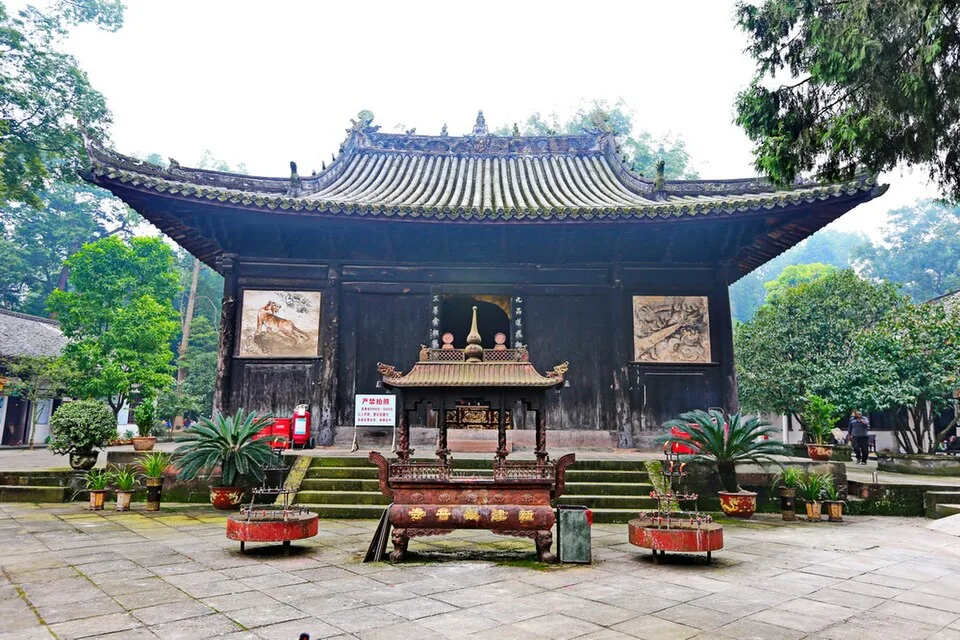
The surviving complex combines the Ming-dynasty Pilu Hall and Guanyin Hall with a Qing-dynasty mountain gate, Maitreya Hall and Jieyin Hall, covering a total building area of 1,180 square metres. Pilu Hall, built in 1462, is a single-eave, hip-and-gable-roofed structure three bays wide and 10.72 metres across, containing seven finely detailed polychrome murals painted in 1468. Guanyin Hall, also built in 1468, is a single-eave, hip-and-gable-roofed structure five bays wide and holds an elaborate group of Buddhist and arhat statues.
The temple was designated a Sichuan historical and revolutionary cultural relic protection unit in 1956, redesignated a Sichuan heritage protection unit in 1980, and listed as a Major Historical and Cultural Site Protected at the National Level in 2001, recognition tied to the surviving Ming-dynasty halls and their murals and statuary.
What to look for
- Pilu Hall’s Ming murals depict Buddhist figures in detailed colour.
- The historic halls preserve different forms of Buddhist painting and sculpture.
Location & getting there
Getting to Guanyin Temple, Xinjin
Use Guanyin Temple in Baoqiao village, Yongshang Town, Xinjin, on the Jiulian Mountain side of town. Arrange the onward road transfer from Xinjin’s urban or rail area. Confirm hall access and follow the staff’s photography rules.
Combine your visit
Choose from these complementary stops when planning your visit.
-
Temple approach观音寺入寺院落
Check which historic halls are open.
-
Pilu Hall毗卢殿
Spend time with the permitted mural views.
-
Open temple courtyards开放寺院庭院
Continue only through areas released for visitors.
This is a suggested combination, not a timed route; confirm the opening and transport arrangements for your date.
Find Guanyin Temple, Xinjin
新津观音寺 · 新津区
The pin marks the area, not the entrance.
More places nearby
Approximate straight-line distances between map pins, not travel distances.
Laojun Mountain, Xinjin新津老君山
5 km awayXinjin’s Laojun Mountain is a wooded Taoist temple hill, with steep stairways linking a series of halls. Hunyuan Hall is devoted to Laozi, while the higher Sanqing Hall introduces the Three Pure Ones. The sequence of buildings…
View guide →Baodun Archaeological Site宝墩遗址
10 km awayBaodun introduces the prehistoric settlement history of the Chengdu Plain. Its exhibition explains the ancient walled town, rice agriculture and the roots of Shu culture through archaeological finds and interpretation. The…
View guide →Tianfu Agricultural Expo Park中国天府农业博览园
16 km awayTianfu Agricultural Expo Park places large exhibition structures within the farming landscape of Xinjin. The main halls use sweeping timber-and-steel roof forms with a lightweight membrane enclosure, making the architecture a…
View guide →Sources & visit information
The sources below support the place-specific description and arrival information. Suggested combinations are editorial planning ideas; confirm current opening, entry arrangements and transport services for your date.
- Xinjin Guanyin Temple: surviving halls and Ming artwork ↗
- May 2026 visitor observation: Guanyin Hall conservation work; verify current access with the temple ↗
- Chinese Wikipedia: 观音寺 (新津区) (revision 85362379, 2024-12-18) ↗
Background paragraphs translated and condensed from Wikipedia contributors, "观音寺 (新津区)", Chinese Wikipedia · CC BY-SA 4.0. Source revision 85362379.