

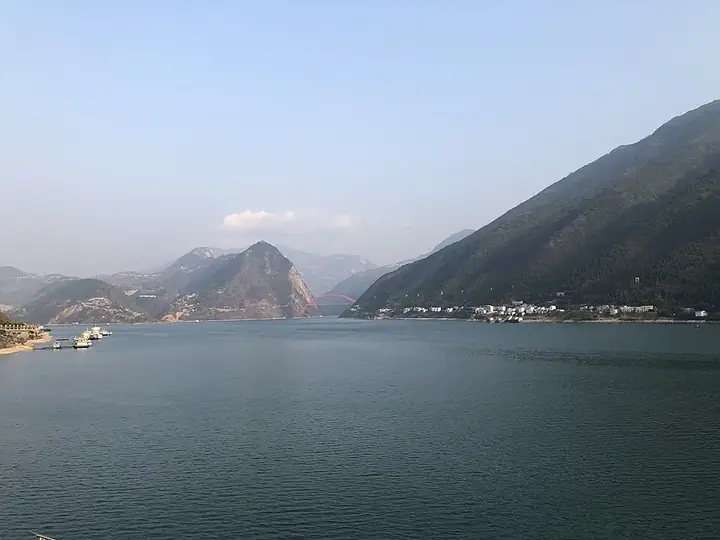
Photo adjustments
Full frame retained; resized proportionally to a maximum dimension of 960 pixels and converted to WebP quality 88. No crop, retouch, generated elements, or subject alteration. Final website rendition: full frame retained, proportionally resized to at most 720 pixels and converted to WebP. No additional retouching or subject alteration. Card displays may crop the view.
Explore the region
About Wu Gorge
High ridges frame the river, with the Twelve Peaks providing named landmarks along the route. Goddess Peak is the best-known of these, connected in local legend with the figure Yaoji. The interest is in the sequence of mountain profiles as the river turns, so choose a sightseeing route that identifies which viewpoints or water sections it actually reaches.
Wu Gorge begins at the mouth of the Daning River (大宁河) in Wushan County and ends at Guandukou in Badong County. The mountains that flank the Yangtze along both banks of the gorge are known as the Wu Mountains (巫山). According to local tradition, Goddess Peak (神女峰) is the incarnation of a fairy who helped Yu the Great (大禹) control floods and guided boatmen through the gorge.
What to look for
- Goddess Peak is a distinctive landmark among the Twelve Peaks.
- The opposing Wu Mountain ridges frame the Yangtze through a succession of bends.
Background & history
Wu Gorge (simplified Chinese: 巫峡; traditional Chinese: 巫峽; pinyin: Wū Xiá), sometimes called Great Gorge (Chinese: 大峡; pinyin: Dà Xiá), is the second gorge of the Three Gorges system on the Yangtze River, People's Republic of China. It stretches 45 km (28 mi) from Wushan to Guandukou, and is located downstream of Qutang Gorge and upstream of Xiling Gorge. The gorge straddles the boundary between Wushan County of Chongqing Municipality (formerly part of Sichuan Province) and Badong County, Hubei Province. The gorge has been known as the Wu Gorge since at least the Three Kingdoms period, when it was recorded in the geographical treatise Shui Jing Zhu. In 589 AD, General Lü Zhongsu of the Chen dynasty stationed troops in the Wu and Xiling Gorges in an attempt to stop the advancing Sui dynasty armies. Tang dynasty poet Yang Jiong wrote a classical poem entitled "Passing Wu Gorge" (Chinese: 過巫峽). Among the Twelve Peaks of the Wu Gorge, the most spectacular is the Goddess Peak.
Excerpt from Wikipedia: Wu Gorge · Wikipedia contributors · CC BY-SA 4.0. Selected introductory sentences; formatting simplified. Background information, not current visitor-service advice.
Location & getting there
Getting to Wu Gorge
For a land-based Wu Gorge outlook, arrange a road transfer from Wushan to Liuping Visitor Centre and use the managed sightseeing vehicle for Goddess Sky Road. A river passage has a separate departure pier and booking; the Little Three Gorges follows a different river.
- The Huangyan, Jiulong and Wangxia cableways are scheduled to close for maintenance on 7–11 September 2026, with reopening planned for 12 September. The official notice identifies Liuping’s sightseeing-vehicle route as an alternative. Confirm operations for your date.
Combine your visit
Suggested order for the visit:
-
Liuping Visitor Centre
Confirm the operating land-view route.
-
Goddess Sky Road
Follow the managed sightseeing route above Wu Gorge.
-
Open gorge viewing stops
Compare the river bends and opposing ridges.
This is an editorial sequence of named spaces or places. It does not imply a verified walking connection or promise opening, ticket availability or a journey time.
Find Wu Gorge
巫峡 · 巫山
The pin marks the area, not the entrance.
More places nearby
Approximate straight-line distances between map pins, not travel distances.
Wushan County, Chongqing 巫山
20 km awayWushan is a riverside base where the Daning meets the Yangtze, linking urban viewpoints with separate gorge excursions. Ningjiangdu’s waterfront makes the confluence legible, while Wushan Museum introduces the area’s…
View guide →Mini Three Gorges 小小三峡
31 km awayThe Mini Three Gorges are the Sancheng, Qinwang and Changtan gorges on the lower Madu River, a tributary of the Daning. They are distinct from the larger Little Three Gorges on the Daning, although excursions commonly connect…
View guide →Baidicheng 白帝城
49 km awayBaidicheng sits on a hill now surrounded by reservoir water, connected to the Yangtze’s northern bank by a bridge. The temple complex brings together the area’s association with poetry and Three Kingdoms history, while its…
View guide →Sources & visit information
The sources below support the place-specific description and arrival information. Suggested combinations are editorial planning ideas; confirm current opening, entry arrangements and transport services for your date.
- Wu Gorge ↗
- Chongqing government: Wu Gorge Goddess scenic-area cableway maintenance notice, 4 September 2026 ↗
- Chinese Wikipedia: 巫峡 (revision 88165853, 2025-07-08) ↗
- English Wikipedia: Wu Gorge (revision 1336430864, 2026-02-03) ↗
Visitor information adapted and edited from Wikipedia contributors, “Wu Gorge” · CC BY-SA 4.0. Source revision 1336430864.
Background paragraphs translated and condensed from Wikipedia contributors, "巫峡", Chinese Wikipedia · CC BY-SA 4.0. Source revision 88165853.
Background paragraphs condensed from Wikipedia contributors, "Wu Gorge", English Wikipedia · CC BY-SA 4.0. Source revision 1336430864.