

Photo adjustments
Full frame retained; proportionally resized and converted to WebP. No retouching or changes to the photographed subject. Card displays may crop the view.
Explore the region
About Gushan Yongquan Temple
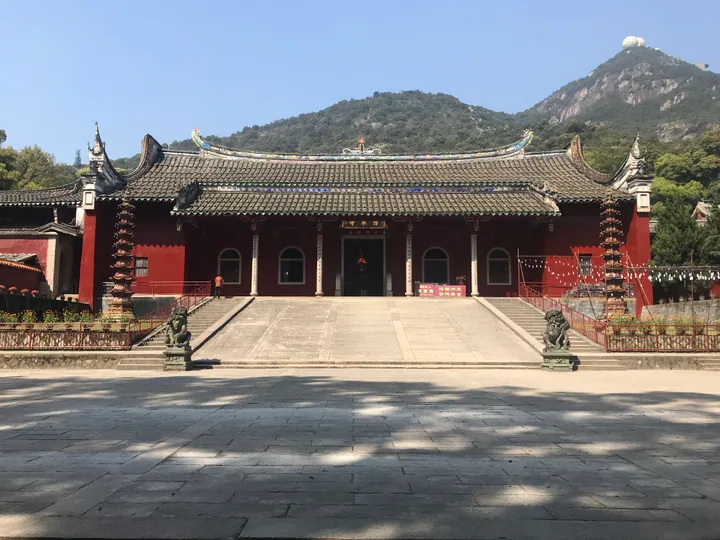
Gushan Yongquan Temple (鼓山涌泉寺) is a Buddhist monastery on Mount Gu (鼓山), or Drum Mountain, in Jin'an District (晋安区) of Fuzhou (福州), Fujian. It is traditionally called "the crown of Fujian's monasteries" (闽刹之冠).
The Chan master Lingqiao (灵峤) founded the temple in 783, under Emperor Dezong of the Tang, as Huayan Temple (华严寺). It was destroyed in Emperor Wuzong's persecution of Buddhism. In 908 Wang Shenzhi (王审知), ruler of Fujian, asked the monk Shenyan (神晏), state preceptor of the Min kingdom (闽国), to rebuild it, and in 915 it became Yongquan Chan Monastery (涌泉禅院). The name, "gushing spring", refers to a spring that ran through its Hall of the Four Heavenly Kings. It has been Yongquan Temple since 1407.
Fires struck in 1408 and 1542, and by 1542 the monastery lay abandoned. In 1627 the monk Wuyi Yuanlai (无异元来) arrived at the request of its monks and local gentry and restored its rules; later monks, among them Yongjue Yuanxian (永觉元贤) and Weilin Daopei (为霖道霈), made it once more the leading monastery in Fujian. The Kangxi Emperor granted it a gold name plaque in 1699. The four traditional Buddhist lineages of Taiwan, those of Yuemei Shan (月眉山), Guanyin Shan (观音山), Fayun Si (法云寺) and Dagang Shan (大岗山), all have dharma ties to Yongquan Temple. In 1983 the State Council placed it among the national key Buddhist temples of Han Chinese areas.
Most of today's buildings date from the Ming and Qing and keep the plan of the Jiajing reign (1522–1566). Some 25 halls climb the slope in tiers over a site of 16,650 m², among them the Mahavira Hall, the Dharma Hall and the patriarchs' hall, with bell and drum towers and a pond for releasing animals. The Mahavira Hall, burned in the Ming and restored in 1882, holds the Buddhas of the Three Ages flanked by the Eighteen Arhats. Two pottery pagodas of a thousand Buddhas, made in 1082, stand before the temple as a national key cultural relic site: each is 6.83 m tall, octagonal and nine storeys high, with more than 1,078 niches of small Buddhas. The temple was once an important sutra-printing house and holds over 20,000 carved printing blocks from the Ming, Qing and modern periods.
What to look for
- The twin thousand-Buddha pottery pagodas (千佛陶塔) of 1082, 6.83 m high with over 1,078 Buddha niches
- The Mahavira Hall, restored in 1882, with the Buddhas of the Three Ages and the Eighteen Arhats
- The Three Sages of the West at the back of the Mahavira Hall
- A Qing bronze bell of 2,000 kg cast with 6,372 characters of the Diamond Sutra
- The bell and drum towers and the pond for releasing animals
- The terraced run of some 25 halls keeping the Jiajing-era plan
- The Mount Gu cliff inscriptions (鼓山摩崖石刻), Song to modern carvings listed as a national key site in 2001
Location & getting there
Getting to Gushan Yongquan Temple
- Search for 鼓山涌泉寺 with 福州市 and 晋安区.
Find Gushan Yongquan Temple
鼓山涌泉寺 · 晋安区
No reliable map pin yet: search by the Chinese name.
Sources & visit information
Written from the linked sources and checked sentence by sentence against quoted extracts by a separate reviewer on 2026-09-23. Opening hours, admission and access arrangements are not covered; confirm current visitor information with the site.
Some facts checked against Wikipedia contributors, "涌泉寺 (福州)" · CC BY-SA 4.0.
Some facts checked against Wikipedia contributors, "Yongquan Temple (Fuzhou)" · CC BY-SA 4.0.