

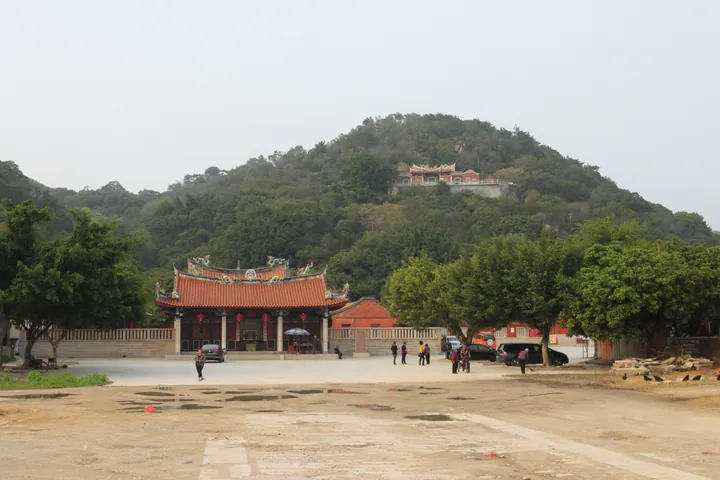
Photo adjustments
Full frame retained; proportionally resized and converted to WebP. No retouching or changes to the photographed subject. Card displays may crop the view.
About Jiuri Mountain
Jiuri Mountain (九日山) is a hill in Xushan Village (旭山村), Fengzhou Town (丰州镇), Nan'an (南安), about 7.5 km from the urban area of Quanzhou (泉州). Its east and west peaks hold 75 cliff inscriptions dating from the Northern Song to the Qing, most of them Song, among them records of a yearly wind-prayer rite.
The hill stands some 15 km from the sea. Of its three peaks (east, west and north), the eastern one is Jiangxiang Peak (姜相峰), known too as the East Terrace; it is named after the grave of Jiang Gongfu (姜公辅), a Tang-dynasty chancellor, and its outline has earned it the popular name Qilin Hill (麒麟山). The western one, Gaoshi Peak (高士峰), also called the West Terrace, is tied to the Tang poet Qin Xi (秦系) from Kuaiji (会稽), who withdrew from the world to live on it. Two stories explain the name, which means 'Nine Days'. In one, settlers who came south during the Jin period made a yearly climb on the ninth of the ninth month to look north. In the other, a Daoist claimed that walking here from the top of Daiyun Mountain (戴云山) had taken him nine days.
In 965 frequent fires in the Nan'an county town led Chen Hongjin (陈洪进), military governor of the Pinghai Army (平海军), to propose a stone Buddha on the west peak as a prayer against them, and an inscription recording the work was left there. Under the Song the hill reached its peak of fame, with 36 named sights, and carvings from that period record the wind-prayer sacrifice (祈风祭祀) held on the hill each year. An old saying claims that no rock on the hill was left uncarved. In January 1988 the cliff inscriptions were listed as a Major Historical and Cultural Site Protected at the National Level (全国重点文物保护单位).
In 1991 a UNESCO expedition on the Maritime Silk Road climbed the hill, and specialists from more than 20 countries jointly signed a new cliff inscription recording the visit. In July 2021 the 44th World Heritage session, meeting in Fuzhou (福州), added 'Quanzhou: Emporium of the World in Song-Yuan China' to the World Heritage List, and the Jiuri Mountain wind-prayer inscriptions (九日山祈风石刻) are one of its components. Visitors can follow the carvings across both main peaks; the west peak also has a Stone Buddha Hall (石佛殿) with a stone Buddha inside.
What to look for
- Song-dynasty wind-prayer inscriptions (祈风石刻) recording the rite held here each year
- Cliff inscriptions on the east and west peaks: 75 surviving pieces from the Northern Song to the Qing, mostly Song
- Stone Buddha Hall (石佛殿) on the west peak, with its stone Buddha
- Jiangxiang Peak (姜相峰), named for the grave of the Tang chancellor Jiang Gongfu
- Gaoshi Peak (高士峰), where the Tang poet Qin Xi lived as a recluse
- The 1991 inscription signed by Maritime Silk Road experts from more than 20 countries
Location & getting there
Getting to Jiuri Mountain
- Search for 九日山 with 泉州市 and 南安市.
Find Jiuri Mountain
九日山 · 南安市
No reliable map pin yet: search by the Chinese name.
Sources & visit information
Written from the linked sources and checked sentence by sentence against quoted extracts by a separate reviewer on 2026-09-23. Opening hours, admission and access arrangements are not covered; confirm current visitor information with the site.
Some facts checked against Wikipedia contributors, "九日山" · CC BY-SA 4.0.
Some facts checked against Wikipedia contributors, "泉州:宋元中国的世界海洋商贸中心" · CC BY-SA 4.0.