

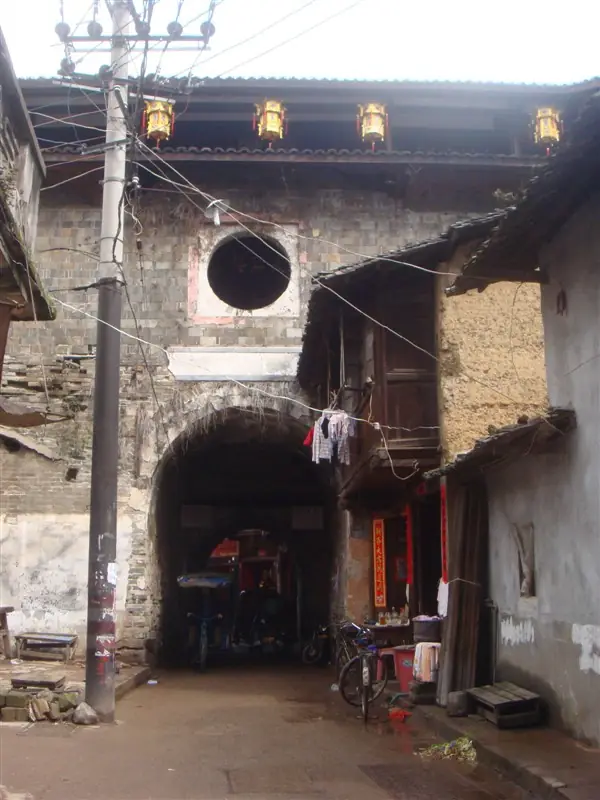
Photo adjustments
Full frame retained; EXIF orientation normalized, proportionally resized to at most 800 pixels and converted to WebP. No generated pixels or subject changes. Cards may crop the display.
Explore the region
About Tingzhou Ancient City
The State Council named Changting in 1994 in the third batch of National Historic and Cultural Cities, and it is the only county-level city among Fujian's four. For more than a thousand years, from the Tang to the Qing, it was the seat of successive prefectures and circuits, which is the basis of its reputation as the Hakka capital. The old city plan survives complete, with a protected core of 2.48 square kilometres, and the traditional quarters show the Jiangnan Hakka building character of the Song, Ming and Qing. The Ting River, which runs past the town, is called the first river of the Hakka world and the Hakka mother river. In the Second Revolutionary Civil War the county town served as the only city of the Chinese Soviet Republic's soviet area and was known as the little red Shanghai.
The wall is the defining structure. It was begun in 769, in the fourth year of the Tang Dali reign, and runs from the summit of Wolong Hill down both the eastern and western slopes to enclose the town, a line compared from a distance to a hanging string of beads. It was enlarged in 1066, when its circuit was recorded as five li and two hundred and fifty paces with six gates; in 1371 the earth rampart was faced with brick and stone, and in the Chongzhen reign the prefectural and county walls were merged and the wall extended beyond 5,000 metres, giving the layout that survives. The wall measures ten metres across the base, six across the top and 5.4 metres high. Most of its bricks were taken for road-making in the Republican period, and the protected monument today is the stretch between Chaotian Gate and Chezi Pass together with three gate towers, Sanyuan Ge, Chaotian Gate and Baozhu Gate, about 1,500 metres in all; restoration work reported separately had recovered 2,998 metres of wall and four gates and gate towers by 2012. In 2013 the Tingzhou city wall was listed as a major national protected cultural heritage site. Within the walls the protected quarter is organised as four streets, each with its own character: Nan Dajie as a Tang and Song street, Diantou Jie as a Ming and Qing street, Dong Dajie presenting Hakka daily life, and Shuidong Jie presenting its role as the first street of the Central Soviet area. Wolong Academy, on Nan Dajie, was founded in the Southern Song and is recorded as the earliest academy in Tingzhou; Zhu Xi and Wang Yangming are among the scholars who lectured there, and men from Tingzhou took 309 jinshi and 1,752 juren degrees in the imperial examinations.
What to look for
- The city wall climbing from Wolong Hill down around the town, ten metres across the base and 5.4 metres high
- Sanyuan Ge, whose gateway is 8.55 metres wide and whose two-storey tower was rebuilt in 1938
- Baozhu Gate, with its double inner and outer gates and the wooden plaque of 1691 reading bangjia zhi ji
- Wolong Academy, founded in the Southern Song and recorded as the earliest academy in Tingzhou
- The four historic streets, Nan Dajie, Diantou Jie, Dong Dajie and Shuidong Jie, and the Baxi Guan on Dong Dajie with its restored old stage
Location & getting there
Getting to Tingzhou Ancient City
Identify the main visitor approach and any separately managed houses, museums or performances. Ask before entering residential spaces or photographing residents.
- Search for 汀州古城 with 龙岩市 and 长汀县.

Find Tingzhou Ancient City
汀州古城 · 长汀县
No reliable map pin yet: search by the Chinese name.
Sources & visit information
The linked sources support the identity and background described in this introduction. Opening hours, admission, activity availability and exact arrival arrangements have not been comprehensively checked. Confirm current visitor information with the venue; the original catalogue locality and editorial review flag are retained.