

Photo adjustments
Wikimedia thumbnail; fitted to the ranking-card frame.
City & district guides
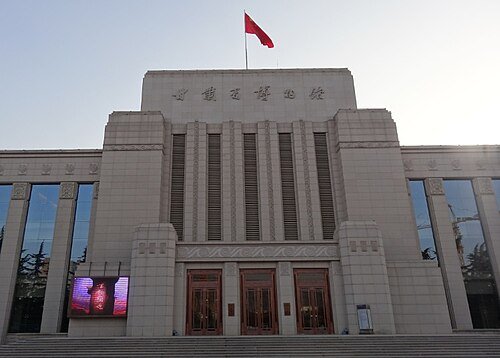
About Gansu Provincial Museum
The bronze galloping horse from Wuwei’s Leitai tomb is its best-known object, but the patterned Neolithic vessels provide an equally revealing view of regional craftsmanship. The museum also has a palaeontology collection, broadening the story beyond human settlement. Choose two or three themes rather than rushing through every gallery, and check temporary loans before expecting a particular object.
The museum's predecessor was the Gansu Provincial Science Education Hall (甘肃省科学教育馆), formed in 1939, one of the earliest comprehensive regional museums in western China; it was renamed the National Gansu Science Education Hall (国立甘肃科学教育馆) in 1945, the Northwest People's Science Hall (西北人民科学馆) in 1950, and formally established as the Gansu Provincial Museum in 1956. In November 2012 the National Cultural Heritage Administration (国家文物局) rated it a First-Grade Museum (国家一级博物馆).
The museum has 18 exhibition halls and five permanent thematic exhibitions, covering painted pottery, Silk Road civilization, palaeontological fossils, and Buddhist art. Its holdings total more than 350,000 precious historical relics and natural specimens, of which 16 pieces or sets are rated as national treasures.
What to look for
- The bronze galloping horse and the wider Silk Road archaeological collection.
- The patterned vessels in the Gansu painted-pottery exhibition.
The surrounding area
Riverbank walks, beef noodles and tea culture make a useful beginning or ending to a provincial route.
Location & getting there
Getting to Gansu Provincial Museum
Go to 3 Xijin West Road in Lanzhou’s Qilihe District. The museum’s own directions identify Xizhan Shizi on Metro Line 1 as an approach station. Use the official museum reservation channel and follow the entrance instructions for your booking.
Combine your visit
A suggested order for the documented features and stops.
-
Painted-pottery gallery
Begin with the forms and designs of early regional communities.
-
Silk Road civilisation gallery
Continue to the exchange networks represented by the archaeological finds.
-
Buddhist-art gallery
Compare the province’s religious sculpture with the wider route history.
This is an editorial sequence. Check access and any road or boat transfers; it does not establish a walking route, common ticket or guaranteed same-day connection.
Find Gansu Provincial Museum
甘肃省博物馆 · 兰州
The pin marks the area, not the entrance.
More places nearby
Approximate straight-line distances between map pins, not travel distances.
Lanzhou Stele Forest兰州碑林
3 km awayLanzhou Stele Forest presents calligraphy in a garden setting on the western side of White Pagoda Mountain. Caosheng Pavilion is its architectural centre, with carved versions of works associated with the Chunhua model-book…
View guide →White Pagoda Mountain白塔山
4 km awayWhite Pagoda Mountain rises directly above the north bank of the Yellow River. Its white brick pagoda combines a rounded lower form with an octagonal, seven-tiered upper tower. Terraces and temple buildings climb the slope below…
View guide →Zhongshan Bridge中山桥
4 km awayZhongshan Bridge is a metal river crossing framed by the Yellow River below and White Pagoda Mountain beyond. Its latticework and curved strengthening arches distinguish it from the older floating bridges that once served this…
View guide →Sources & visit information
The sources below support the place-specific description and arrival information. Suggested combinations are editorial planning ideas; confirm current opening, entry arrangements and transport services for your date.
Visitor information adapted and edited from Wikipedia contributors, “甘肃省博物馆” · CC BY-SA 4.0. Source revision 93356891.
Background paragraphs translated and condensed from Wikipedia contributors, "甘肃省博物馆", Chinese Wikipedia · CC BY-SA 4.0. Source revision 94245625.