

Photo adjustments
Full frame retained; proportionally resized and converted to WebP. No retouching or changes to the photographed subject. Card displays may crop the view.
Explore the region
About Han Yu Memorial Temple
Han Yu Memorial Temple (韩文公祠) is a shrine to the Tang-dynasty writer Han Yu (韩愈) in Chaozhou (潮州), on the eastern bank of the Han River (韩江), set at the western foot of Bijia Mountain (笔架山), also called Hanshan (韩山). The Chaozhou city government describes it as the oldest and best-preserved temple to Han Yu in China.
The shrine moved twice before settling here. In 999 it was set up in the east wing of the Confucius temple below Jinshan (金山); in 1090 the prefect Wang Di (王涤) moved it to a spot seven li south of the city, for which Su Shi (苏轼) composed the stele text. In 1189 the prefect Ding Yunyuan (丁允元) moved it to the present hillside, reasoning that Han Yu had often climbed there and that oaks he planted still grew on it. Each of the Yuan, Ming and Qing dynasties repaired it, and the main halls today are largely Ming and Qing work. On 25 May 2006 the State Council placed it on the national list of key protected heritage sites (全国重点文物保护单位), and the city lists it as an AAAA scenic area.
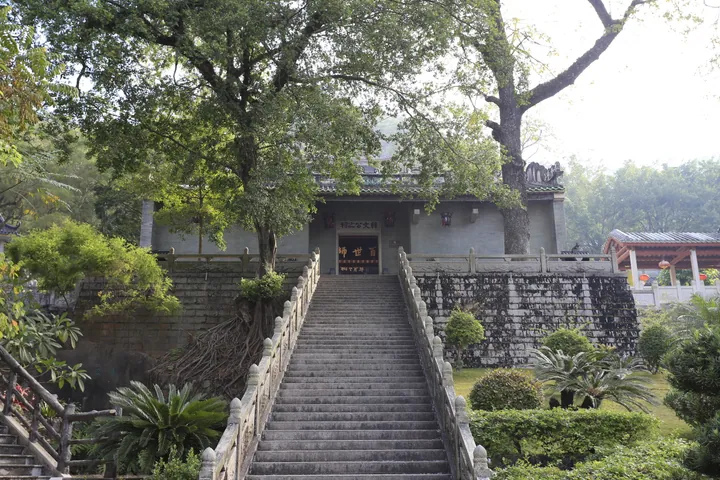
The climb to the shrine takes 56 stone steps in three flights of 51, 1 and 4, recalling that Han Yu was 51 when demoted to prefect of Chaozhou, spent a year there and lived to 56. Inside, about forty steles from successive dynasties survive, including a Qing recarving of Su Shi's temple inscription.
Since the main shrine was restored in 1984, new features have been built in the grounds. An 89 m calligraphy corridor, "Tiannan Beisheng" (天南碑胜), holds 41 steles by modern calligraphers. Tianshui Garden (天水园) honours Zhao De (赵德), whom Han Yu put in charge of Chaozhou's schooling, with a carving of their parting. The two-storey Shilang Pavilion (侍郎阁) holds an exhibition on Han Yu's rule of Chaozhou, and a 21 m relief corridor illustrates Su Shi's praise of him. On the slope north of the main shrine, the Oak Garden (橡木园) recalls "Oaks at the Han Temple" (韩祠橡木), one of the Eight Sights of Chaozhou (潮州八景): local people once read the number of blossoms on Han Yu's oak as a forecast of exam success, until the tree withered in the mid-to-late Qianlong era. More than thirty oaks brought from Henan (河南), Han Yu's home province, now grow there, beside a stone wall shaped like bamboo slips bearing Rao Zongyi's (饶宗颐) handwriting of Wang Dabao's (王大宝) "Ode to Han's Tree" (韩木赞).
What to look for
- The 56-step stone stair in flights of 51, 1 and 4, keyed to Han Yu's life
- The Ming–Qing main shrine with about forty steles from successive dynasties
- The Qing recarving of Su Shi's stele text for the temple
- "Tiannan Beisheng" (天南碑胜), an 89 m corridor of 41 modern calligraphy steles
- Tianshui Garden (天水园) with its carving of Han Yu parting from Zhao De
- Shilang Pavilion (侍郎阁), a two-storey pavilion with an exhibition on Han Yu in Chaozhou
- The Oak Garden (橡木园), planted with oaks from Henan, and Rao Zongyi's inscription of "Ode to Han's Tree"
Location & getting there
Getting to Han Yu Memorial Temple
- Search for 韩文公祠 with 潮州市 and 湘桥区.
Find Han Yu Memorial Temple
韩文公祠 · 湘桥区
No reliable map pin yet: search by the Chinese name.
Sources & visit information
Written from the linked sources and checked sentence by sentence against quoted extracts by a separate reviewer on 2026-09-23. Opening hours, admission and access arrangements are not covered; confirm current visitor information with the site.
Some facts checked against Wikipedia contributors, "韩文公祠" · CC BY-SA 4.0.