

Explore the region
About Lychee Bay
Lychee Bay (荔枝湾) is a network of creeks around Pantang (泮塘) in the Xiguan (西关) quarter of Liwan District (荔湾区), western Guangzhou, beside the Pearl River. Long a summer pleasure ground nicknamed "Little Qinhuai" (小秦淮), it gave Liwan District its name.
The name covers the upper and lower Xiguan creeks (西关涌) and the Lizhi creek, branches of water in the heart of Xiguan. The area once belonged to Pantang village (泮塘乡) in Nanhai County (南海县), across the water from Huadi (花地) and Fangcun (芳村). In his Guangdong Xinyu (广东新语), Qu Dajun (屈大均) credits Lu Jia (陆贾), whom the Han founder Liu Bang (刘邦) sent as envoy to Zhao Tuo (赵佗) of Nanyue (南越), with laying out the bay, its flower beds and its lotus ponds. Lychee trees lined the main creeks, and the ponds grew the "Five Treasures of Pantang" (泮塘五秀): lotus root, water caltrop, water bamboo, water chestnut and arrowhead.
Gardens followed. The Southern Han (南汉) ruler Liu Chang (刘鋹) made the bay part of his imperial garden and held "Red Cloud Banquets" (红云宴) there when the lychees ripened. In the Ming dynasty the scene called "Fishing Songs at Lychee Bay" (荔湾渔唱) was counted among the Eight Sights of Guangzhou (羊城八景). In the late Qing the salt merchant Pan Shicheng (潘仕成) built Haishan Xianguan (海山仙馆), a garden villa with a large library; it was confiscated with the rest of his property, and some of its carved stones survive in the Guangdong Provincial Museum. Pleasure-boat outings on the bay were at their height from the 1930s until Guangzhou fell.
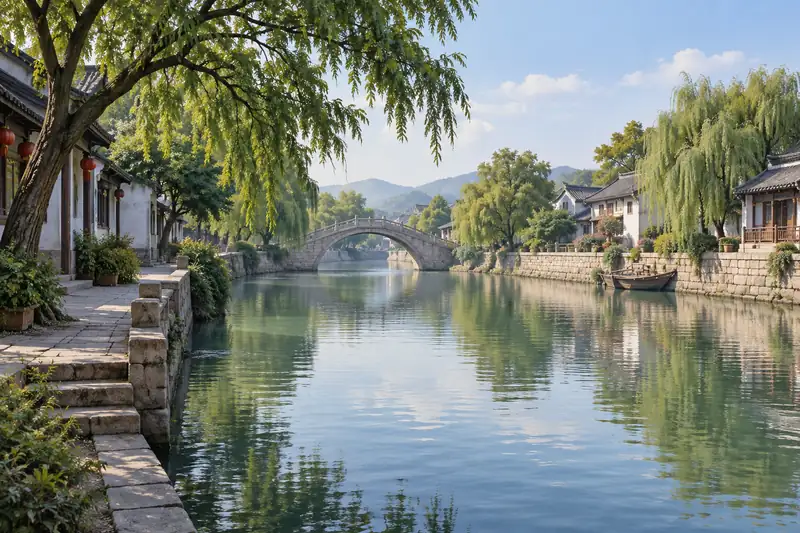
In 1958 the fields, fish ponds and waste ground around Pantang were dug into four artificial lakes, named Liwan Lake Park (荔湾湖公园) in 1960, which took in much of the "new" Lychee Bay. In 1993 the polluted end of the upper Xiguan creek was covered with stone slabs and became Lizhiwan Road, lined with antique dealers. The city government uncovered the channel again in 2010; the older and the newly dug stretches each run for over 700 m and connect with the park lakes. Five stone bridges now cross the restored creek, three of them reusing names from the old "Eight Bridges of Xiguan" (西关八桥), and flower boats carry visitors along the water. Boat congee (艇仔粥) is the dish that people long remembered from an outing here.
What to look for
- The restored Lizhiwan creek (荔枝湾涌), two stretches of over 700 m each joined to the Liwan Lake waters
- Five stone bridges, among them Dexing (德兴), Daguan (大观) and Yongning (永宁), which keep names of the old Eight Bridges of Xiguan
- Liwan Lake Park (荔湾湖公园), four lakes dug in 1958 from the fields, fish ponds and waste ground of Lychee Bay and Pantang
- An 1882 tablet set up by the Wenlan Academy (文澜书院) recording the clearing of the Xiguan creeks, now beside the boat pier at Yongqingfang (永庆坊)
- Renwei Temple (仁威庙), the Liang Ancestral Hall (梁家祠) and the Guangzhou Wenta (广州文塔), historic sites near the bay
Location & getting there
Getting to Lychee Bay
- Search for 荔枝湾 with 广州市 and 荔湾区.
Find Lychee Bay
荔枝湾 · 荔湾区
No reliable map pin yet: search by the Chinese name.
Sources & visit information
Written from the linked sources and checked sentence by sentence against quoted extracts by a separate reviewer on 2026-09-23. Opening hours, admission and access arrangements are not covered; confirm current visitor information with the site.
Some facts checked against Wikipedia contributors, "荔枝湾" · CC BY-SA 4.0.