

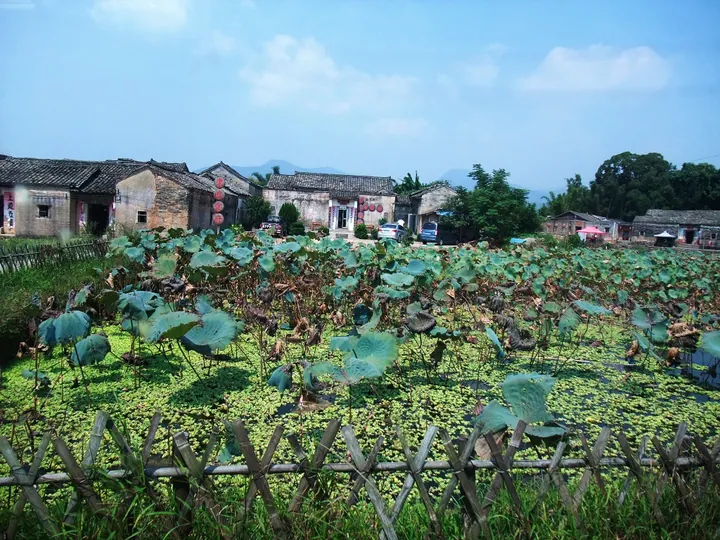
Photo adjustments
Full frame retained; proportionally resized and converted to WebP. No retouching or changes to the photographed subject. Card displays may crop the view.
About Sujiawei Village
By the account of the Su lineage genealogy, the village was founded in 1381, the fourteenth year of the Hongwu reign, when Su Xiuhong, a descendant of Su Shi then serving as an inspector at Jingshan in Dongguan, moved his family to Heshui and named the place Su Wei. The Dong River runs past on the north and the Jiushe River comes in from the west, so the settlement sits in the angle between two waterways with hills behind. Eighteen old houses in Ming and Qing style survive among the lanes and wells.
The buildings are worth reading in sequence, because they change. The earliest follow a courtyard plan closer to northern practice than to the round Hakka enclosures of eastern Guangdong; only from the Qing do walled houses of the Hakka hall-and-cross-wing type appear here, which makes the village a record of how Hakka building custom shifted as it spread down the Dong River valley. Two of the lineage halls, the Dongshan Su hall and the Yifeng Su hall, were designated in the third batch of Heyuan municipal cultural relics protection units in 2011. The village had a strong examination record for its size: across the Ming and Qing it produced 126 xiucai, 29 gongsheng, two juren and three gongshi, 160 degree-holders in all.
What to look for
- The Dongshan Su ancestral hall and the Yifeng Su ancestral hall, both municipal protected monuments since 2011
- The eighteen surviving Ming and Qing houses scattered through the village
- The difference between the earlier courtyard-plan houses and the Qing hall-and-cross-wing Hakka walled houses
- The old wells and lanes between the houses
- The village's position in the angle where the Jiushe River meets the Dong River
Location & getting there
Getting to Sujiawei Village
Identify the main visitor approach and any separately managed houses, museums or performances. Ask before entering residential spaces or photographing residents.
- Search for 苏家围 with 河源市 and 东源县.

Find Sujiawei Village
苏家围 · 东源县
No reliable map pin yet: search by the Chinese name.
Sources & visit information
The linked sources support the identity and background described in this introduction. Opening hours, admission, activity availability and exact arrival arrangements have not been comprehensively checked. Confirm current visitor information with the venue; the original catalogue locality and editorial review flag are retained.