


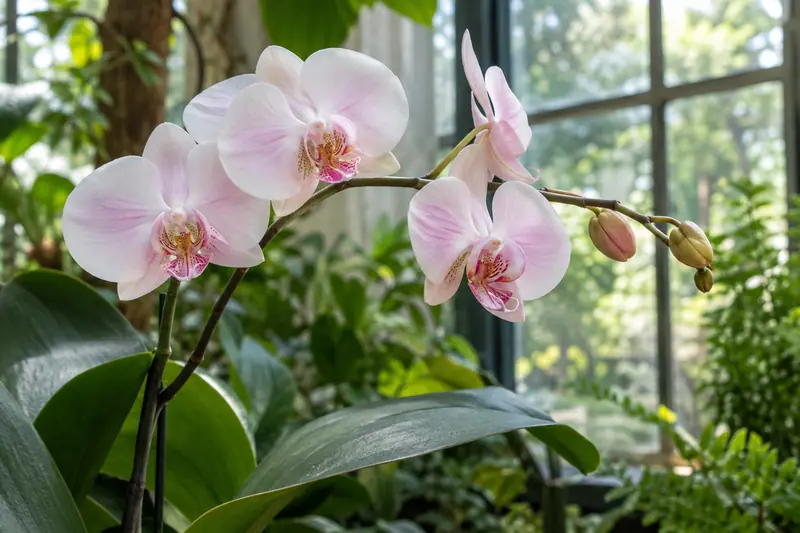
Photo adjustments
EXIF orientation normalized; resized without changing aspect ratio; converted to WebP. No subject edits.
About South China National Botanical Garden
The institution traces back to 1929, when the botanist Chen Huanyong founded the Institute of Agriculture and Forestry Botany at National Sun Yat-sen University. It passed to the Chinese Academy of Sciences in 1954, the garden itself was laid out from 1956, and the body took the name South China Botanical Garden of CAS in 2003. In May 2022 the State Council approved the establishment of a South China National Botanical Garden at Guangzhou, jointly built by the national forestry and grassland administration, the ministry of housing and urban-rural development, the Academy, Guangdong Province and the city; it was formally inaugurated that July.
What visitors walk through is the ex-situ conservation park, 282.5 hectares next to the research campus. It is organised as 39 specialist gardens, among them collections of magnolias, palms and gingers, alongside a conservatory complex, the Longdong Qilin landscape and a propagation centre for rare and endangered species. By the end of 2025 the living collection held 19,766 plant taxa counting subspecific units. The adjoining 36.8-hectare research campus is a working institute rather than a public garden, and includes a herbarium of more than 1.3 million specimens.
The garden's own account of its design places it in the Lingnan tradition: Longdong Qilin is cited as the model for its naturalistic layout, the bromeliad and orchid gardens as a newer Lingnan manner, and the conservatory group as habitat-style planting. Interpretation has a long history here too; the Pugang nature education trail, opened in 2002, was the first such trail on the Chinese mainland. One further point of scope is worth knowing: the same institution also runs the Dinghushan National Nature Reserve and arboretum, but that unit lies in Zhaoqing, well outside Guangzhou, and is not part of this garden.
What to look for
- The conservatory complex, built as habitat-style displays rather than conventional glasshouse beds
- Longdong Qilin, the naturalistic landscape the garden treats as the model for its Lingnan-style layout
- The specialist gardens, among them the magnolia, palm and ginger collections, part of a set of 39
- The breeding centre for rare and endangered plants within the ex-situ conservation park
- The Pugang nature education trail, opened in 2002 as the first nature education trail on the Chinese mainland
Location & getting there
Getting to South China National Botanical Garden
Check the open visitor route and follow the site’s rules on distance, food and photography. Conservation areas may limit access beyond designated paths.
- Search for 中国科学院华南国家植物园 with 广州市 and 天河区.
Find South China National Botanical Garden
中国科学院华南国家植物园 · 天河区
No reliable map pin yet: search by the Chinese name.
Sources & visit information
The linked sources support the identity and background described in this introduction. Opening hours, admission, activity availability and exact arrival arrangements have not been comprehensively checked. Confirm current visitor information with the venue; the original catalogue locality and editorial review flag are retained.