


Photo adjustments
EXIF orientation normalized; resized without changing aspect ratio; converted to WebP. No subject edits.
Explore the region
About Xiushui Top Scholar Village
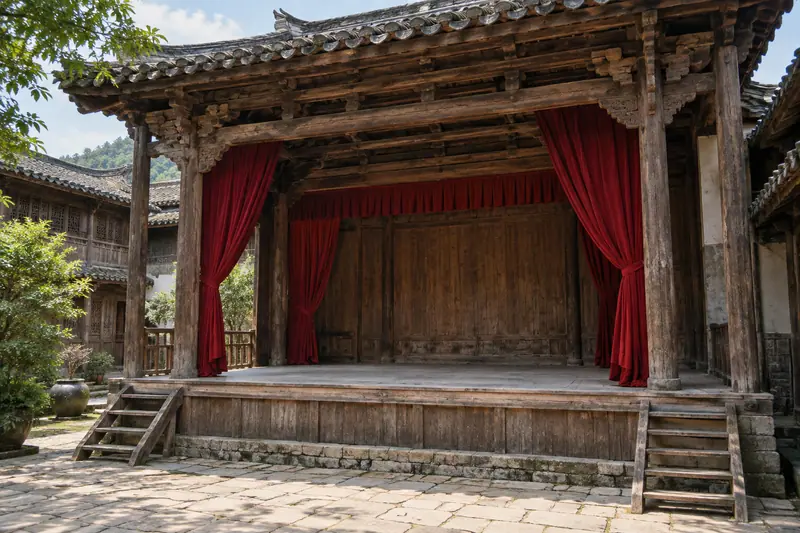
The village sits among the outlying hills of the Dupang and Mengzhu ranges. Its buildings keep traditional styles from the Tang, Song, Ming, Qing and modern periods, and along the bluestone-flagged lanes stand old academies, an opera stage, memorial arches, dwellings, trees, springs, walls and gate towers, with mounting stones, hitching posts and plaques of many kinds. The founding ancestor Mao Zhong brought his wife and children from Jiangshan county in Zhejiang and built the settlement; at the time of the account his descendants numbered just over six hundred households and more than two thousand people. Four academies were founded here in the course of that history: Aoshan Shikusi, Shanshang, Duizhaishan and Jiangdong.
The Zhuangyuan Lou, the village's landmark building, stands at the foot of Xiufeng hill with a clear stream running east in front of it. Built of grey brick under dark tiles with upswept eaves, it takes something from Jiangnan hall building and something from temple building. Three gilt plaques hang above the main gate, Zhuangyuan jidi in the centre with Wenkui and Jinshi to either side. Inside the gate a pool of fifty square metres occupies the courtyard; beyond a second gate lie a lower hall and an upper hall, reached across a light well and along side galleries, and in the middle of the upper hall sits a statue of the zhuangyuan Mao Zizhi holding a scroll. Elsewhere the village keeps plaques of many patterns conferred by figures from the emperor down to the county magistrate, and the Mao clan ancestral hall holds portraits of the family's worthies set out in order. The autonomous region's culture and tourism department carried the Fuchuan Xiushui zhuangyuan village scenic area at grade 3A in its register compiled to the end of 2021.
What to look for
- The Zhuangyuan Lou at the foot of Xiufeng hill, with its three gilt plaques reading Zhuangyuan jidi, Wenkui and Jinshi
- The statue of the zhuangyuan Mao Zizhi, seated holding a scroll in the middle of the upper hall
- The fifty-square-metre pool in the Zhuangyuan Lou's courtyard, between the outer and second gates
- The Mao clan ancestral hall with its portraits of the family's worthies
- The bluestone-flagged lanes and the old gate towers, memorial arches and opera stage along them
Location & getting there
Getting to Xiushui Top Scholar Village
Identify the main visitor approach and any separately managed houses, museums or performances. Ask before entering residential spaces or photographing residents.
- Search for 秀水状元村 with 贺州市 and 富川瑶族自治县.
Find Xiushui Top Scholar Village
秀水状元村 · 富川瑶族自治县
No reliable map pin yet: search by the Chinese name.
Sources & visit information
The linked sources support the identity and background described in this introduction. Opening hours, admission, activity availability and exact arrival arrangements have not been comprehensively checked. Confirm current visitor information with the venue; the original catalogue locality and editorial review flag are retained.