


Explore the region
About Longli Ancient City
The town's residents descend from garrison soldiers of the Ming 'pacify the north, campaign the south' resettlement, and now number more than 760 households and 3,280 people. Over the centuries their Han culture has mixed with local Miao and Dong culture into a subculture distinct from both central-plains and local minority culture, a 'Han-culture community' in a minority region that scholars have called 'an unreproducible Han-culture old town'. Longli is one of the China-Norway international 'Guizhou Ecomuseum' sites, was listed as a Famous Historical and Cultural Village of China in 2007, had its old architectural complex listed as a Major Historical and Cultural Site Protected at the National Level in 2013, and became a national AAAA tourist attraction in 2018.
The town's wall was first built in earthen construction in 1392, rebuilt with garrison troops in 1404, rebuilt again with stone facing in 1457, and rebuilt a third time in 1653 to a height of 4 metres and a circumference of 1,700 metres. Each of its four sides had a gate topped by a two-storey pine gate tower, also called a drum tower, with upturned eaves hung with wind chimes: the east gate was named Qingyang, the south gate Zhengyang, and the west gate Yingen, while the north gate was blocked up and kept closed, with only a side postern at the north-east corner for passage. Each gate originally had a barbican requiring a turn to pass through, called 'reining in the horse to turn back'.
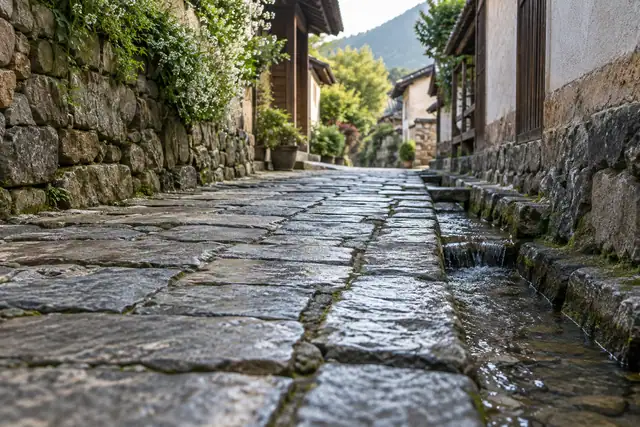
Inside the walls, three main streets run east, west and south from the old garrison command's street gate, branching into six lanes that divide the town into nine residential quarters, a pattern locally known as 'three streets, six lanes, nine courtyards'. More than 20 named streets and lanes are paved in cobblestone in a tortoise-shell pattern inlaid with centipede and coin motifs, and 13 of the town's historic stone-lined wells survive, out of 72 said to have once served the town's 72 surnames. Houses stand raised above street level, mostly two-storey, with brick firewalls topped with blue tile and upturned eaves, painted or carved decoration, and gate towers bearing plaques naming each family's ancestral origin; more than sixty such Jiangxi-style courtyard mansions survive, of which the county government calls the Tao family mansion, in the east of the town, the most typical. Named sights include the four gate drum towers, the ecomuseum, Longbiao Academy, the old garrison office, six clan ancestral halls, the Yuhuang Pavilion, the Guanyu and Feishan temples, and, outside the walls, the three-span Zhuangyuan Bridge; the Zhuangyuan Shrine, 50 metres west of that bridge, was built in 1599 to commemorate the Tang-dynasty poet Wang Changling.
Longli's 'painted-face dragon', also called the 'glutinous-cake dragon', is a distinctive local dragon-dance tradition, placed on the provincial intangible-cultural-heritage list in 2007; according to the local record Longbiao Miscellany, it originated in the Song dynasty from a folk drama and is still performed at Spring Festival and Lantern Festival.
What to look for
- The four gate drum towers, named among the old town's sights and described as two-storey pine buildings with upturned, chime-hung eaves
- The 'three streets, six lanes, nine courtyards' street plan, with its cobblestone tortoise-shell paving
- The Tao family mansion, which the county government calls the most typical of the town's Jiangxi-style courtyard houses
- The Zhuangyuan Shrine, built to commemorate the exiled Tang poet Wang Changling, and the Zhuangyuan Bridge, which the county page calls a historical relic connected with him
- The town's 13 surviving historic wells
Location & getting there
Getting to Longli Ancient City
Identify the main visitor approach and any separately managed houses, museums or performances. Ask before entering residential spaces or photographing residents.
- Search for 隆里古城 with 黔东南苗族侗族自治州 and 锦屏县.
Find Longli Ancient City
隆里古城 · 锦屏县
No reliable map pin yet: search by the Chinese name.
Sources & visit information
The linked sources support the identity and background described in this introduction. Opening hours, admission, activity availability and exact arrival arrangements have not been comprehensively checked. Confirm current visitor information with the venue; the original catalogue locality and editorial review flag are retained.