

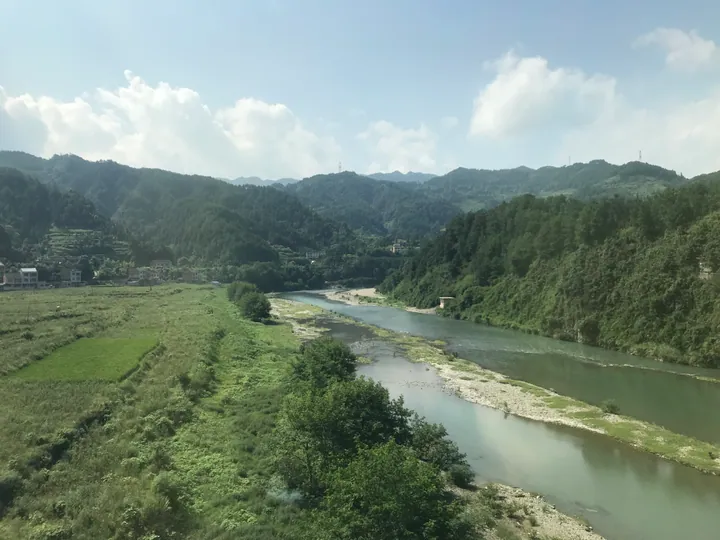
Photo adjustments
Full frame retained; proportionally resized and converted to WebP. No retouching or changes to the photographed subject. Card displays may crop the view.
Explore the region
About Wuyang River
The river rises in Wengan in the Miao Ridge range and flows through eastern Guizhou into the Yuan river. Legend holds that more than 5,000 years ago a branch of the defeated Chiyou tribe migrated south from Wuyang in Henan and settled beside a river under a screen-shaped mountain, giving the place the name Wuyang town, the mountain Shiping Shan and the river Wuyanghe; in the Song dynasty Wuyang town was renamed Zhenyuan prefecture, and the river kept its name's sound while gaining a water-radical variant character. The river became a scenic area after a hydroelectric station built at Zhenyuan raised the upstream water level, submerging former shoals and rocks and forming more than 20 kilometres of canyon; the scenic area was confirmed as a national-level scenic area in 1988. Under the prefectural regulation governing it, the Wuyanghe Scenic Area also takes in Zhenyuan's historic old city, Tiexi, Yuntaishan, Heichong, Shanmuhe, the historic town of Jiuzhou and Feiyunya, across a total area of 625 square kilometres.
From the Zhenyuan county town to Zhenxiongguan, and from there a walk of under twenty minutes along the Xiangjian river, whose clear water shows visible waterweed, reaches the tour-boat dock, with karst peak formations named Three Sword Peaks, Lion Looking Back and Sifang Cave along the way. Inside the Longwang gorge a waterfall drops from the Longwang rock face in three tiers, checked by calcified deposits on the cliff. Further along, Peacock Peak, a pair of joined stone pillars standing in the water with a green hillside behind them, forms the image of a peacock displaying its tail, and is printed on postcards and used as a trademark by people in Zhenyuan. Where the canyon narrows to a sliver of sky and then opens out, the water is known locally as Gaobei Lake, with a peak resembling a reclining Buddha visible looking back and the Zhuge gorge in Shibing County ahead.
What to look for
- The Longwang gorge and its three-tiered waterfall off the Longwang rock face
- Peacock Peak, the paired stone pillars forming the 'peacock displaying its tail' image
- The karst peak formations of Three Sword Peaks, Lion Looking Back and Sifang Cave along the Xiangjian river approach
- Gaobei Lake, where the canyon opens out after its narrowest point
Location & getting there
Getting to Wuyang River
Confirm the visitor entrance and which boat or walking routes operate on your date. Rainfall, water levels and weather can change access.
- Search for 舞阳河 with 黔东南苗族侗族自治州 and 镇远县.

Find Wuyang River
舞阳河 · 镇远县
No reliable map pin yet: search by the Chinese name.
Sources & visit information
The linked sources support the identity and background described in this introduction. Opening hours, admission, activity availability and exact arrival arrangements have not been comprehensively checked. Confirm current visitor information with the venue; the original catalogue locality and editorial review flag are retained.