

Photo adjustments
EXIF orientation normalized; resized without changing aspect ratio; converted to WebP. No subject edits.
Explore the region
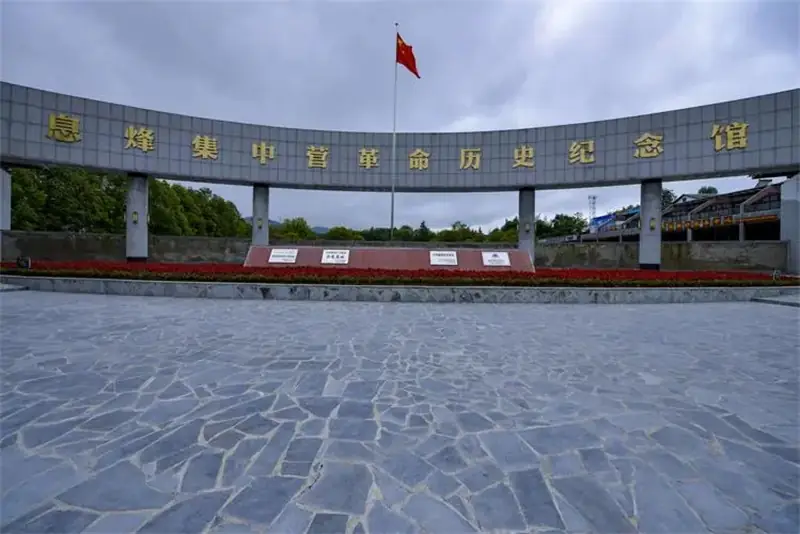
About Xifeng Concentration Camp Memorial Hall
The camp was set up by the Nationalist military intelligence bureau to hold Communists and dissenters. Its public signboard read National Government Military Commission Xifeng Field Office, and inside the bureau it was known as the university. Its predecessor was the Nanjing New Prison, which had moved from Nanjing to Wuhan, from Wuhan to Yiyang in Hunan, and finally to Xifeng. In November 1938, after the National Government moved its capital to Chongqing, the bureau enclosed more than 80 mu at Yanglangba and built the camp. It had two parts: the headquarters here, and the place where General Yang Hucheng was confined at the Xuantian Cave 14 km away. The bureau divided the compound into what it called a heaven, the office area with a lake, an assembly hall and a basketball court, and a hell, the cell blocks.
The cell blocks were not called prisons but zhai, and there were nine of them – zhong, xiao, ren, ai, xin, yi, he, ping and the special zhai – with 52 cells between them; prisoners were separated by case, rank, political identity, age and sex, and the yi zhai was the women's prison. Behind the cells is a natural limestone cave in which interrogation rooms and a water cell were set up, and Xinhua reports as many as twelve kinds of torture in use. From the camp's establishment in November 1938 to its closure in July 1946 more than 1,200 people were held, among them Luo Shiwen, Che Yaoxian, Zhang Luping, Yang Hucheng, Xu Xiaoxuan, Ma Yinchu and the child prisoner Song Zhenzhong, known as Xiaoluobotou. More than 600 were secretly killed or died under torture, more than 400 disappeared, 72 were moved to Chongqing when the camp closed, and only a little over a hundred were released. Communist prisoners including Luo Shiwen, Che Yaoxian and Xu Xiaoxuan used the meetings allowed by the camp's so-called prison-administration reform to set up an underground party branch inside the prison.
The museum mounts an exhibition called Fenghuo Buxi, which uses relics, pictures, text, tables, photographs, sound, light and scene reconstruction to set out the camp's history and what the prisoners did inside it. The site is a national patriotic education demonstration base, a national clean-government education base, a national defence education demonstration base, a national primary and secondary school study-practice education base, a national AAAA-grade tourist scenic area and one of the first hundred classic red tourism sites named nationally; on 18 May 2010 it was published by the Central Commission for Discipline Inspection and the Ministry of Supervision as one of the first fifty national clean-government cultural education bases.
What to look for
- The four characters tai qi tou lai above the camp gate, which Xinhua glosses as telling those imprisoned to look up and face reality.
- The nine cell blocks named zhong, xiao, ren, ai, xin, yi, he, ping and te, 52 cells in all, with the yi zhai as the women's prison.
- The natural limestone cave behind the cells, where an interrogation room and a water cell were installed.
- The couplet the camp gate formerly carried, that heaven and hell are a man's own choice and success and failure are in his own hands.
- The Fenghuo Buxi exhibition, which sets out the camp's history and the prisoners' activities through relics and reconstructed scenes.
Location & getting there
Getting to Xifeng Concentration Camp Memorial Hall
Confirm the venue or campus, reservation channel and exhibition calendar. A museum name may cover more than one building.
- Search for 息烽集中营革命历史纪念馆 with 贵阳市 and 息烽县.
Find Xifeng Concentration Camp Memorial Hall
息烽集中营革命历史纪念馆 · 息烽县
No reliable map pin yet: search by the Chinese name.
Sources & visit information
The linked sources support the identity and background described in this introduction. Opening hours, admission, activity availability and exact arrival arrangements have not been comprehensively checked. Confirm current visitor information with the venue; the original catalogue locality and editorial review flag are retained.