

Photo adjustments
Wikimedia thumbnail; fitted to the ranking-card frame.
Explore the region
About Beidaihe District
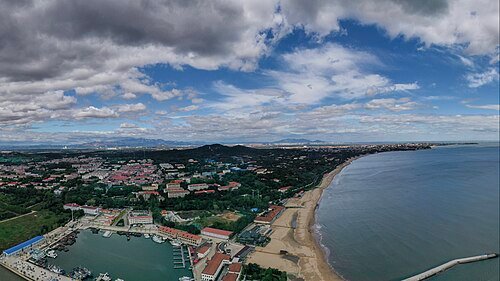
Laohushi provides a familiar seafront anchor, while Lianfeng Mountain adds a wooded inland contrast. Pigeon Nest and nearby wetlands are associated with migration-season birdwatching, but sightings depend on season and conditions. Choose either a beach-and-hill outing or a wetland-focused visit, keeping the protected areas and resort compounds within their authorised access boundaries.
During the Guangxu era of the Qing dynasty, foreign residents of Beijing petitioned to build villas at Beidaihe, and in 1898 the Qing government formally designated it a summer resort for people of all nations. By 1938 more than 700 villas had been built; after the founding of the People's Republic of China, the Communist Party's Central Committee and other large work units built about 200 more sanatoriums in Beidaihe.
The district covers 70.3 square kilometers with a 22.5-kilometer coastline on the Bohai Gulf, and has a warm-temperate, semi-humid monsoon climate moderated by the sea; average summer temperatures reach only 24.5 degrees Celsius, and forest coverage exceeds 70 percent. The beach resort stretches 10 kilometers from the Yinjiao Pavilion to the mouth of the Daihe River; nearby, Mount Lianfeng has two peaks covered by pine and cypress trees, with caves and pavilions.
Beidaihe is one of East Asia's most important corridors for migratory birds, with large numbers of wading and other birds passing through each year; its wetlands are known among birdwatchers as a 'birdwatching Mecca.' The Beidaihe Bird Banding Station (北戴河鸟类环志站) is among China's most active banding stations, and the district contains a municipal-level migratory bird reserve.
What to look for
- The Laohushi seafront and established resort landscape.
- Lianfeng Mountain's wooded setting.
- The coastal wetlands and Pigeon Nest area during suitable birdwatching seasons.
Location & getting there
Getting to Beidaihe District
For a beach-focused visit, use 老虎石海上公园 as a specific coastal starting point rather than the Beidaihe district centre.
- Choose a separate local transfer for Lianfeng Mountain or Pigeon Nest; the district's attractions are distributed along the coast.
Combine your visit
Suggested order within this visit:
-
Laohushi seafront
Start with the seaside character of the resort.
-
Lianfeng Mountain
Add the wooded inland landscape on a separately planned local transfer.
This sequence is an editorial suggestion based on the features described in the sources. Access to individual buildings or areas should be checked locally; no travel time or shared admission is implied.
Find Beidaihe District
北戴河 · 秦皇岛市
The pin marks the area, not the entrance.
More places nearby
Approximate straight-line distances between map pins, not travel distances.
Aranya 阿那亚
26 km awayAranya's Gold Coast community combines seaside residential and resort space with contemporary cultural buildings. The Seashore Library, the beachside chapel and UCCA Dune Art Museum are its best-known architectural anchors. They…
View guide →UCCA Dune Art Museum UCCA沙丘美术馆
26 km awayUCCA Dune Art Museum is embedded in the sand rather than standing above the beach. OPEN Architecture arranged the interior as connected, cave-like rooms reached through a dark entrance passage. Skylights and openings towards the…
View guide →Shanhaiguan 山海关
30 km awayShanhaiguan controls the narrow corridor between the Yanshan Mountains and the Bohai Sea. The old town's eastern gate, Zhendong Tower, carries the famous First Pass under Heaven inscription and is the clearest place to…
View guide →Sources & visit information
The linked encyclopedia sources support background and place descriptions. Current opening hours, ticket prices, booking rules and transport schedules have not been independently verified for this guide. Confirm them with the venue or operator before travelling.
Visitor information adapted and edited from Wikipedia contributors · CC BY-SA 4.0. Source revision 93186566.
Background paragraphs translated and condensed from Wikipedia contributors, "北戴河区", Chinese Wikipedia · CC BY-SA 4.0. Source revision 93186566.
Background paragraphs condensed from Wikipedia contributors, "Beidaihe, Qinhuangdao", English Wikipedia · CC BY-SA 4.0. Source revision 1369426376.