

Photo adjustments
Proportionally resized and converted to WebP without cropping, retouching or changing the photographed subject.
Explore the region
About Kaiyuan Temple (Xingtai)
The distinction matters: the older halls hold the carved stone columns, inscribed pillars and iron bell that give the site its architectural depth. In the Bodhisattva Hall, dragons curl around four substantial stone columns dated to the Ming rebuilding. A visit can concentrate on these surviving objects and the old hall sequence without assuming that every building in the expanded complex is ancient.
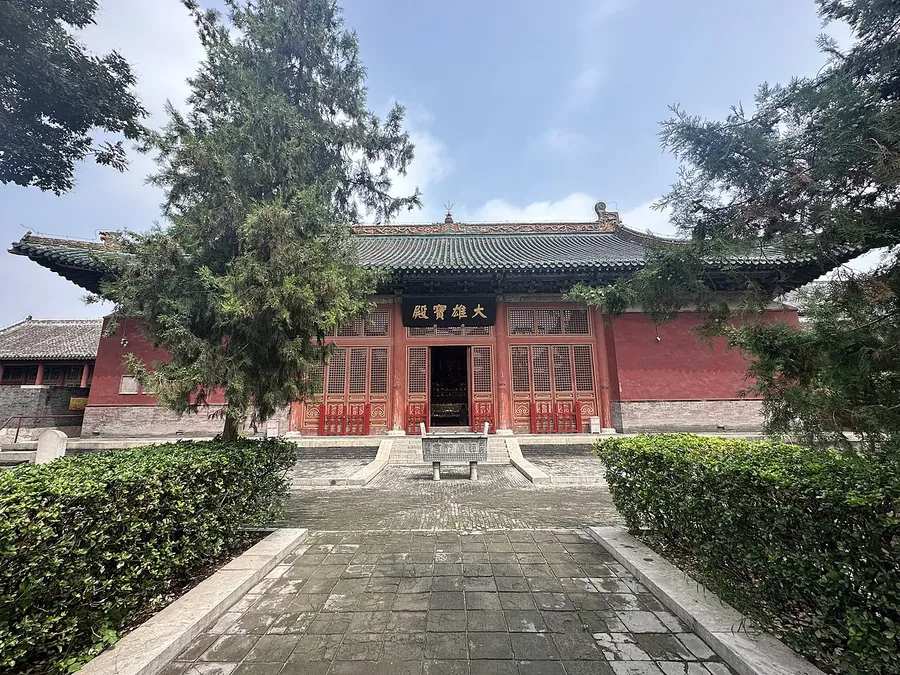
The temple's predecessor is traced to the Later Zhao period, when the monk Fotudeng (佛图澄) built nearly 900 temples in the kingdom, including Xiangguo Zhongsi (襄国中寺) on this site; a stone lotus pedestal excavated in 2002 southeast of the Mahavira Hall (大雄宝殿) was reused from a stele commemorating Later Zhao ruler Shi Le's (石勒) mother, dated to about 313. It took its present name from the Kaiyuan era (开元, 713-741) of Tang Emperor Xuanzong. Its original pagoda burned down during the Yuan dynasty, and the temple was rebuilt over more than 40 years from the Ming Hongzhi era.
The temple stands in the northeast corner of the old city of Xingtai, which gave it the alternate name Dongdasi (东大寺, East Great Temple), facing the West Great Temple, Tianning Temple (天宁寺), in the old city's northwest corner. It is now divided into the western Old Kaiyuan Temple, which retains its historic halls including the Mahavira Hall, and a larger new eastern Da Kaiyuan Temple, a five-courtyard, seven-hall complex.
Kaiyuan Temple is among the sixth group of Major Historical and Cultural Sites Protected at the National Level. It preserves a sixteen-sided Zunsheng Dharani sutra pillar (十六面尊胜陀罗尼经幢) and a Great Buddha's Crown Suiqiu Zunsheng Dharani pillar (大佛顶随求尊胜陀罗尼之幢) among its relics.
What to look for
- The four dragon-carved stone columns at the Bodhisattva Hall, bearing inscriptions associated with the 1518 rebuilding.
- The large iron bell cast in 1184 and the temple's inscribed Buddhist stone pillars.
Location & getting there
Getting to Kaiyuan Temple (Xingtai)
Go to Kaiyuan Temple in the northeast corner of Xingtai's old city in Xiangdu District; the temple-square entrances are on its southern approach.
- For historic architecture, identify the western Kaiyuan Gusi compound beside the newer eastern Da Kaiyuan Temple.
Combine your visit
Suggested order within this visit:
-
Old temple's front halls
Establish the historic compound's north-south axis.
-
Bodhisattva Hall
Examine the dragon columns from the permitted viewing area.
-
Bell and inscribed-pillars area
Complete the visit with the older cast and carved objects.
This sequence is an editorial suggestion based on the features described in the sources. Access to individual buildings or areas should be checked locally; no travel time or shared admission is implied.
Find Kaiyuan Temple (Xingtai)
邢台开元寺 · 邢台市
The pin marks the area, not the entrance.
More places nearby
Approximate straight-line distances between map pins, not travel distances.
Kongshan White Cloud Cave 崆山白云洞
43 km awayKongshan White Cloud Cave is a developed limestone cave at Lincheng on the eastern side of the Taihang Mountains. Its interior is organised into five named halls, including Human World, Heaven, Maze, Underworld and Dragon…
View guide →Guangfu Ancient City 广府古城
46 km awayGuangfu's brick walls and water-rich surroundings preserve the outline of a fortified town on the Yongnian plain. Inside and beside those walls, courtyard houses connect the town with the development of Yang- and Wu-style…
View guide →Sources & visit information
The linked encyclopedia sources support background and place descriptions. Current opening hours, ticket prices, booking rules and transport schedules have not been independently verified for this guide. Confirm them with the venue or operator before travelling.
Visitor information adapted and edited from Wikipedia contributors · CC BY-SA 4.0. Source revision 87243873.
Background paragraphs translated and condensed from Wikipedia contributors, "开元寺 (邢台市)", Chinese Wikipedia · CC BY-SA 4.0. Source revision 87243873.