


Photo adjustments
Proportionally resized and converted to WebP without cropping, retouching or changing the photographed subject.
Explore the region
About Xiangtangshan Caves
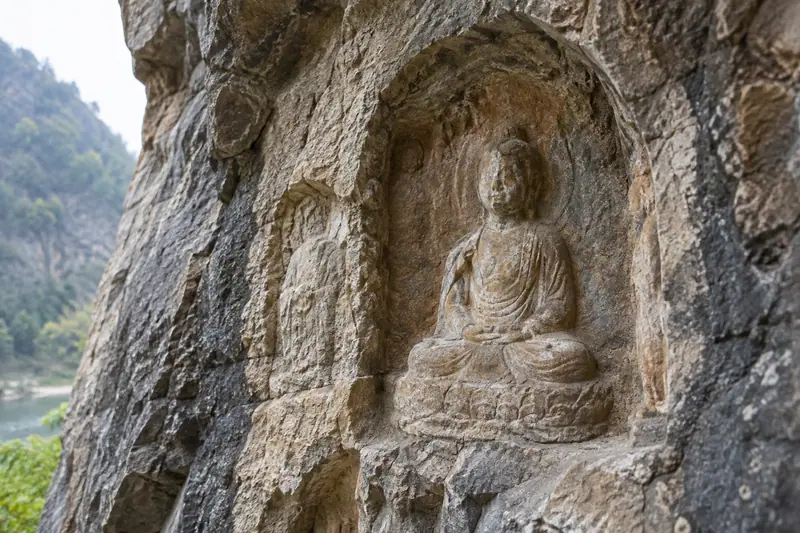
The northern group on Mount Gu contains large central-pillar chambers, while other groups occupy separate sites. Look at the relationship between the carved walls, niches and supporting pillars, and at the empty or damaged spaces left by sculpture removed in the early twentieth century. That absence is part of the site's history: many fragments now survive in museum collections abroad.
The caves were begun in the Eastern Wei and mainly carved during the Northern Qi in the sixth century, with further repairs and additions made through the Sui, Tang, Song, Jin, Yuan and Ming dynasties. The southern group's caves were begun in 565 under the monk Hui Yi of Linghua Temple and continued under the patronage of Gao Anahong, king of Huai Ying, with work ending around 577 when the Northern Qi was annexed by the Northern Zhou.
The complex comprises three groups about 15 kilometres apart: the northern caves on Mount Gu (鼓山) near Hecun village, the southern caves near Zhifang village on the Fuyang River (滏阳河), and the smaller Shuiyusi (水浴寺) caves. A 2025 survey by Handan recorded 19 main caves, 4 cliff-carved niches and 37 small niches, with 5,869 carved images in total, along with Northern Qi stone-inscribed Buddhist scripture.
Xiangtangshan was designated a Major Historical and Cultural Site Protected at the National Level (全国重点文物保护单位) in 1961. From around 1910, dealers chiselled Buddha heads, hands and reliefs from the walls for sale abroad; pieces are now held by museums including the Metropolitan Museum of Art, the Victoria and Albert Museum and the Freer Gallery of Art. Locals later added replacement clay and stone heads so worship could continue.
What to look for
- Northern-group Cave 7, a large central-pillar chamber with an elevated niche.
- The different chamber layouts of Caves 4 and 2, alongside surviving carving and the scars of removed sculpture.
Location & getting there
Getting to Xiangtangshan Caves
For the northern group, go to North Xiangtangshan on Mount Gu near Hecun in Handan's Fengfeng district.
- The northern, southern and Shuiyusi groups are separate locations; confirm which site your transport or ticket arrangement serves.
Combine your visit
Suggested order within this visit:
-
Northern-group Cave 7
Begin with the large chamber and central pillar.
-
Northern-group Cave 4
Compare the central cave's architecture and sculpture.
-
Northern-group Cave 2
Finish with another chamber in the same northern group, where accessible.
This sequence is an editorial suggestion based on the features described in the sources. Access to individual buildings or areas should be checked locally; no travel time or shared admission is implied.
Find Xiangtangshan Caves
响堂山石窟 · 邯郸市
The pin marks the area, not the entrance.
More places nearby
Approximate straight-line distances between map pins, not travel distances.
Zhaowangcheng Ruins Park 赵王城遗址公园
25 km awayZhaowangcheng preserves the earthwork outline of the Zhao royal city rather than a standing ancient palace. The archaeological complex had eastern, western and northern compounds, with substantial platforms and rammed-earth…
View guide →Wahuang Palace 娲皇宫
50 km awayWahuang Palace clings to Fenghuang Mountain in She County, with temple buildings set against a cliff and above steep drops. The site brings together the worship of Nüwa with older Buddhist material: Northern Qi scriptures were…
View guide →Sources & visit information
The linked encyclopedia sources support background and place descriptions. Current opening hours, ticket prices, booking rules and transport schedules have not been independently verified for this guide. Confirm them with the venue or operator before travelling.
Visitor information adapted and edited from Wikipedia contributors · CC BY-SA 4.0. Source revision 1371221841.
Background paragraphs translated and condensed from Wikipedia contributors, "响堂山石窟", Chinese Wikipedia · CC BY-SA 4.0. Source revision 94107757.
Background paragraphs condensed from Wikipedia contributors, "Xiangtangshan Caves", English Wikipedia · CC BY-SA 4.0. Source revision 1371221841.