

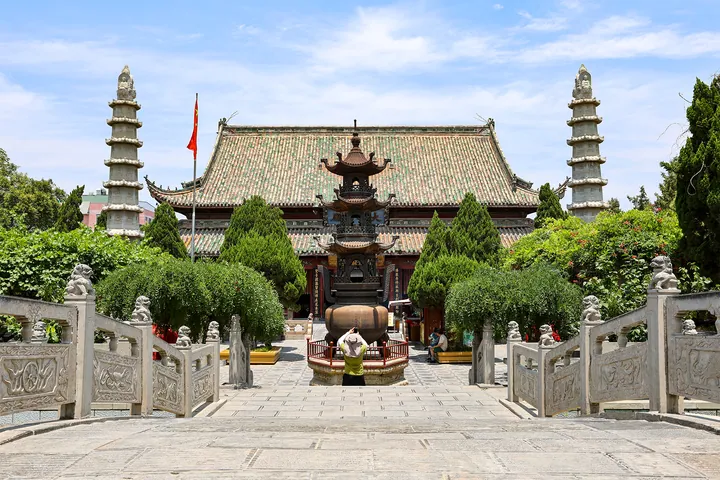
Photo adjustments
Full frame retained; proportionally resized and converted to WebP. No retouching or changes to the photographed subject. Card displays may crop the view.
Explore the region
About Daxiangguo Temple
The sequence of halls is distinguished by sculpture, especially the four-sided, many-armed Guanyin in the octagonal glazed hall. Its radiating hands contrast with the broad, frontal arrangement of Buddhas in the main hall. Looking at the roofs, painted beams and statues together makes this more than a brief stop at a famous temple name.
The temple was first built in 555, during the Northern Qi dynasty, on land that had belonged to Mr. Xinling, and was named Xiangguo Temple (相国寺). In the early Tang it became a private residence, and in 706 the monk Huiyun (惠云) built a temple on the site. It took its present name, Daxiangguo Temple (大相国寺), in 712, in memory of Emperor Ruizong of Tang (睿宗), who had earlier held the princely title Xiangwang (相王).
By the Northern Song the temple's status and scale had reached their height: it administered 64 halls of Chan and Vinaya practice, covered 540 mu (亩), and housed several thousand monks, serving as the country's leading Buddhist center and a hub where merchants from across China traded in the capital. The temple was destroyed by Yellow River flooding in 1642, during the late Ming dynasty, and was rebuilt in stages under the Qing; most of its surviving buildings date from that reconstruction.
Its Tianwang Dian, or Hall of the Heavenly Kings (天王殿), has three red doors, five bays and a roof of golden glazed tile; a statue known as Mi Le Fo sits at its center on a lotus throne, flanked by the Four Heavenly Kings standing guard.
What to look for
- The four-sided, many-armed Guanyin in the octagonal glazed hall.
- The main Buddha hall and the contrast between its large central figures and smaller attendants.
Background & history
Daxiangguo Temple (simplified Chinese: 大相国寺; traditional Chinese: 大相國寺) is a famous Chinese Buddhist Temple in Kaifeng in eastern Henan province, People's Republic of China. It is located in the center of Kaifeng City. It played a key role in the development of Chinese Buddhism. The views of the temple earned many honors, include "Ten Miracles of a Chinese Temple", "Eight sights of Bianliang", "Xiangguo Frosty Bells," which is also one of the most famous views of this temple. It is also considered among the top ten famous temples in China. A famous computer game called "Moonlight Blade Online" created by Tencent Games recognizes this temple.
Excerpt from Wikipedia: Daxiangguo Temple · Wikipedia contributors · CC BY-SA 4.0. Selected introductory sentences; formatting simplified. Background information, not current visitor-service advice.
The surrounding area
A provincial city base for food traditions and a Gulou-area evening.
Location & getting there
Getting to Daxiangguo Temple
Approach from Ziyou Road in central Kaifeng. The temple lies in the established urban street network, so use the Ziyou Road entrance as the destination for a local ride and follow the temple’s photography instructions inside the halls.
Combine your visit
A suggested sequence linking the specific features of this visit.
-
Main Buddha hall
Begin with the principal statues and the hall’s broad interior arrangement.
-
Octagonal glazed hall
Compare the four-sided Guanyin and the building designed around it.
-
Sutra-library building
Complete the axial sequence at the rear of the temple.
This order is editorial. Confirm access and any transfers between stops; it does not establish a walking route, same-day connection or common admission ticket.
Find Daxiangguo Temple
大相国寺 · 开封市
The pin marks the area, not the entrance.
More places nearby
Approximate straight-line distances between map pins, not travel distances.
Kaifeng 开封
Less than 1 km awayKaifeng’s former capital status is visible through a mixture of surviving monuments and later recreations. The Song-period Iron Pagoda provides an architectural anchor, while Daxiangguo Temple and the raised Dragon Pavilion…
View guide →Dragon Pavilion 龙亭
2 km awayDragon Pavilion stands on a high brick platform above the lakes of northern central Kaifeng. The visible hall belongs to the later history of a site occupied by earlier palaces; it should not be read as an intact Northern Song…
View guide →Millennium City Park 清明上河园
2 km awayQingming Riverside Garden is a modern recreation inspired by Zhang Zeduan’s painting of urban life along a river. The artificial waterway links market streets, bridges and performance areas, with Rainbow Bridge forming a central…
View guide →Sources & visit information
The sources below support the place-specific description and arrival information. Suggested combinations are editorial planning ideas; confirm current opening, entry arrangements and transport services for your date.
- Daxiangguo Temple ↗
- Kaifeng ↗
- Chinese Wikipedia: 大相国寺 (revision 93237050, 2026-06-28) ↗
- English Wikipedia: Daxiangguo Temple (revision 1367525074, 2026-08-03) ↗
Visitor information adapted and edited from Wikipedia contributors, “Daxiangguo Temple” · CC BY-SA 4.0. Source revision 1367525074.
Visitor information adapted and edited from Wikivoyage contributors, listing “Daxiangguo Temple” · CC BY-SA 4.0.
Background paragraphs translated and condensed from Wikipedia contributors, "大相国寺", Chinese Wikipedia · CC BY-SA 4.0. Source revision 93237050.
Background paragraphs condensed from Wikipedia contributors, "Daxiangguo Temple", English Wikipedia · CC BY-SA 4.0. Source revision 1367525074.