

Photo adjustments
Full frame retained; proportionally resized and converted to WebP. No retouching or changes to the photographed subject. Card displays may crop the view.
Explore the region
About Xinxiang Museum
The main history display moves from early settlement toward later dynasties. A separate group of collections concentrates on bronze, ceramics, painting and calligraphy, inscription rubbings and Buddhist sculpture. These changes of medium make a useful contrast: an object can first be read as evidence of local history, then examined for how it was made.
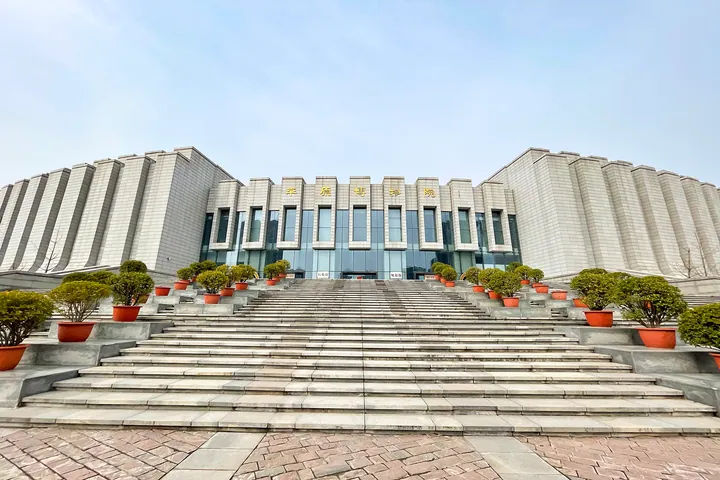
The museum's construction began with a ground-breaking ceremony on 2 June 2007 and it opened to the public on 7 May 2009. The building is a combined complex housing a museum, an archives office, a local gazetteer hall and an urban construction archives hall.
The complex covers a planned site of 7.5 hectares, with a total floor area of 51,598.7 square metres across three above-ground storeys, built as a frame-and-shear-wall structure 24 metres tall. It contains 17 artefact galleries and 6 archive galleries: the ground floor holds storage, technical and equipment rooms, while the exhibition and office spaces occupy the second and third floors. The architecture follows three design concepts named Light of China (华夏之光), Rings of History (历史年轮) and Contours of the Taihang Mountains (太行山势), and its main structure curves in an arc along the adjoining road.
What to look for
- The Muye Huazhang history galleries, tracing the Xinxiang region through successive periods.
- The specialist collections of bronze, inscription rubbings and Buddhist sculpture within the Muye Baozang displays.
Location & getting there
Getting to Xinxiang Museum
Go to 697 Renmin East Road in Xinxiang’s Hongqi District, opposite the municipal civic area. Ask for Pingyuan Museum or Xinxiang Museum; the larger building also contains archive-related institutions.
Combine your visit
A suggested sequence linking the specific features of this visit.
-
Muye Huazhang
Establish the region’s historical sequence before focusing on individual materials.
-
Muye Baozang specialist galleries
Compare bronze work, sculpture and rubbings in the collections open on your visit.
This order is editorial. Confirm access and any transfers between stops; it does not establish a walking route, same-day connection or common admission ticket.
Find Xinxiang Museum
平原博物院 · 新乡市
The pin marks the area, not the entrance.
More places nearby
Approximate straight-line distances between map pins, not travel distances.
Yunmeng Mountain in Qixian 淇县云梦山
38 km awayYunmeng Mountain in Qi County combines a rugged cave setting with the tradition of Guiguzi and his students. Water Curtain Cave is the main physical focus of that story, while cliff inscriptions around it preserve the responses…
View guide →Baligou 八里沟
47 km awayBaligou follows streams and pools into a steep-sided valley of the southern Taihang Mountains. Peach Blossom Bay introduces the lower water landscape, while Tianhe Waterfall gives the gorge a much larger vertical scale. Higher…
View guide →Yuntai Mountain (Henan) 云台山
53 km awayYuntai Mountain is a collection of gorges, cliffs and water landscapes in the Taihang foothills of Xiuwu. Red Stone Gorge concentrates the experience into coloured rock walls and a confined passage, while the waterfall valleys…
View guide →Sources & visit information
The sources below support the place-specific description and arrival information. Suggested combinations are editorial planning ideas; confirm current opening, entry arrangements and transport services for your date.
Visitor information adapted and edited from Wikivoyage contributors, listing “Xinxiang Museum” · CC BY-SA 4.0.
Background paragraphs translated and condensed from Wikipedia contributors, "平原博物院", Chinese Wikipedia · CC BY-SA 4.0. Source revision 91536778.