

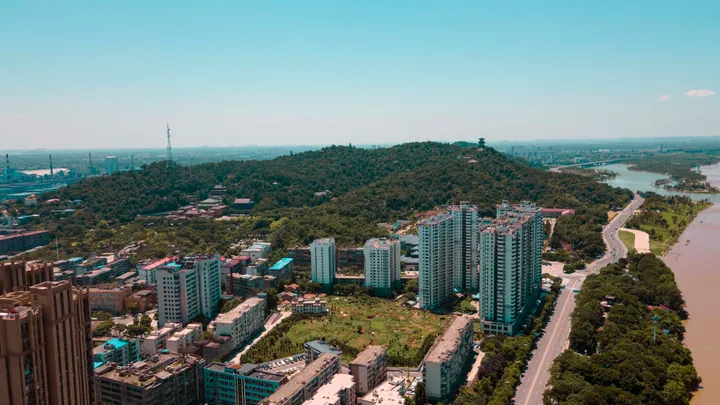
Photo adjustments
Full frame retained; proportionally resized and converted to WebP. No retouching or changes to the photographed subject. Card displays may crop the view.
Explore the region
About Ezhou West Hill
The main building on the hill is Gu Lingquan Temple, also known as Xishan Temple, which stands on the east slope and takes its name from the Pusa Spring in front of it. By the account in the local gazetteer, the temple has carried different names across more than 1,600 years: Yuantong Pavilion under the Three Kingdoms, Xizhu Lanruo in the Wei and Jin, Jicui Shanfang under the Northern and Southern dynasties, Lingquan Temple from the Song and Yuan, Zifu Temple in the Ming, and Gu Lingquan Temple from the Qing onward. Tradition holds that the monk Huiyuan founded it on the former site of the Wu king's summer palace, enshrined Manjushri there and established the Pure Land teaching. Records from the Yuan to the late Qing count six destructions and seven rebuildings; the last was in 1864, paid for with 3,000 taels donated by the Huguang governor-general Guan Wen. It was badly damaged during the Cultural Revolution and repaired afterwards. The halls recorded at the temple, in brick and timber with lotus brackets and double eaves, are the Manjushri hall, the Sanquan Pavilion, the Heavenly Kings hall, the worship hall, the main hall, the Wusheng hall and the Guanyin hall. The temple is one of Hubei's eight designated key temples.
The Three Kingdoms group is separate from the temple. It centres on the Wu king's summer palace, which is made up of four buildings – the Wuchang Tower, the summer palace, the reading hall and the council hall – and takes in the Wu king's sword-testing rock, the sword-comparing rock, the sword-washing pool and the spot where Pang Tong is said to have studied. Work in 2015 and again in 2019 reworked these sites; the sword-washing pool was enclosed within the Songfeng Pavilion grounds so that the pool, the two sword rocks and the pavilion now form one connected area. Hubei's provincial government approved the scenic area's master plan in January 2017, placing Xishan Park in a secondary core protection zone where new building is tightly restricted.
What to look for
- Gu Lingquan Temple's main halls, including the Manjushri hall and the Sanquan Pavilion, built in brick and timber with lotus brackets
- The Pusa Spring, with the five characters reading 'second spring under heaven' attributed to the Yuan calligrapher Zhao Mengfu
- The ink-washing pool beside the spring, associated with the Song calligrapher Huang Tingjian
- The plum-blossom stone carving in the Sanquan Pavilion, signed by the Qing minister of war Peng Yulin
- The four buildings of the Wu king's summer palace, with the sword-testing and sword-comparing rocks and the sword-washing pool nearby
Location & getting there
Getting to Ezhou West Hill
Check which interiors and courtyards are accessible. Active places of worship and protected monuments may have different visitor rules.
- Search for 鄂州西山 with 鄂州市 and 鄂城区.
Find Ezhou West Hill
鄂州西山 · 鄂城区
No reliable map pin yet: search by the Chinese name.
Sources & visit information
The linked sources support the identity and background described in this introduction. Opening hours, admission, activity availability and exact arrival arrangements have not been comprehensively checked. Confirm current visitor information with the venue; the original catalogue locality and editorial review flag are retained.