

Photo adjustments
Proportionally resized and converted to WebP without cropping, retouching or changing the photographed subject.
Explore the region
About Jingzhou
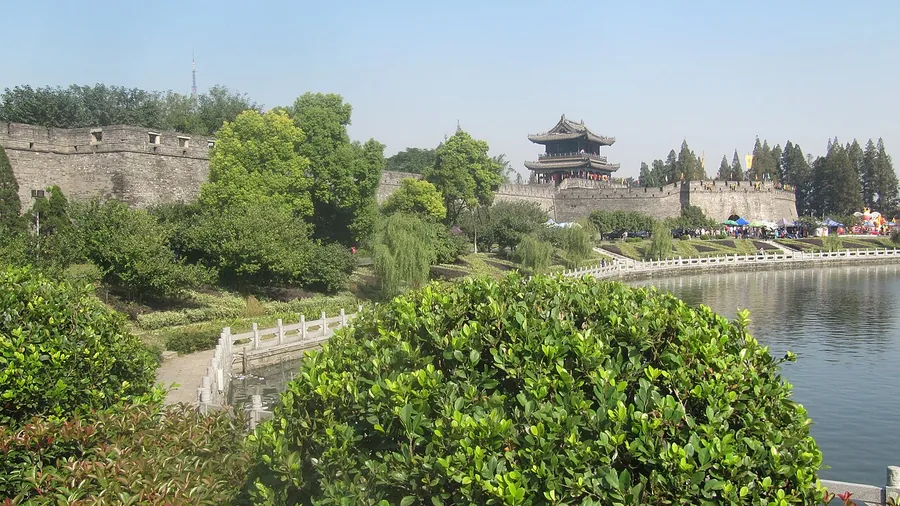
The old city’s gates and moat explain its defensive importance, while the museum brings the much earlier Chu world into focus through excavated objects. These periods should not be collapsed into a single Three Kingdoms story: the visible walls, archaeological collections and memorial buildings belong to different centuries. Start inside the historic town, then make a separate outing to the royal burial landscape beyond the urban area.
The city is named after the ancient province of Jingzhou (荆州), one of the nine provinces of ancient China, which itself took its name from the nearby Jing Mountains. Its urban core grew out of the separate settlements of Shashi and Jingzhou Town, historically known as Jiangling, whose names survive in the present Shashi and Jingzhou districts.
Jingzhou is a prefecture-level city in southern Hubei on the banks of the Yangtze River, covering 14,067 square kilometers with a topography rising from east to west and a dense network of waterways and lakes on the Jianghan Plain. Wuhan, the provincial capital, lies downstream to the east, Yichang and the Three Gorges lie to the west, Jingmen borders it to the north, and Yueyang and Changde, in Hunan, lie to the south.
According to the 2020 census the city had a total population of 5,231,180, with 1,068,291 residing in its built-up area. The prefecture-level city has jurisdiction over two districts, three county-level cities, three counties and one economic and technological development zone; suburban areas of the wider historical Jiangling region are administered by Jiangling County.
What to look for
- The historic town’s walls, gates and moat.
- The archaeological collections that reveal the earlier Chu and Han cultural world.
The surrounding area
A separate historic-city stay on the Jianghan plain, centred on the old city and its enclosure.
Location & getting there
Getting to Jingzhou
From the railway station or Shashi Airport, specify whether your accommodation is in Jingzhou’s old town or Shashi. For the historic core, use a named gate or Jingzhong Road destination rather than the prefecture-wide city pin.
Combine your visit
A suggested order for exploring this place and its immediate setting.
-
Jingzhou Museum荆州博物馆
Begin with the archaeological background.
-
Old-city wall and east gate荆州古城墙
Compare the later defensive landscape with the museum history.
-
Zhang Juzheng memorial residence张居正故居
Add a focused introduction to a Ming political figure.
Check access to the individual stops. A suggested sequence does not imply a combined ticket or guaranteed transfer.
Find Jingzhou
荆州 · 荆州市
The pin marks the area, not the entrance.
More places nearby
Approximate straight-line distances between map pins, not travel distances.
Zhang Juzheng Former Residence 张居正故居
3 km awayThis reconstructed memorial residence introduces Zhang Juzheng, the influential chief minister of the Ming Wanli period. Courtyard halls, including Taiyue Hall, organise the story of his life, political career and later…
View guide →Jingzhou City Wall 荆州古城墙
3 km awayJingzhou’s walls are best understood as a layered defensive system, with brick facing, earthwork and a moat shaping the old town’s edge. Binyang Tower marks the eastern gate, while surviving gate enclosures show how attackers…
View guide →Zhanghua Temple 荆州章华寺
4 km awayZhanghua Temple in Shashi combines an active Buddhist precinct with old trees, a well and inscribed stonework. The celebrated Chu Mei is actually wintersweet, despite its name suggesting a plum; its legendary age and association…
View guide →Sources & visit information
The sources below support the place-specific description and arrival information. Suggested combinations are editorial planning ideas; confirm current opening, entry arrangements and transport services for your date.
- Jingzhou ↗
- Historic-city operator — principal visitor sites ↗
- English Wikipedia: Jingzhou (revision 1361807032, 2026-06-30) ↗
Visitor information adapted and edited from Wikipedia contributors: Jingzhou · CC BY-SA 4.0. Source revision 1361807032.
Background paragraphs condensed from Wikipedia contributors, "Jingzhou", English Wikipedia · CC BY-SA 4.0. Source revision 1361807032.