

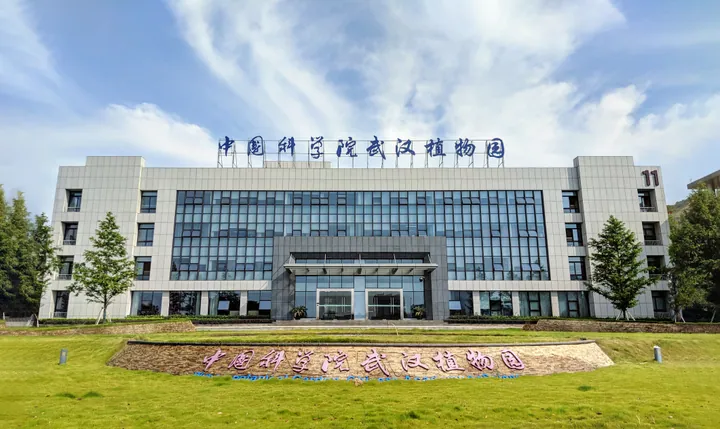
Photo adjustments
Full frame retained; proportionally resized and converted to WebP. No retouching or changes to the photographed subject. Card displays may crop the view.
About Wuhan Botanical Garden of the Chinese Academy of Sciences
Wuhan Botanical Garden of the Chinese Academy of Sciences (中国科学院武汉植物园) is a research botanical garden in Wuhan whose Moshan campus (磨山园区), rated a national 4A tourist attraction, lies on Lumo Road in Hongshan District, on the shore of East Lake (东湖) at the southern foot of Moshan Hill (磨山).
Planning began in 1956 and the institution was formally established in 1958; English Wikipedia gives 1958 as the year it opened to the public. The garden calls itself one of China's three core scientific botanical gardens. Besides the 886-mu Moshan campus it runs a larger research campus at the Future Science and Technology City in the East Lake High-tech Zone (Optics Valley, 光谷), bases in Jiangxia (江夏) and Xinzhou (新洲), and a Sino-Africa Joint Research Center campus in Kenya. In 2007 it hosted the third World Botanic Gardens Congress.
The Moshan campus serves as a national research base for plant reserves and ex situ conservation and holds more than 13,000 kinds of plants and has 17 specialty gardens. By the garden's own description these include the kiwifruit garden covering the widest range of genetic resources in the world, the largest aquatic plant garden in East Asia and the largest wild fruit tree garden in central China. The institution also runs the national kiwifruit germplasm repository; English Wikipedia lists Donghong, Jinyan and Jintao among the kiwifruit strains archived there.
A Masson pine forest stands at the centre of the garden. Other sections include a rare plant area, built in 1984, of relict species that survived from the Tertiary and Quaternary in central China. A Three Gorges section, finished in 2005, keeps plants of the reservoir's drawdown zone, including more than 50 species found only in the Three Gorges. Seasonal colour comes from a peony garden of 1988 with over 200 peony and herbaceous peony cultivars and an azalea garden started in 1991.
What to look for
- The kiwifruit specialty garden and national kiwifruit germplasm repository
- The aquatic plant garden, which the garden calls the largest in East Asia
- The Bencao Garden (本草园), a medicinal plant garden founded in 1956 with more than 1,500 medicinal species
- The rare plant section of 1984, showing relict species of central China
- The Three Gorges plant section, with more than 50 species endemic to the Three Gorges
- The azalea garden's 'wild azalea king', a Rhododendron latoucheae brought from Maoba (毛坝) in Lichuan (利川) in 1981
- The bamboo garden by East Lake, with close to a hundred kinds of bamboo
- China's first garden of invasive plants for biosecurity education, completed in 2011
Location & getting there
Getting to Wuhan Botanical Garden of the Chinese Academy of Sciences
- Search for 中国科学院武汉植物园 with 武汉市 and 洪山区.
Find Wuhan Botanical Garden of the Chinese Academy of Sciences
中国科学院武汉植物园 · 洪山区
No reliable map pin yet: search by the Chinese name.
Sources & visit information
Written from the linked sources and checked sentence by sentence against quoted extracts by a separate reviewer on 2026-09-23. Opening hours, admission and access arrangements are not covered; confirm current visitor information with the site.
Some facts checked against Wikipedia contributors, "Wuhan Botanical Garden" · CC BY-SA 4.0.