

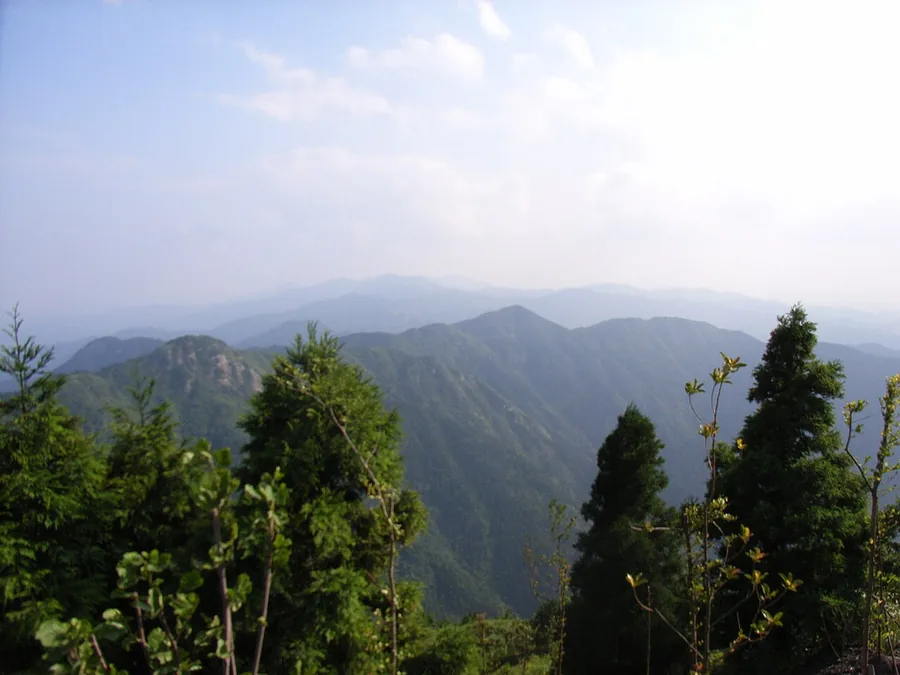
Photo adjustments
Proportionally resized and converted to WebP without cropping, retouching or changing the photographed subject.
Explore the region
About Mount Heng (Hunan)
Temples, wooded slopes and ceremonial viewpoints make the ascent a cultural as well as a mountain visit. The Grand Temple in town is a separate complex and ticket decision. Plan the climb around the current shuttle-and-walking arrangement: the former central cableway stopped operating in 2020, and a proposal for replacement transport should not be treated as an operating service.
The name Hengshan is said to derive from the Ganshi Xingjing (甘石星经), an ancient astronomical text linking the peak to the Zhen constellation (轸星) among the twenty-eight lunar mansions, able to weigh the balance between heaven and earth like a scale, hence 'Heng.' Nanyue was first consecrated as a sacrificial site in the legendary era of Tang and Yu.
The Hengshan range lies in east-south-central Hunan, running about 80 kilometres from Bailu'ao (白露坳) in Hengyang in the south to a point west of Changsha city in the north, and is traditionally described as having 'seventy-two peaks,' with Huiyan (回雁) as its head and Yuelu (岳麓) as its foot. It is a fault-block range of Yanshanian-period granite, raised and fractured by late-Tertiary tectonic movement after long erosion had reduced it to a peneplain. Its highest peak, Zhurong Peak (祝融峰), reaches 1,300.2 meters.
Nanyue is described as the religious center of southern China and the birthplace of the Southern Chan, Tiantai and Caodong Buddhist schools, and is also a noted Daoist site, home to the Zhuling Grotto-Heaven (朱陵洞天), third of Daoism's Thirty-six Grotto-Heavens. Its main scenic area was first listed as a National Key Scenic Area (国家重点风景名胜区) on 8 November 1982, and the Nanyue Hengshan Nature Reserve (南岳衡山自然保护区), established in 1984 as a provincial-level reserve, was upgraded to national level in 2005.
What to look for
- The pilgrimage route towards Zhurong Peak and its summit hall.
- The combination of wooded slopes, temple traditions and Nanyue’s mountain setting.
Location & getting there
Getting to Mount Heng (Hunan)
Use the Nanyue Hengshan visitor service centre for the main mountain transport system. Confirm the operating shuttle endpoint and remaining climb. The Huixian Bridge entry point was closed for works in May 2026; use a currently confirmed entrance.
Combine your visit
A suggested order for exploring this place and its immediate setting.
-
Main visitor service centre南岳衡山游客服务中心
Check the open route and shuttle endpoint.
-
Nantianmen approach南天门一带
Continue by the authorised transport-and-walking arrangement.
-
Zhurong Peak祝融峰
Reach the summit only if conditions and return time allow, then descend by the planned route.
Check access to the individual stops. A suggested sequence does not imply a combined ticket or guaranteed transfer.
Find Mount Heng (Hunan)
南岳衡山 · 衡阳市
The pin marks the area, not the entrance.
More places nearby
Approximate straight-line distances between map pins, not travel distances.
Grand Temple of Mount Heng 南岳大庙
7 km awayThe Grand Temple of Mount Heng occupies Nanyue town at the foot of the sacred mountain. Its long central axis leads through gates and courtyards towards the main hall, with Buddhist and Daoist precincts arranged along the sides…
View guide →Shigu Academy 石鼓书院
44 km awayShigu Academy occupies a prominent river-confluence setting in northern Hengyang. Its scholarly tradition reaches back many centuries, but the present buildings reconstruct an institution whose earlier fabric was destroyed…
View guide →Sources & visit information
The sources below support the place-specific description and arrival information. Suggested combinations are editorial planning ideas; confirm current opening, entry arrangements and transport services for your date.
- Mount Heng (Hunan) ↗
- Nanyue government — former cableway ceased operation ↗
- May 2026 notice — Huixian Bridge entrance works and alternative gates ↗
- Chinese Wikipedia: 衡山 (revision 92663743, 2026-05-15) ↗
Visitor information adapted and edited from Wikipedia contributors: Mount Heng (Hunan) · CC BY-SA 4.0. Source revision 1369568190.
Background paragraphs translated and condensed from Wikipedia contributors, "衡山", Chinese Wikipedia · CC BY-SA 4.0. Source revision 92663743.