

Photo adjustments
Full frame retained; proportionally resized and converted to WebP. No retouching or changes to the photographed subject. Card displays may crop the view.
Explore the region
About Puguang Chan Temple
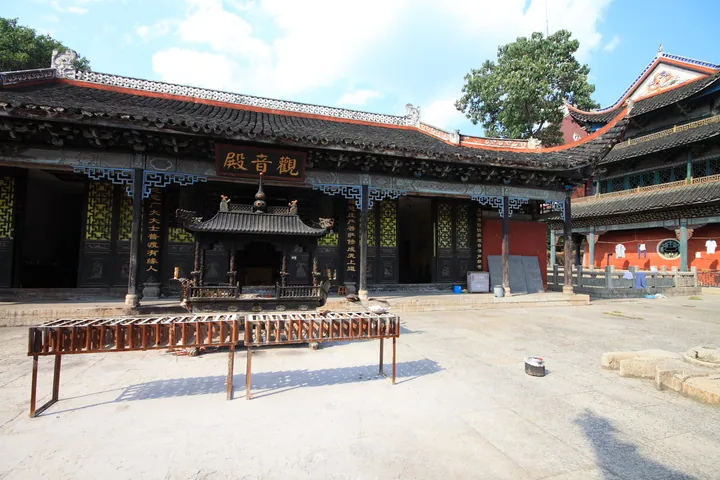
The surviving complex reflects more than a single Buddhist tradition, with the temple, martial shrine and Wenchang-related buildings recalling the interwoven religious and educational life of the town. Its timber halls and courtyard sequence reward a slower visit than the city’s mountain-transfer timetable often allows. Read the White Goat origin story as local legend, and distinguish later repairs from the early history of the institution.
The temple stands on Jiefang Road (解放路) in Yongding, and was built in the eleventh year of the Yongle era of the Ming dynasty (1413), according to the Hunan Yongding Local Gazetteer (湖南永定乡土志). It was renovated in 1733, during the reign of the Yongzheng Emperor of the Qing dynasty, by a local official named Shi Cheng. The temple was listed as a Hunan provincial cultural relic protection unit in the fifth batch in 1983, and was announced a Major Historical and Cultural Site Protected at the National Level (全国重点文物保护单位) in the seventh batch on 5 March 2013.
The surviving complex follows Ming- and Qing-dynasty building principles, its halls arranged behind a mountain gate (山门) and centered on the Mahavira Hall (大雄宝殿). The Mahavira Hall's eaves bear a plaque inscribed by the former head of the Buddhist Association of China, Zhao Puchu (赵朴初); the hall has been rebuilt more than ten times, most recently in 1989, and enshrines statues of Guanyin, Manjushri and Samantabhadra.
What to look for
- The surviving Buddhist hall and courtyard arrangement.
- The martial and Wenchang shrine context within the historic complex.
Location & getting there
Getting to Puguang Chan Temple
Use No 70 Jiefang Road in Yongding District. This is a city-centre temple, separate from Tianmen Mountain Temple; follow the current public entrance and temple visitor rules.
Combine your visit
A suggested order for exploring this place and its immediate setting.
-
Main entrance and courtyard普光禅寺山门庭院
Begin with the layout of the surviving complex.
-
Buddhist hall佛殿
Observe the architecture and religious use from the permitted visitor area.
-
Associated shrine buildings武庙与文昌祠建筑
Compare the traditions represented where the buildings are open.
Check access to the individual stops. A suggested sequence does not imply a combined ticket or guaranteed transfer.
Find Puguang Chan Temple
普光禅寺 · 张家界市
The pin marks the area, not the entrance.
More places nearby
Approximate straight-line distances between map pins, not travel distances.
Zhangjiajie Museum 张家界市博物馆
3 km awayZhangjiajie Museum links the region’s famous geology with its human and urban history. The ground-floor geological display provides a useful introduction to the landscape, while the upper historical galleries move through local…
View guide →Tianmen Mountain 天门山
9 km awayTianmen Mountain is defined by its enormous natural arch and cliff-edge paths above Zhangjiajie city. The mountain-top circuit, temple area and Tianmen Cave give it a different character from Wulingyuan’s sandstone pillars…
View guide →Baofeng Lake 宝峰湖
23 km awayBaofeng Lake occupies a dammed mountain valley south of Wulingyuan town. Its boat route places visitors close to the reflections of wooded stone peaks, offering a gentler perspective than the high plateau viewpoints. The…
View guide →Sources & visit information
The sources below support the place-specific description and arrival information. Suggested combinations are editorial planning ideas; confirm current opening, entry arrangements and transport services for your date.
- Temple profile — surviving buildings and local traditions ↗
- Provincial cultural history — Puguang’s combined traditions ↗
- Zhangjiajie — Puguang Chan Temple ↗
- Chinese Wikipedia: 普光禅寺 (revision 86763475, 2025-04-09) ↗
- English Wikipedia: Puguang Temple (Zhangjiajie) (revision 1366901404, 2026-07-30) ↗
Visitor information adapted and edited from Wikivoyage contributors: Zhangjiajie · CC BY-SA 4.0.
Background paragraphs translated and condensed from Wikipedia contributors, "普光禅寺", Chinese Wikipedia · CC BY-SA 4.0. Source revision 86763475.
Background paragraphs condensed from Wikipedia contributors, "Puguang Temple (Zhangjiajie)", English Wikipedia · CC BY-SA 4.0. Source revision 1366901404.