

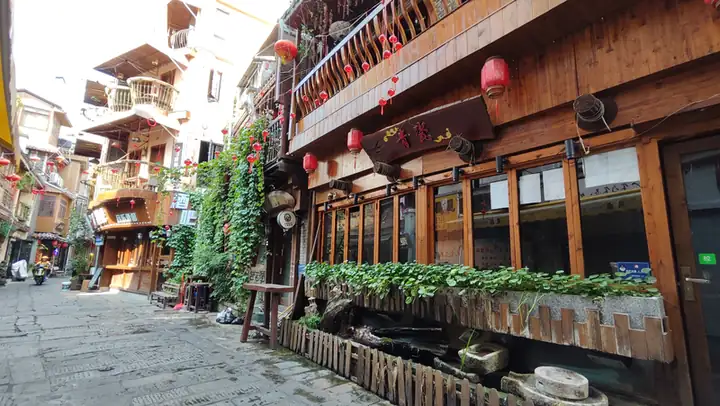
Photo adjustments
EXIF orientation normalized; resized without changing aspect ratio; converted to WebP. No subject edits.
Explore the region
About Taiping Street and Pozi Street
Taiping Street has been a place of commerce and scholarship since the Western Han, and its fishbone pattern of a main lane with side alleys has survived largely unchanged, making it one of the most complete surviving Ming-Qing to Republican street layouts in central Changsha. The main street is 380 metres long and contains six immovable cultural relics and 31 designated excellent historic buildings, among stone archways, traditional dwellings, an old opera stage and continuous shopfronts. The former residence of the Han writer and official Jia Yi stands at the southern end, with an old stele pavilion, a well and an ancestral hall, while No. 17 Majia Lane, about a hundred metres off the main street, is the former site of the Gongjinhui of the 1911 Revolution. In January 2022 the Ministry of Culture and Tourism and the National Development and Reform Commission named Taiping Street among the first batch of national tourism and leisure blocks.
Pozi Street runs 640 metres from Huangxing South Road west to Xiangjiang Avenue, covering about 180 mu with its flanking blocks, and links the Wuyi commercial area, the Jiefang West Road bar street and the Huangxing South Road pedestrian street; 27 national, provincial and municipal protected heritage units stand along it. It was named in the Qing for its gradient, and the Tongzhi-era Shanhua County Gazetteer records it as three parts, the flatter upper street given over to money businesses and the steeper lower street to the medicine trade. River traffic on the Xiang made it an important trading district from the Tang onwards, and in 2012 archaeologists working on a site on its southern side, about 60 metres from the river, uncovered north-south city walls of three periods: Ming, Song and the Five Dynasties. Its best-known building is Huogongdian, also called Qianyuan Gong, a temple to the fire god first built in 1747 and rebuilt in 1826, whose stage carries a couplet by the Qing calligrapher He Shaoji.
What to look for
- The former residence of Jia Yi at the south end of Taiping Street, with its stele pavilion, old well and ancestral hall
- No. 17 Majia Lane, the former site of the Gongjinhui of the 1911 Revolution, a short walk off the main street
- The 380-metre main lane of Taiping Street and the side alleys of its fishbone plan, with stone archways, an old opera stage and 31 designated historic buildings
- Huogongdian on Pozi Street, a fire-god temple first built in 1747, rebuilt in 1826, destroyed in the 1938 fire and rebuilt in 1941, whose stage couplet was written by He Shaoji
- The Taipingli cultural and creative market at the north end of Taiping Street, in a converted 1980s sugar and wine factory
Location & getting there
Getting to Taiping Street and Pozi Street
Choose a precise starting address and return transport stop. Access to individual buildings, performances or viewing platforms is separate from access to public streets.
- Search for 太平街与坡子街 with 长沙市 and 天心区.
Find Taiping Street and Pozi Street
太平街与坡子街 · 天心区
No reliable map pin yet: search by the Chinese name.
Sources & visit information
The linked sources support the identity and background described in this introduction. Opening hours, admission, activity availability and exact arrival arrangements have not been comprehensively checked. Confirm current visitor information with the venue; the original catalogue locality and editorial review flag are retained.