


Photo adjustments
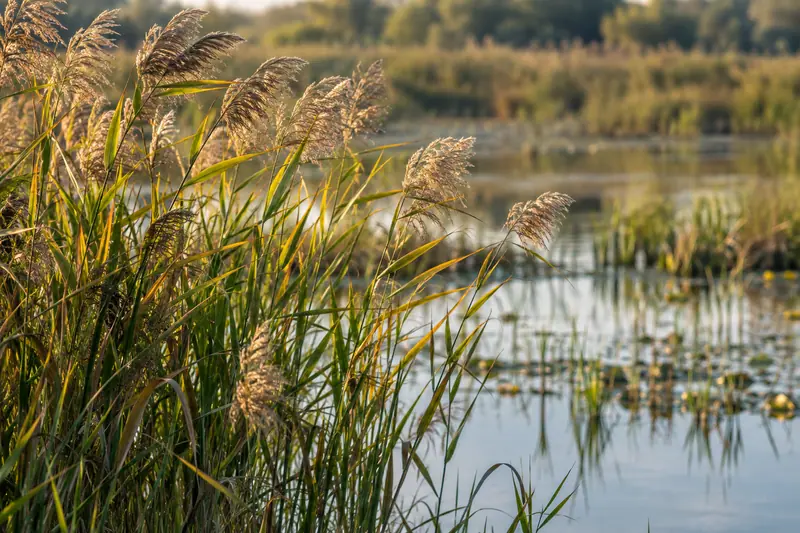
Full frame retained; proportionally resized and converted to WebP. No retouching or changes to the photographed subject. Card displays may crop the view.
Explore the region
About Wuliangsuhai Lake
Its shallow water and reed beds support a rich wetland community, including mute swans and other migratory birds. The managed visitor shore provides the clearest introduction: an extended pier opens the lake view, while the bird exhibition adds context to the habitat beyond it. Observing from public facilities keeps the visit focused on the lake without disturbing the protected reed interiors.
The name is Mongolian for “poplar forest”. The lake is a river-formed lake that developed from a former course of the Yellow River, within the Ningxia-Inner Mongolia plateau region and the Yellow River drainage system. It stretches 35 to 40 kilometers from north to south and 5 to 10 kilometers from east to west, covering an area of about 293 square kilometers. It lies within Wulate Front Banner (乌拉特前旗), where the Wuliangsuhai wetland is also located. Its water is supplied mainly by tail water from several hundred kilometers of irrigation and drainage canals in the Hetao irrigation district, with part of the outflow regulated back into the Yellow River via a return canal.
Wuliangsuhai is an important freshwater fishery base for the Hetao region of western Inner Mongolia, with more than twenty fish species, including carp, crucian carp, grass carp, silver carp and Huanghe yaluoyu (黄河雅罗鱼), producing an annual catch of 300 to 800 wan jin (万斤). It is also habitat for more than 120 bird species, including the whooper swan (大天鹅) and spot-billed pelican (斑嘴鹈鹕), both national key protected bird species in China.
What to look for
- The shallow lake and reed margins from the extended visitor pier.
- The bird exhibition and the wetland habitat associated with mute swans and migratory waterbirds.
Location & getting there
Getting to Wuliangsuhai Lake
Approach the Wuliangsuhai ecological tourism area in E'erdengbulage Sumu, Urad Front Banner.
- Use the managed visitor shore and check any boat programme locally; bird sightings vary with season and conditions.
Combine your visit
Suggested order within this visit:
-
Bird exhibition
Begin with the species and habitat context.
-
Visitor pier and lakeside
Continue to the open water and reed-edge view.
This sequence is an editorial suggestion based on the features described in the sources. Access to individual buildings or areas should be checked locally; no travel time or shared admission is implied.
Find Wuliangsuhai Lake
乌梁素海 · 巴彦淖尔
The pin marks the area, not the entrance.
More places nearby
Approximate straight-line distances between map pins, not travel distances.
Urad Grassland 乌拉特草原
74 km awayThe Urad grassland covers a wide pastoral region rather than one fenced attraction. For an introduction from Hailiutu, Delingshan Reservoir provides a specific managed destination where water meets the surrounding open country…
View guide →Kubuqi Desert 库布齐沙漠
79 km awayThe Kubuqi Desert stretches below the Yellow River's great northern bend. Chains of mobile dunes, areas of stabilised sand and planted vegetation create a varied landscape rather than one continuous bare surface. Xiangshawan, at…
View guide →Baotou Museum 包头博物馆
85 km awayBaotou Museum connects the city's trading history with the older cultures of the Yinshan region. Its rock-art collection is especially useful: animal figures, hunting and pastoral scenes preserve a visual record that differs…
View guide →Sources & visit information
The sources below support the place-specific description and arrival information. Suggested combinations are editorial planning ideas; confirm current opening, entry arrangements and transport services for your date.
- Wikipedia: 烏梁素海 ↗
- Urad Front Banner: Wuliangsuhai bird exhibition and visitor facilities ↗
- Urad Front Banner: Wuliangsuhai extended visitor pier ↗
- Urad Front Banner: existing scenic-area location in E'erdengbulage Sumu ↗
Visitor information adapted and edited from Wikipedia contributors · CC BY-SA 4.0. Source revision 92023797.
Background paragraphs translated and condensed from Wikipedia contributors, "烏梁素海", Chinese Wikipedia · CC BY-SA 4.0. Source revision 92023797.