

Photo adjustments
Proportionally resized and converted to WebP without cropping, retouching or changing the photographed subject.
Explore the region
About Xanadu Ruins
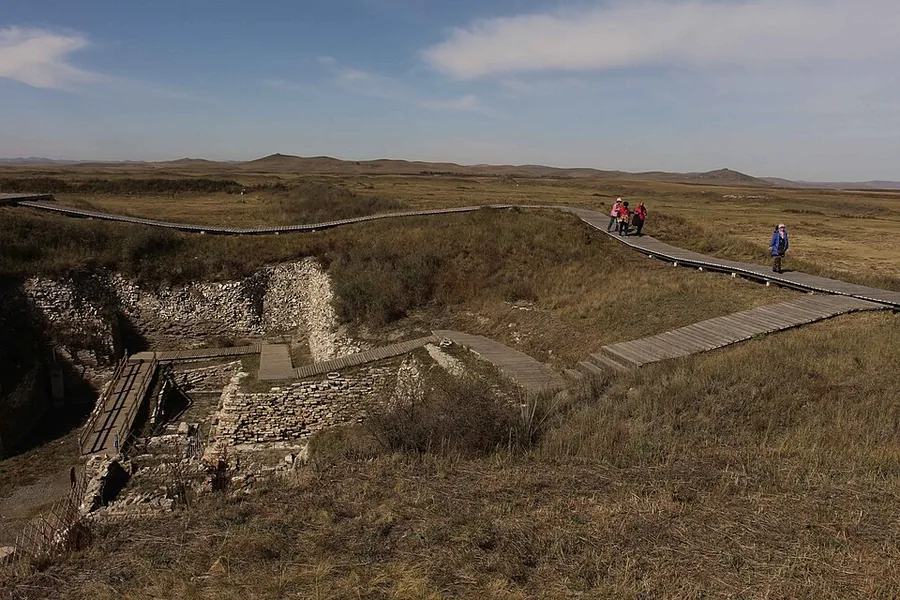
The low walls and palace foundations need a little interpretation: the nested outer, imperial and palace enclosures once combined a Chinese-style capital with space for the Mongol court's tents and seasonal life. Begin at the separate site museum to understand that plan, then follow the authorised route among the surviving earthworks. The surrounding Jinlianchuan grassland remains essential to understanding why the court came here.
Liu Bingzhong (刘秉忠) began building a residence for Kublai Khan on the site in March 1256, and Kublai was enthroned there on 5 May 1260. On 16 June 1263 the settlement, then called Kaiping (开平), was elevated and renamed Shangdu (上都). After Kublai moved his capital to Yanjing (renamed Dadu in 1271) in 1267, Shangdu continued to serve as a secondary and summer capital. Red Turban forces captured the city on 8 January 1359 and burned its palace halls before withdrawing after seven days. The Ming army took Shangdu on 20 July 1369, after which it was renamed Kaiping Prefecture and later downgraded to a garrison.
The site was listed as an Inner Mongolia protected cultural site in 1964 and as a Major Historical and Cultural Site Protected at the National Level in 1988. It was placed on China's tentative World Heritage list in 1996, nominated for inscription in 2012, and on 29 June 2012 the World Heritage Committee, meeting in Saint Petersburg, inscribed it on the World Heritage List. The inscribed area covers about 251 square kilometers, including the city site, the outskirts (关厢), Tiefangan Canal (铁幡竿渠) and the Zhenzishan (砧子山) and Yikeshu (一棵树) burial grounds, with a buffer zone of about 1,507 square kilometers.
What to look for
- The nested city enclosures and surviving palace foundations, including the Da'an Pavilion area.
- The site museum's archaeological interpretation of the Yuan summer capital.
Location & getting there
Getting to Xanadu Ruins
Travel from Shangdu Town in Zhenglan Banner toward the ruins, about 20 kilometres east of town.
- The museum is roughly five kilometres south of the ruins at Wulantai Aobao Mountain; plan a road transfer between the two, then check the site's current internal transport options.
Combine your visit
Suggested order within this visit:
-
Xanadu Site Museum
Read the capital's plan before visiting its low surviving remains.
-
City enclosure route
Follow the walls and gateways within the open archaeological area.
-
Palace-foundation viewpoint
Locate the imperial core within the much larger grassland setting.
This sequence is an editorial suggestion based on the features described in the sources. Access to individual buildings or areas should be checked locally; no travel time or shared admission is implied.
Find Xanadu Ruins
元上都遗址 · 锡林郭勒盟
The pin marks the area, not the entrance.
More places nearby
Approximate straight-line distances between map pins, not travel distances.
Duolun Luanhe Headwaters Wetland Park 多伦滦河源国家湿地公园
47 km awayDuolun's Luanhe Headwaters Wetland Park follows a connected river-and-reservoir landscape, including Duolun Lake and the Luan River toward Dahekou. Its importance lies in the water, marsh vegetation and wooded catchment…
View guide →Dali Lake 达里诺尔
111 km awayDali Lake, also called Dalinor, lies where the Gongger grassland approaches the Hunshandake sands. It is a closed saline lake with a wide horizon and important bird habitat around its margins. The southern visitor area adds the…
View guide →Hexigten Global Geopark 克什克腾世界地质公园
148 km awayHexigten Geopark is a dispersed geological landscape rather than a single enclosed park. Its best-known formations include the horizontally layered granite towers of Arshihaty and the rounded rock basins at Qingshan, with…
View guide →Sources & visit information
The sources below support the place-specific description and arrival information. Suggested combinations are editorial planning ideas; confirm current opening, entry arrangements and transport services for your date.
- Wikipedia: 元上都 ↗
- Xilingol Culture and Tourism: Xanadu site location and layout ↗
- Xilingol heritage authority: Xanadu Museum location ↗
- Xilingol government: June 2026 internal visitor transport improvements ↗
- English Wikipedia: Shangdu (revision 1369616885, 2026-08-16) ↗
Visitor information adapted and edited from Wikipedia contributors · CC BY-SA 4.0. Source revision 92023781.
Background paragraphs translated and condensed from Wikipedia contributors, "元上都", Chinese Wikipedia · CC BY-SA 4.0. Source revision 92023781.
Background paragraphs condensed from Wikipedia contributors, "Shangdu", English Wikipedia · CC BY-SA 4.0. Source revision 1369616885.