

Photo adjustments
Proportionally resized and converted to WebP without cropping, retouching or changing the photographed subject.
Explore the region
About Zhaojun Tomb
Its identification as her actual burial place is uncertain. The approach is lined with stone figures, inscriptions and museum buildings explaining the marriage-alliance tradition. Reading those displays before approaching the Green Mound makes the visit an exploration of historical memory, rather than an expectation of an excavated tomb interior.
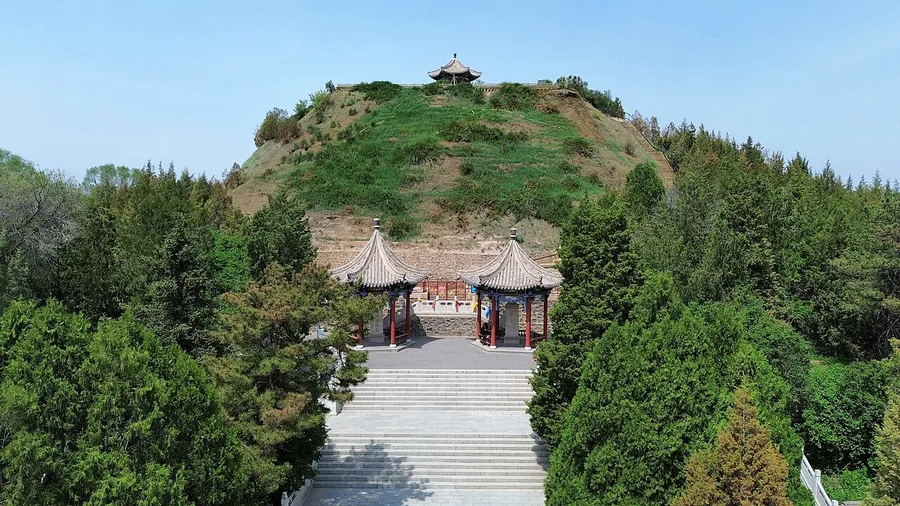
The mound is also known as the Green Mound (青冢); according to local tradition, the surrounding grass yellows in autumn while the mound itself stays green. Its Mongolian name, Temür Urkhu (特木尔乌尔虎), means “iron wall”. More than ten other sites elsewhere are locally claimed as Zhaojun's tomb, but the Hohhot mound is considered the most prominent, since it has the earliest textual record and the most literary references, though its authenticity remains undetermined. The earliest mention of its location appears in the Tang-dynasty Tongdian (通典) by Du You.
The site has been renovated repeatedly since the 1960s and now includes the Zhaojun Museum. It was listed as an Inner Mongolia autonomous region protected cultural site in 1964 and, on 25 May 2006, as a Major Historical and Cultural Site Protected at the National Level, in the sixth national batch.
The present mound is an artificial rammed-earth, truncated-pyramid form standing 33 meters high with a base area of about 13,000 square meters. Stone steps lead to a platform two-thirds of the way up the front, where two hexagonal pavilions stand, with paths continuing to a glazed-tile pavilion at the summit. Eight late-Qing and Republican-era stone steles flank the mound's front.
What to look for
- The Green Mound and the inscribed stones around its base.
- The stone-figure avenue and museum interpretation of Wang Zhaojun and marriage alliances.
The surrounding area
Autonomous-region capital and urban base for temple streets, museums and local breakfast traditions.
Location & getting there
Getting to Zhaojun Tomb
Use the Zhaojun Museum's south entrance beside the G209 road, south of the Dahei River in Yuquan District.
- Plan a separate road transfer from central Hohhot; follow the museum's current directions for the mound paths.
Combine your visit
Suggested order within this visit:
-
Museum interpretation
Begin with Zhaojun's story and its historical context.
-
Stone-figure avenue
Follow the formal commemorative approach.
-
Green Mound and inscriptions
Compare the monument with the stories preserved around it.
This sequence is an editorial suggestion based on the features described in the sources. Access to individual buildings or areas should be checked locally; no travel time or shared admission is implied.
Find Zhaojun Tomb
昭君墓 · 呼和浩特
The pin marks the area, not the entrance.
More places nearby
Approximate straight-line distances between map pins, not travel distances.
Five Pagoda Temple 五塔寺
10 km awayFive Pagoda Temple takes its name from the five small towers rising from a single diamond-throne base. Rows of individually varied Buddha images cover the masonry, making close observation as rewarding as the overall silhouette…
View guide →Saishang Old Street 塞上老街
10 km awaySaishang Old Street runs west from Dazhao through Hohhot's historic trading quarter. Brick-and-timber shopfronts recall the period when goods from the grasslands met tea, silk and other products from farther south. Today's shops…
View guide →Dazhao Temple 大召寺
11 km awayDazhao anchors the temple quarter of old Hohhot. Its main hall combines Chinese and Tibetan building forms and preserves a celebrated silver image of Shakyamuni. Golden dragons coil around the columns in front of the image…
View guide →Sources & visit information
The sources below support the place-specific description and arrival information. Suggested combinations are editorial planning ideas; confirm current opening, entry arrangements and transport services for your date.
- Wikipedia: 昭君墓 ↗
- Amap: Zhaojun Museum south gate beside G209 ↗
- English Wikipedia: Zhaojun Tomb (revision 1349752935, 2026-04-18) ↗
Visitor information adapted and edited from Wikipedia contributors · CC BY-SA 4.0. Source revision 92583336.
Background paragraphs translated and condensed from Wikipedia contributors, "昭君墓", Chinese Wikipedia · CC BY-SA 4.0. Source revision 92583336.
Background paragraphs condensed from Wikipedia contributors, "Zhaojun Tomb", English Wikipedia · CC BY-SA 4.0. Source revision 1349752935.