


Photo adjustments
Wikimedia thumbnail; fitted to the ranking-card frame.
Explore the region
About Lingering Garden
Its central garden gathers buildings around a pond and a yellow-stone grotto, while the eastern section focuses attention on a major viewing stone.
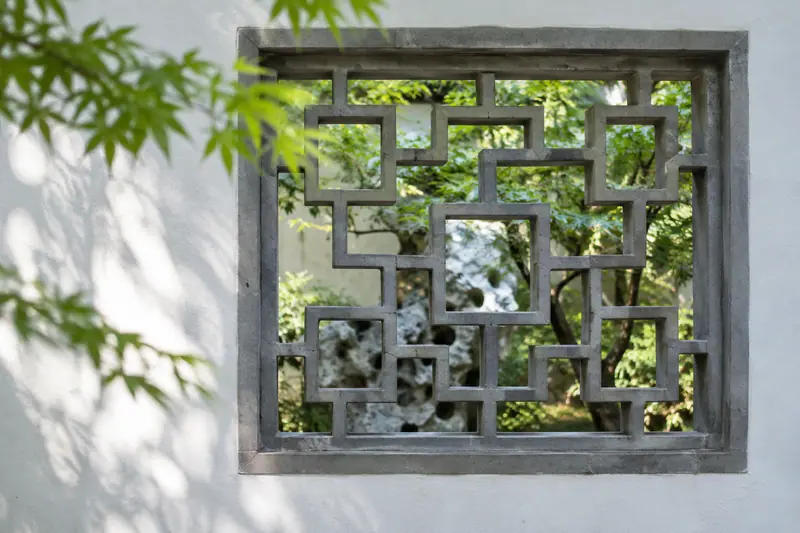
The western part is more open and natural in character, with fewer buildings and an artificial hill. The covered corridors make these differences readable as a sequence of framed scenes. Take time to compare the garden’s use of enclosure, stone and water instead of treating every pavilion as a separate attraction.
Lingering Garden was built beginning in 1593 for Xu Taishi (徐泰时), who had already been dismissed from his post as Vice Minister of the Court of the Imperial Stud, and was designed by the rockery specialist Zhou Shichen (周时臣); it was first named Dongyuan (东园). In 1798 Liu Shu (刘恕) rebuilt the then-derelict garden as Hanbizhuang (寒碧庄), also known as Liu Yuan (刘园) after his surname, and opened it to the public in 1823. After falling into neglect during the Taiping Rebellion, it was bought in 1873 by the official Sheng Kang (盛康), who rebuilt it over three years, completing the work in 1876 and giving it, as a homophone of the earlier name, its present name.
During the Japanese occupation the garden was abandoned again and used to stable army horses; after 1949 the Suzhou government restored it and reopened it to the public in 1954. It is now grouped with the Summer Palace in Beijing, the Chengde Mountain Resort and Suzhou's Humble Administrator's Garden as one of China's four great classical gardens.
In 1961 Lingering Garden was named by the State Council among the first group of Major Historical and Cultural Sites Protected at the National Level (全国重点文物保护单位). In 1997, together with three other classical Suzhou gardens, it was inscribed on the UNESCO World Heritage List.
What to look for
- Covered walkways connect contrasting themed sections.
- The central pond and grotto differ from the eastern scholar-stone composition.
- The western section has a more open, hill-and-planting character.
The surrounding area
A provincial city base for classical gardens, canals and soup-noodle breakfasts; do not confuse its old city with the distant North railway station.
Location & getting there
Getting to Lingering Garden
Approach 338 Liuyuan Road in Suzhou and follow the signed route through the garden’s four sections.
Combine your visit
A suggested sequence linking the specific features of this visit.
-
Central pond and grotto
Begin with the oldest garden’s main water-and-rock scene.
-
Eastern scholar-stone courts
Compare the display of individual stones with the larger grotto.
-
Western garden
Finish with the more open hill and planted setting.
This order is editorial. Confirm access and any transfers between stops; it does not establish a walking route, same-day connection or common admission ticket.
Find Lingering Garden
留园 · 苏州市
The pin marks the area, not the entrance.
More places nearby
Approximate straight-line distances between map pins, not travel distances.
The Garden of Cultivation 艺圃
2 km awayThe Garden of Cultivation, or Yipu, places a central pond between northern buildings and a southern rock-and-tree landscape. Its relatively direct composition preserves the character of a scholar’s residential garden.
View guide →Mountain Villa with Embracing Beauty 环秀山庄
2 km awayHuanxiu Shanzhuang is a compact Suzhou garden centred on an elaborate rockery associated with the Qing garden designer Ge Yuliang. Its peaks, narrow passages and surrounding pond create a miniature mountain landscape.
View guide →Hanshan Temple 寒山寺
2 km awayHanshan Temple stands at Fengqiao west of Suzhou’s old city. Its association with Zhang Ji’s poem about a night mooring has made the temple bell and canal-side setting central to its identity.
View guide →Sources & visit information
The linked encyclopedia sources support background and place descriptions. Current opening hours, ticket prices, booking rules and transport schedules have not been independently verified for this guide. Confirm them with the venue or operator before travelling.
- Lingering Garden ↗
- Chinese Wikipedia: 留园 (revision 92806784, 2026-05-26) ↗
- English Wikipedia: Lingering Garden (revision 1366154942, 2026-07-26) ↗
Visitor information adapted and edited from Wikipedia contributors, “Lingering Garden” · CC BY-SA 4.0. Source revision 1366154942.
Background paragraphs translated and condensed from Wikipedia contributors, "留园", Chinese Wikipedia · CC BY-SA 4.0. Source revision 92806784.
Background paragraphs condensed from Wikipedia contributors, "Lingering Garden", English Wikipedia · CC BY-SA 4.0. Source revision 1366154942.