

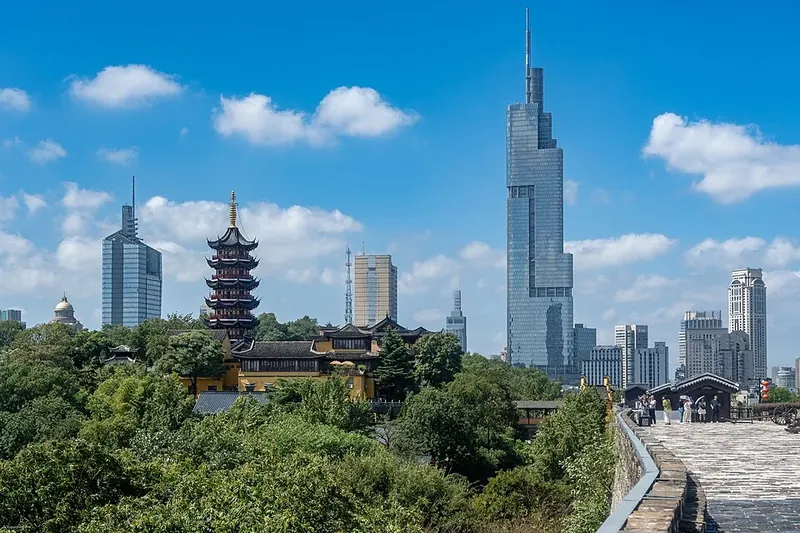
Photo adjustments
Full frame retained; proportionally resized and converted to WebP. No retouching or changes to the photographed subject. Card displays may crop the view.
City & district guides
About Nanjing
Together they connect urban defence, republican government and imperial burial. Choose one central-city pairing before adding the Purple Mountain sites, which form a separate larger excursion. The Qinhuai River and Xuanwu Lake provide contrasting waterside settings between museum and monument visits, rather than requiring every major attraction in a single circuit.
Nanjing's city wall was built in the early Ming dynasty as four concentric rings: a palace city, an imperial city, an inner city (内城) and an outer wall (外郭). The outer wall, mostly rammed earth with about 18 gates, has since disappeared, surviving only in place names. The inner wall, built of rammed earth faced with brick, followed the terrain in an irregular shape rather than the traditional square plan, and originally had 13 gates.
The inner wall runs by Zhongshan (钟山) to the east, Shitou (石头) to the west, the Qinhuai River to the south and Houhu (后湖) to the north, with a total circumference of 35.267 kilometres, of which about 25 kilometres survive largely intact, the longest existing ancient city wall in the world. Of the 13 original gates, only Julebao Gate (聚宝门, now Zhonghua Gate), Shicheng Gate (石城门, now Hanxi Gate), Shence Gate (神策门, now Heping Gate) and Qingliang Gate (清凉门) remain.
The wall was listed as a Major Historical and Cultural Site Protected at the National Level (全国重点文物保护单位) in January 1988. Systematic management began in the late 1970s, and the Nanjing City Wall Management Centre now oversees the surviving remains; the Nanjing Ming City Wall History Museum opened in May 1998.
What to look for
- The surviving Ming city wall makes the former capital’s defensive scale tangible.
- The Presidential Palace combines garden spaces with buildings associated with republican government.
The surrounding area
The provincial capital suits museums and major historical sites; reserve time for different districts instead of treating it as one walking circuit.
Location & getting there
Getting to Nanjing
Check whether the booked train arrives at Nanjing Station, beside the northern shore of Xuanwu Lake, or Nanjing South Station. Both connect with the city’s metro; choose the onward journey for the actual station printed on the ticket.
Combine your visit
A suggested sequence linking the specific features of this visit.
-
Presidential Palace南京总统府
Begin with the garden and government buildings of the republican period.
-
City wall南京城墙
Compare the government compound with the older defensive landscape.
-
Ming Xiaoling明孝陵
Add the Purple Mountain mausoleum as a separately planned excursion into imperial ceremonial space.
This order is editorial. Confirm access and any transfers between stops; it does not establish a walking route, same-day connection or common admission ticket.
Find Nanjing
南京 · 南京市
The pin marks the area, not the entrance.
More places nearby
Approximate straight-line distances between map pins, not travel distances.
John Rabe's former residence拉贝与国际安全区纪念馆
Less than 1 km awayJohn Rabe’s former home in Nanjing interprets his life in China and the work of the Nanjing Safety Zone during the 1937 atrocities. The renewed exhibition places Rabe’s biography on the first floor and the Safety Zone’s…
View guide →Jiming Temple鸡鸣寺
1 km awayJiming Temple rises on Jilong Hill beside the southern shore of Xuanwu Lake. Its present ensemble includes substantial modern reconstruction, including the seven-storey, eight-sided Medicine Buddha Pagoda. The Guanyin Hall is…
View guide →Presidential Palace (Nanjing)南京总统府
2 km awayNanjing’s Presidential Palace is a layered political complex on Changjiang Road. It housed the office of the Republic of China’s president during the period when the government was based in Nanjing.
View guide →Sources & visit information
The sources below support the place-specific description and arrival information. Suggested combinations are editorial planning ideas; confirm current opening, entry arrangements and transport services for your date.
- en.wikipedia.org ↗
- Nanjing ↗
- www.wikidata.org ↗
- 南京城墙 ↗
- en.wikipedia.org ↗
- Presidential Palace (Nanjing) ↗
- Xiao Mausoleum ↗
- Chinese Wikipedia: 南京城墙 (revision 93416093, 2026-07-11) ↗
Visitor information adapted and edited from Wikipedia contributors, “南京城墙” · CC BY-SA 4.0. Source revision 93416093.
Visitor information adapted and edited from Wikivoyage contributors, “Nanjing” · CC BY-SA 4.0.
Visitor information adapted and edited from Wikipedia contributors, “Presidential Palace (Nanjing)” · CC BY-SA 4.0. Source revision 1363274048.
Visitor information adapted and edited from Wikipedia contributors, “Xiao Mausoleum” · CC BY-SA 4.0. Source revision 1365742078.
Background paragraphs translated and condensed from Wikipedia contributors, "南京城墙", Chinese Wikipedia · CC BY-SA 4.0. Source revision 93416093.