


Photo adjustments
Proportionally resized and converted to WebP without cropping, retouching or changing the photographed subject.
City & district guides
About Qixia Temple
The Buddhist precinct is connected with a wooded hillside of paths, pavilions and stone features.
Bell and drum towers introduce the temple’s architectural sequence, followed by the principal hall and its Buddhist imagery. The mountain setting gives the visit a second layer beyond the halls. Choose an appropriate hillside route after the temple, rather than assuming that every named pavilion or rock feature belongs to one short circuit.
Qixia Temple was founded in 489, during the Southern Qi dynasty, on the former private residence of the hermit Ming Sengshao (明僧绍), taking its name from his courtesy name 'Qixia'; it became the ancestral court of the Three Treatise school (三论宗) of Buddhism. In the Tang dynasty it was known as Gongde Temple (功德寺) and ranked among the 'Four Great Monasteries under Heaven'. The temple was destroyed by war in 1130.
It was rebuilt in 1392 by the Ming Taizu Emperor, who granted it monastery fields and hills of over 1,300 mu (亩). During the Qing dynasty the Qianlong Emperor stayed at Qixia Temple five times on his six southern tours, and a temporary palace built for him on Qixia Mountain was burned along with the temple in 1853 during the Taiping Rebellion. The temple was rebuilt again in 1919 by the monk Zongyang (宗仰).
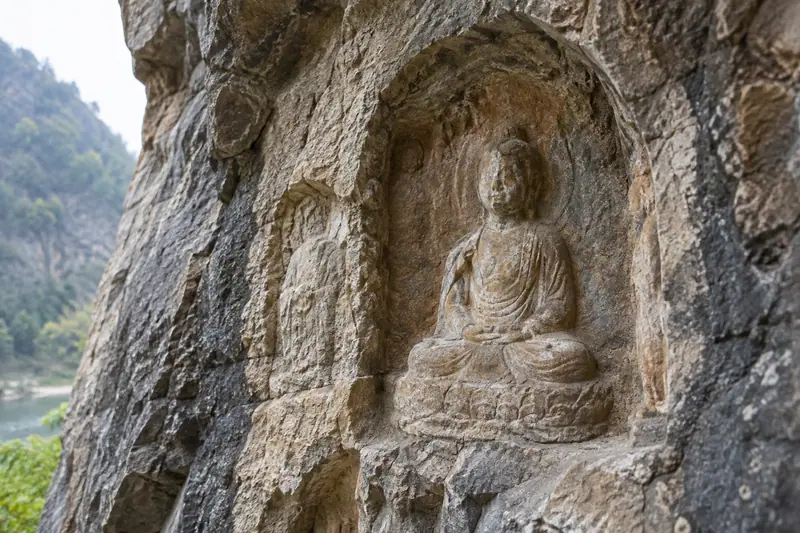
Qixia Temple was designated a Major Buddhist Temple of National Importance in Han Chinese Areas (汉族地区全国重点寺院) in 1983 and listed as a Jiangsu Provincial Cultural Relic Protection Unit (江苏省文物保护单位) in 2002. Its Sui-dynasty sarira stone pagoda (舍利石塔) was listed as a Major Historical and Cultural Site Protected at the National Level in 1988, and the nearby Thousand Buddha Cliff grottoes (千佛崖石窟) and Ming Zhengjun Stele (明征君碑) were listed under the same designation in 2001.
What to look for
- Bell and drum towers frame the approach to the principal hall.
- The temple’s wooded mountain setting links architecture with pavilions and stone features.
The surrounding area
The provincial capital suits museums and major historical sites; reserve time for different districts instead of treating it as one walking circuit.
Location & getting there
Getting to Qixia Temple
Approach 88 Qixia Street in Qixia village at the mountain’s foot. Arrange the onward journey to this specific temple area rather than relying on an old bus number.
Combine your visit
A suggested sequence linking the specific features of this visit.
-
Bell and drum towers
Begin with the paired structures at the temple approach.
-
Principal Buddhist hall
Continue into the main religious space.
-
Selected hillside path
Add the mountain setting through a managed route suited to your visit.
This order is editorial. Confirm access and any transfers between stops; it does not establish a walking route, same-day connection or common admission ticket.
Find Qixia Temple
栖霞寺 · 南京市
The pin marks the area, not the entrance.
More places nearby
Approximate straight-line distances between map pins, not travel distances.
Dr. Sun Yat-sen's Mausoleum中山陵
14 km awaySun Yat-sen’s Mausoleum occupies a slope of Purple Mountain east of central Nanjing. Completed in 1929 to a design by Lü Yanzhi, it combines a modern national memorial with elements of traditional Chinese tomb architecture.
View guide →Ming Xiaoling明孝陵
15 km awayMing Xiaoling is the mausoleum of the Hongwu emperor, founder of the Ming dynasty. It lies at the southern foot of Purple Mountain, where its processional route and burial precinct form a major imperial landscape.
View guide →Xuanwu Lake玄武湖
17 km awayXuanwu Lake lies beside the northeastern part of Nanjing’s historic centre. Its island-and-causeway landscape brings pavilions, planted gardens and open water together within the city.
View guide →Sources & visit information
The sources below support the place-specific description and arrival information. Suggested combinations are editorial planning ideas; confirm current opening, entry arrangements and transport services for your date.
Visitor information adapted and edited from Wikipedia contributors, “Qixia Temple” · CC BY-SA 4.0. Source revision 1366901220.
Visitor information adapted and edited from Wikivoyage contributors, listing “Qixia Temple” · CC BY-SA 4.0.
Background paragraphs translated and condensed from Wikipedia contributors, "栖霞寺", Chinese Wikipedia · CC BY-SA 4.0. Source revision 90895481.