


Photo adjustments
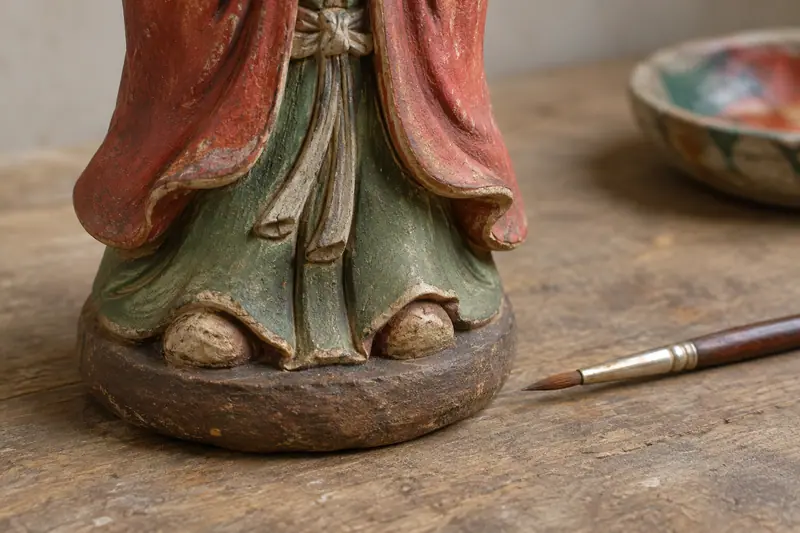
Full frame retained; proportionally resized and converted to WebP. No retouching or changes to the photographed subject. Card displays may crop the view.
Explore the region
About Wuxi Museum
The local-history theme connects with material from Qian Yu’s tomb, while Huishan clay figurines and Yixing zisha introduce two regional craft traditions. These offer a useful sequence from archaeological context to objects made for domestic, ritual and decorative use. The collection includes celebrated paintings and metalwork, but visitors should choose the current galleries without assuming that every named treasure is on display.
The museum's predecessor was founded on 25 November 1929, when the Wuxi County Bureau of Education proposed a county historical museum using sacrificial items from the Wuxi Confucian Temple (无锡孔庙); it opened on 8 June 1930 and was destroyed when Japanese forces occupied Wuxi in 1937. An excavated-relics exhibition room set up at Huishan Temple's Datong Hall (大同殿) in 1955 became the Wuxi Museum in 1958; it closed in 1966, merged with the city library in 1970, and reopened in 1975. On 15 October 2007 it merged with the former Wuxi Revolution Exhibition Hall and Wuxi Science Popularization Hall to form the present museum, opening at Taihu Square on 1 October 2008.
The museum stands south of Taihu Square and north of Zhongshu Road in Liangxi district, in a steel-framed building with two basement levels and five storeys above ground, covering a floor area of 71,000 square metres and following a design concept described as 'water light, stone colour' (水光石色). It holds National First-Grade Museum (国家一级博物馆) status, is counted among China's eight national painting collections (全国八大藏画馆), and administers five affiliated museums, including the Zhou Huaimin Painting Gallery, the Wuxi China National Industry and Commerce Museum and the Zhang Wentian Former Residence. It is currently Wuxi's largest public cultural facility, with exhibits spanning some 6,000 years.
What to look for
- Material associated with Qian Yu’s tomb gives the local-history collection a specific archaeological focus.
- Huishan clay figurines and Yixing zisha show contrasting regional craft materials.
The surrounding area
Use the city for Taihu outings and a distinct local food stop within a southern Jiangsu route.
Location & getting there
Getting to Wuxi Museum
Approach 100 Zhongshu Road on the south side of Taihu Square in Liangxi. Qingmingqiao metro station is the documented public-transport approach.
Combine your visit
A suggested sequence linking the specific features of this visit.
-
Wuxi history galleries
Begin with the development of the city and its regional setting.
-
Qian Yu tomb interpretation
Connect the historical account with a particular excavated context.
-
Clay figurine and zisha collections
Compare two distinctive regional craft traditions.
This order is editorial. Confirm access and any transfers between stops; it does not establish a walking route, same-day connection or common admission ticket.
Find Wuxi Museum
无锡博物院 · 无锡市
The pin marks the area, not the entrance.
More places nearby
Approximate straight-line distances between map pins, not travel distances.
Nanchang Street 南长街
1 km awayNanchang Street follows the old Grand Canal outside Wuxi’s former southern gate. Houses, lanes, workshops and bridges reveal the close relationship between road and water transport. The best-known landmark is Qingming Bridge…
View guide →Donglin Academy 东林书院
3 km awayDonglin Academy preserves a sequence of gates, halls and commemorative spaces in central Wuxi. Associated with the Song scholar Yang Shi and revived in the late Ming, it became a setting for scholarship and public moral…
View guide →Huishan Ancient Town 惠山古镇
5 km awayHuishan Ancient Town lies at the northeastern foot of Huishan in Wuxi. Its defining heritage is a concentration of ancestral halls built for local families over many centuries.
View guide →Sources & visit information
The sources below support the place-specific description and arrival information. Suggested combinations are editorial planning ideas; confirm current opening, entry arrangements and transport services for your date.
- Wuxi ↗
- 无锡博物院 ↗
- Chinese Wikipedia: 无锡博物院 (revision 94273398, 2026-09-10) ↗
- English Wikipedia: Wuxi Museum (revision 1302725487, 2025-07-27) ↗
Visitor information adapted and edited from Wikipedia contributors, “无锡博物院” · CC BY-SA 4.0. Source revision 94203891.
Visitor information adapted and edited from Wikivoyage contributors, listing “Wuxi Museum” · CC BY-SA 4.0.
Background paragraphs translated and condensed from Wikipedia contributors, "无锡博物院", Chinese Wikipedia · CC BY-SA 4.0. Source revision 94273398.
Background paragraphs condensed from Wikipedia contributors, "Wuxi Museum", English Wikipedia · CC BY-SA 4.0. Source revision 1302725487.