

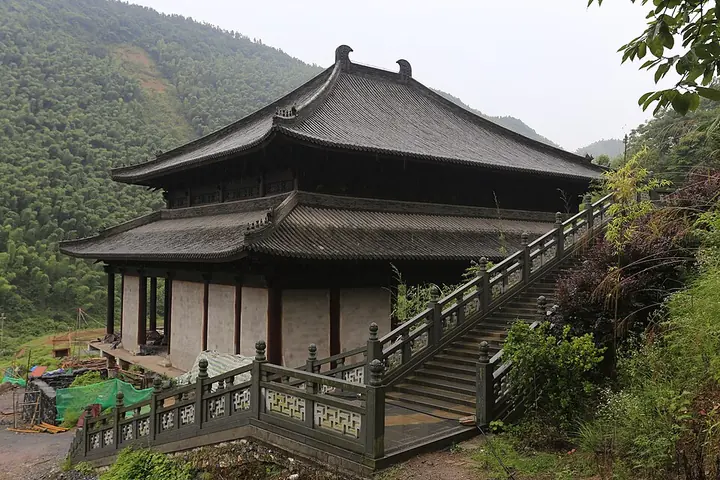
Photo adjustments
Full frame retained; proportionally resized and converted to WebP. No retouching or changes to the photographed subject. Card displays may crop the view.
Explore the region
About Mt. Yangqi
Putong Temple, also called Yangqi Temple, is the main cultural focus. Its surroundings preserve old monuments, including a Tang-period pagoda, stele and cypress, alongside springs and bamboo. A focused temple visit makes the mountain’s religious history easier to understand than treating every rock name as a separate attraction; longer forest exploration can follow the routes available on the day.
The mountain was anciently known as Lushan (漉山) and Wengling Mountain (翁陵山); according to local tradition, its current name comes from the Warring States philosopher Yang Wei (杨为), who lost his way among its many forking paths and wept. Yangqi Mountain is the ancestral court (祖庭) of the Yangqi branch of Chan Buddhism, one of the five houses and seven schools of the tradition. Guangli Chan Temple (广利禅寺) was founded here in the Tang Kaiyuan era (713) by Master Chengguang (乘广禅师), and in 1041, during the Northern Song, Master Fanghui (方会禅师) founded the Yangqi school here and renamed the temple Putong Temple (普通寺).
Yangqi Mountain is designated a national-level scenic area (国家级风景名胜区) combining natural scenery with religious and cultural sites. The Yangqi school's influence spread as far as Japan, and Japanese religious followers continue to visit the mountain today to trace the origins of their tradition.
What to look for
- Putong Temple, the historic centre associated with the Yangqi school of Chan Buddhism.
- The old pagoda, stele and cypress in the temple landscape.
Location & getting there
Getting to Mt. Yangqi
Arrange the final road journey to Yangqi Mountain’s Putong Temple area in Shangli County, north of Pingxiang. Choose the mountain temple destination explicitly: Nielong Cave belongs to the wider scenic region but has a separate approach.
Combine your visit
A suggested sequence linking the specific features of this visit.
-
Putong Temple
Start with the halls connected to the Yangqi Buddhist tradition.
-
Old monuments around the temple
Look for the pagoda, stele and cypress that preserve different layers of the site.
This order is editorial. Confirm access and any transfers between stops; it does not establish a walking route, same-day connection or common admission ticket.
Find Mt. Yangqi
杨岐山 · 萍乡市
The pin marks the area, not the entrance.
More places nearby
Approximate straight-line distances between map pins, not travel distances.
Nielong cave 孽龙洞
10 km awayNielong Cave is a stream-cut limestone cave in the Yangqi Mountain scenic region. Its passage links chambers decorated with stalagmites, curtains and flower-like mineral formations. Water is a defining part of the experience…
View guide →Pingxiang Museum 萍乡博物馆
22 km awayPingxiang Museum stands beside the Pingshui River in a purpose-built building opened in 2010. Its collections connect local archaeology with natural history: dinosaur eggs and skeletal fossils sit alongside ceramics, bronze…
View guide →Pingxiang Confucian Temple 萍乡孔庙
25 km awayPingxiang’s Confucian Temple brings the architecture of worship and scholarship into the old streets around Nanzheng Street. Its present complex preserves and restores a Qing-style arrangement, with Lingxing Gate, Dacheng Hall…
View guide →Sources & visit information
The sources below support the place-specific description and arrival information. Suggested combinations are editorial planning ideas; confirm current opening, entry arrangements and transport services for your date.
- en.wikivoyage.org ↗
- 杨岐山 ↗
- Pingxiang (Jiangxi) ↗
- Chinese Wikipedia: 杨岐山 (revision 92186653, 2026-04-06) ↗
Visitor information adapted and edited from Wikipedia contributors, “杨岐山” · CC BY-SA 4.0. Source revision 92186653.
Visitor information adapted and edited from Wikivoyage contributors, listing “Mt. Yangqi” · CC BY-SA 4.0.
Background paragraphs translated and condensed from Wikipedia contributors, "杨岐山", Chinese Wikipedia · CC BY-SA 4.0. Source revision 92186653.