

Photo adjustments
Proportionally resized and converted to WebP without cropping, retouching or changing the photographed subject.
Explore the region
About Shengjin Tower
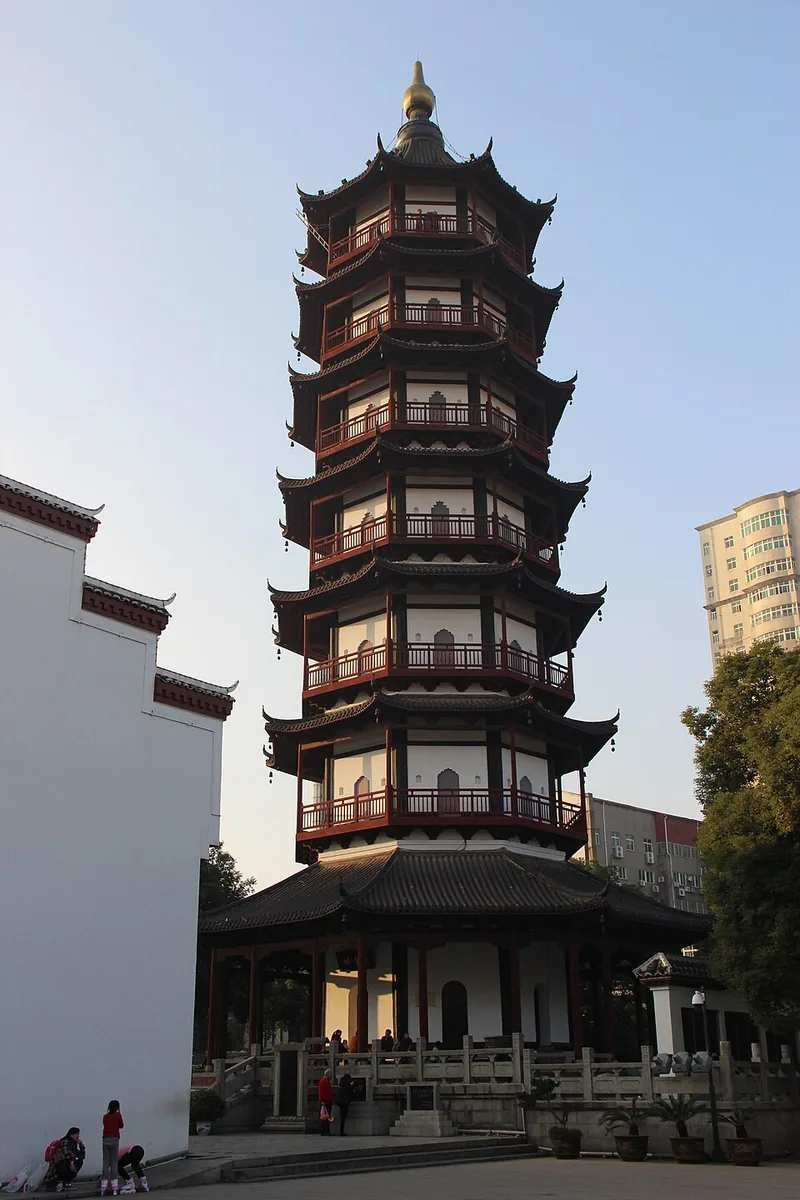
The pagoda has an octagonal plan and seven storeys.
Its foundation dates to the Tang period, while the structure was rebuilt under the Qing. The tower’s relationship to the old city boundary gives its urban setting historical meaning.
The tower was first built in the Tang dynasty's Tianyou era (天佑, 904-907). According to local tradition, monks digging the foundation found an iron chest, a gold rope wound four times, three ancient swords, a gold vase and three hundred relics, and the tower took its name from this find. It collapsed in the 48th year of the Kangxi era (康熙), was rebuilt from the 52nd year, and was completed the year after. The most recent large-scale renovation took place in 2000.
The tower stands 50.86 meters tall with a base circumference of 33.8 meters. A temple beneath it, originally called Qianfo Yuan (千佛院) and later Baifu Temple (百福寺), is also known as Taxia Temple (塔下寺) because of its position below the pagoda. It was an important Buddhist site, grouped with three other Nanchang temples as the 'Four Great Temples of Yuzhang' (豫章四大寺院). A fire-suppressing tripod (镇火鼎) cast in the 53rd year of the Qianlong era (乾隆) stands inside the tower, placed there because of the many houses once crowded around its base.
Local tradition holds that the tower could ward off fire and disaster, making it a favored geomantic pagoda in Nanchang; despite repeated damage it remains one of the city's best-preserved historic buildings. Since 2002, a temple fair (庙会) has been held there each autumn.
What to look for
- The octagonal pagoda has seven storeys.
- Its Tang foundation and Qing rebuilding connect the structure with successive periods of Nanchang history.
The surrounding area
Provincial city base for noodle breakfasts, Tengwang Pavilion and Gan River scenery.
Location & getting there
Getting to Shengjin Tower
Approach via Shengjinta Street in Nanchang’s Xihu district; the tower stands east of the street, outside the former Jinxian Gate area.
- Confirm the visitor entrance and access to the named areas before departure.
Combine your visit
A suggested sequence through the named features described in the source.
-
Tower exterior
Examine Tower exterior as a separate part of Shengjin Tower.
-
Former city-gate setting
Examine Former city-gate setting as a separate part of Shengjin Tower.
The order is an editorial suggestion. Internal opening arrangements and transfers between sectors need checking; no walking duration or access entitlement is implied.
Find Shengjin Tower
绳金塔 · 南昌市
The pin marks the area, not the entrance.
More places nearby
Approximate straight-line distances between map pins, not travel distances.
Tengwang Pavilion 滕王阁
3 km awayTengwang Pavilion overlooks the Gan River from a high platform in Nanchang. Its fame comes from Wang Bo’s Tang-period preface, but the building seen today was completed in 1989, with modern construction dressed in Song-style…
View guide →The Star of Nanchang 南昌之星摩天轮
5 km awayThe Star of Nanchang lifts visitors above the west bank of the Gan River in enclosed cabins. The wheel’s steel circle and changing LED patterns form a landmark on the Honggutan waterfront, while the ride opens views across the…
View guide →Jiangxi Provincial Museum 江西省博物馆
5 km awayJiangxi Provincial Museum’s collections reveal a province with striking Bronze Age metalwork and a long ceramic tradition. The crouching bronze tiger with two tails and a small bird on its back is a memorable example from…
View guide →Sources & visit information
The linked encyclopedia sources support background and place descriptions. Current opening hours, ticket prices, booking rules and transport schedules have not been independently verified for this guide. Confirm them with the venue or operator before travelling.
Visitor information adapted and edited from Wikipedia contributors, “繩金塔” · CC BY-SA 4.0. Source revision 92175131.
Background paragraphs translated and condensed from Wikipedia contributors, "繩金塔", Chinese Wikipedia · CC BY-SA 4.0. Source revision 92175131.