

Photo adjustments
EXIF orientation normalized; resized without changing aspect ratio; converted to WebP. No subject edits.
Explore the region
About Dong Mansion
High outer walls enclose a series of residential courtyards whose brick and timber details reward close observation. Animal, plant and auspicious motifs decorate the entrances and structural elements. The scale expresses the owner’s status, but the spaces remain those of a residential compound rather than an imperial palace.
Dong Fuxiang served as a vanguard under Zuo Zongtang during the Tongzhi-era Hui uprising and captured Jinjibao (金积堡). He was dismissed and sent back to his hometown of Guyuan in 1901. Construction of Dong Mansion began in 1902 on a filled pond in Jinjibao, its foundation packed with a layer of coal, and was completed in 1905; timber was shipped down the Yellow River from southern Gansu and stone brought from Shaanxi. Because Dong held the rank of Junior Guardian of the Crown Prince (太子少保), the mansion became popularly known as 'Gongbao Mansion' (宫保府).
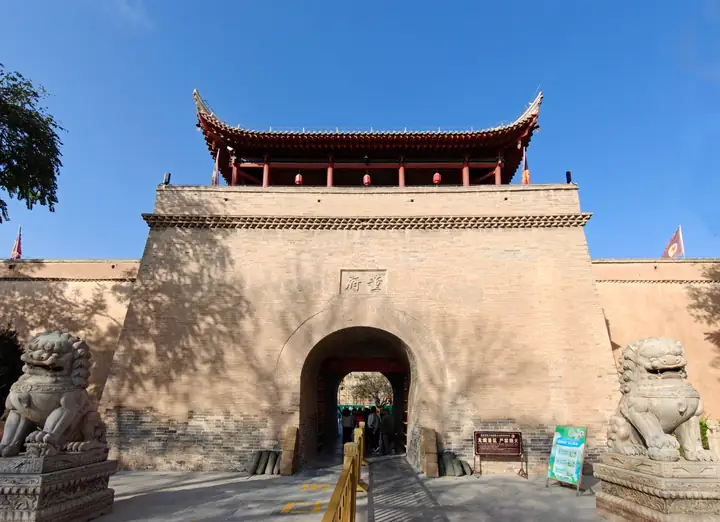
The surviving complex covers 11,025 square metres, down from an original 34,650 square metres that also included an outer wall and moat, both later destroyed. The rectangular mansion wall, built of rammed loess except for its brick-faced gate, encloses an east-facing gatehouse and corner platforms. Inside, the main building forms three successive courtyards, each split into front and back sections, totalling 106 rooms in brick and timber; only the middle courtyard, where Dong Fuxiang lived, rises to two storeys under a glazed-tile roof. The mansion was listed as a Major Historical and Cultural Site Protected at the National Level (全国重点文物保护单位) in 2006.
What to look for
- Successive courtyards reveal the arrangement of a large Qing-period residence.
- Carved brick and timber details carry plant, animal and auspicious motifs.
Location & getting there
Getting to Dong Mansion
Use Dong Mansion near Jinji town in Wuzhong’s Litong District. Confirm the visitor entrance and current access to the courtyard groups before making the road trip from central Wuzhong.
Combine your visit
Choose from these complementary stops when planning your visit.
-
Outer gate董府外门
Notice the contrast between the enclosure and its decorated entrance.
-
Open courtyard groups开放院落
Follow the permitted sequence through the residence.
-
Carved architectural details砖木雕刻
Finish by examining the doorways and eaves.
This is a suggested combination, not a timed route; confirm the opening and transport arrangements for your date.
Find Dong Mansion
董府 · 吴忠
The pin marks the area, not the entrance.
More places nearby
Approximate straight-line distances between map pins, not travel distances.
Qingtongxia 青铜峡
9 km awayQingtongxia is closely tied to the Yellow River, its gorge and the irrigation landscape of Ningxia. The 108 Pagodas give the riverside a distinctive historic landmark, while the Grand Canyon visitor area offers a broader view of…
View guide →Yellow River Tower 黄河楼
10 km awayYellow River Tower is a modern cultural landmark in Qingtongxia, designed with traditional-looking layered roofs and a monumental approach. Its exhibitions interpret the Yellow River through national and Ningxia history, while…
View guide →108 Pagodas 一百零八塔
10 km awayThe 108 Pagodas form a triangular arrangement on stepped terraces above the Yellow River at Qingtongxia. Their repeated white forms are the main distant impression, but the towers have several different shapes. Western Xia…
View guide →Sources & visit information
The linked encyclopedia sources support background and place descriptions. Current opening hours, ticket prices, booking rules and transport schedules have not been independently verified for this guide. Confirm them with the venue or operator before travelling.
- 董府 — Wikipedia geographic and historical reference ↗
- Chinese Wikipedia: 董府 (revision 91790079, 2026-03-06) ↗
Geographic and historical facts selectively adapted from Wikipedia contributors, 董府 · CC BY-SA 4.0. Source revision 91790079.
Background paragraphs translated and condensed from Wikipedia contributors, "董府", Chinese Wikipedia · CC BY-SA 4.0. Source revision 91790079.