

Photo adjustments
Wikimedia thumbnail; fitted to the ranking-card frame.
Explore the region
About Xixia Imperial Tombs
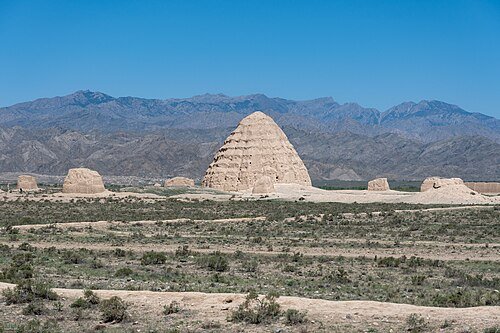
Their surviving rammed-earth cores were once parts of more elaborate buildings. Walled enclosures and the position of the mounds reveal a planned funerary landscape, with Buddhist and Chinese architectural influences. The site entered UNESCO’s World Heritage List in 2025. Begin with the museum so the low ruins are easier to interpret outdoors.
Western Xia's founder Li Yuanhao (李元昊) founded the dynasty in 1038 and reburied his grandfather and father at the eastern foot of the Helan Mountains, in the tombs Yuling (裕陵) and Jialing (嘉陵). Mongol forces destroyed Western Xia in 1227 and severely damaged the tombs; some were later looted without success. The site appeared in 1938 aerial photographs taken by a German pilot, Wulf-Dieter Graf zu Castell.
A full excavation ordered by the State Administration of Cultural Heritage (中国国家文物事业管理局) began in 1972. By 2014 tomb No.7's occupant had been identified as the Western Xia emperor Renzong, Li Renxiao (李仁孝); mausoleum No.3 was attributed to the dynasty's founder and combines mausoleum and temple styles with Buddhist features. The site was listed as a Major Historical and Cultural Site Protected at the National Level (全国重点文物保护单位) in 1988, and its museum was relocated outside the protected area in 2019.
The tombs lie 30 kilometres west of Yinchuan on an alluvial fan at the eastern foot of the Helan Mountains, at 1,150 to 1,220 metres, across 50 square kilometres of gravel-and-sand ground that helped preserve them through several major earthquakes. Nine imperial tombs, some on the plain, others against the mountain, face south and cover over 100,000 square metres, with rammed-earth mounds up to 30 metres across once coated in brick with tiled eaves.
What to look for
- Rammed-earth tomb cores survive within planned walled enclosures.
- The Helan foothill setting remains integral to the cemetery landscape.
Location & getting there
Getting to Xixia Imperial Tombs
Travel west from Yinchuan to the Xixia Imperial Tombs visitor centre. Use the current museum and sightseeing-transport arrangements; the individual tomb map points are protected archaeological locations, not separate drive-up entrances.
Combine your visit
Choose from these complementary stops when planning your visit.
-
Western Xia Museum西夏博物馆
Learn about Tangut history before viewing the ruins.
-
Open mausoleum route开放陵区路线
Follow the visitor route through the funerary layout.
-
Helan foothill view贺兰山麓景观
Observe the relationship between the tombs and mountains.
This is a suggested combination, not a timed route; confirm the opening and transport arrangements for your date.

Find Xixia Imperial Tombs
西夏陵 · 银川
The pin marks the area, not the entrance.
More places nearby
Approximate straight-line distances between map pins, not travel distances.
Western Xia Museum 西夏博物馆
2 km awayThe Western Xia Museum introduces the Tangut state through objects recovered from its monuments and settlements. Architectural tiles, ceramics, coins and religious sculptures help reconstruct a culture whose writing and material…
View guide →Zhenbeibu Western Film Studio 镇北堡西部影城
21 km awayZhenbeibu Western Film Studio uses the rough earth walls and frontier-town setting of Zhenbeibu as a backdrop for cinema. Films including Red Sorghum and A Chinese Odyssey were shot here. The appeal lies in recognising sets…
View guide →Ningxia Science and Technology Museum 宁夏科技馆
21 km awayNingxia Science and Technology Museum offers hands-on exhibits in Yinchuan’s People’s Square museum area. Its programme connects general science with regional themes such as soil conservation and desertification, making the…
View guide →Sources & visit information
The sources below support the place-specific description and arrival information. Suggested combinations are editorial planning ideas; confirm current opening, entry arrangements and transport services for your date.
- UNESCO: Xixia Imperial Tombs World Heritage listing ↗
- Western Xia mausoleums — Wikipedia geographic and historical reference ↗
- Chinese Wikipedia: 西夏陵 (revision 92706891, 2026-05-18) ↗
- English Wikipedia: Western Xia mausoleums (revision 1366157511, 2026-07-26) ↗
Geographic and historical facts selectively adapted from Wikipedia contributors, Western Xia mausoleums · CC BY-SA 4.0. Source revision 1366157511.
Background paragraphs translated and condensed from Wikipedia contributors, "西夏陵", Chinese Wikipedia · CC BY-SA 4.0. Source revision 92706891.
Background paragraphs condensed from Wikipedia contributors, "Western Xia mausoleums", English Wikipedia · CC BY-SA 4.0. Source revision 1366157511.