

Photo adjustments
EXIF orientation normalized; resized without changing aspect ratio; converted to WebP. No subject edits.
Explore the region
About Ga'er Monastery
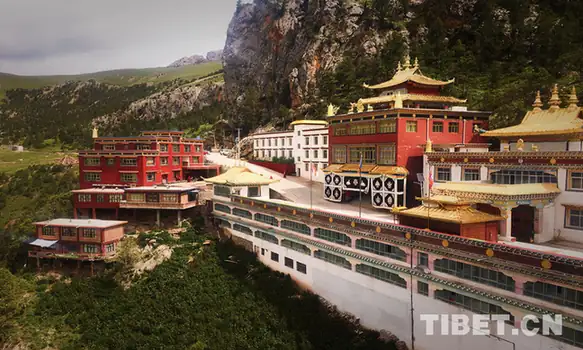
Both features on the Nangqên County government site, drawn from the same 青海在线网 author, describe the temple as set into the cliff face and give it a history of nearly 1,000 years. They record a tradition that Padmasambhava practised there, in a period the page dates to the 700s CE, and they name the temple's treasure as a prayer wheel said to have been part of Princess Wencheng's dowry and left behind on her journey to marry Songtsen Gampo — turned day and night by two monks at a time in the upper temple. The same two pages disagree on that treasure, one calling it a single wheel and the other a pair. For the temple's foundation they agree: created around 1200 by the monk 噶尔当巴秋登 on the instruction of 觉哇久丁桑贡, founder of the Drigung Kagyu school, and later divided into an upper temple for monks under strict discipline and a lower temple for lay devotees. The county pages list three halls inside — 胜乐佛殿, 金刚心佛殿 and 空行佛殿 — with more than 1,000 small statues of 久丁桑贡, and one of them adds that the 噶尔活佛 is abbot within the temple's four reincarnation systems. The China News Service caption dates the building to the 12th century, which agrees with the county pages, and describes its red-and-white halls fused with the surrounding rock.
The county pages describe the temple's surroundings as peaks on every side with dense green woodland sheltering rare birds and animals, and report that bharal and macaques move freely in and out of the temple grounds. One of them identifies the bharal, also called 崖羊, 石羊 or 青羊, as a Class II nationally protected high-mountain animal and says a group of them lives around the temple; it notes a pond near the temple about 8,000 sq m in area and about 30 m deep, clear enough to reflect the woodland, with migratory birds on its shores. The same page reports that a 2017 international nature-observation festival inside the 尕尔寺大峡谷 recorded 15 mammal species, 93 bird species and 222 plant species over four days, among them 藏鹀, 棕草鹛, 黄喉雉鹑, 斑尾榛鸡 and 梭砂贝母. It calls the temple an important one on the Tang–Tubo Ancient Road and describes the approach from the county town as crossing high mountains, grassland and a salt field before entering the gorge and old-growth forest.
The two figures for height do not match. Both county pages put the temple at about 3,700 m; the China News Service caption, published in August 2025 alongside a drone photograph, puts it on the cliff at nearly 4,000 m. The pages describe the temple as an active place of worship and give no opening hours, no ticket arrangement and no boundary for visitors, and the catalogue note that the open range of halls and courtyards has to be confirmed one by one is left standing. The 76 km figure is measured from 香达镇, the county seat, and is not a road distance to a signed entrance.
What to look for
- The cliff-side temple itself, which the county pages describe as set into the rock face, with its red-and-white halls fused with jagged rock in the China News Service aerial photograph
- The three halls the county pages name — 胜乐佛殿, 金刚心佛殿 and 空行佛殿 — and the more than 1,000 small statues of 久丁桑贡 they list inside
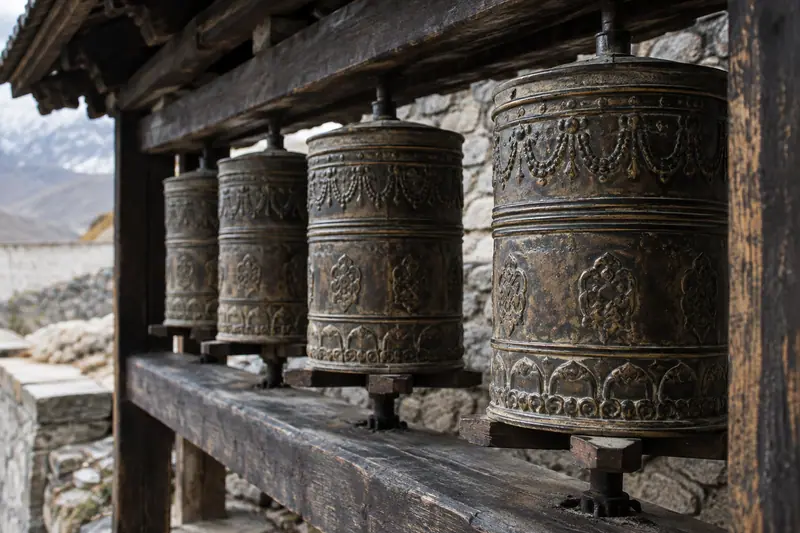
- The prayer wheel the county pages call the temple's treasure and link by tradition to Princess Wencheng's dowry
- The bharal (岩羊) and Tibetan macaques that the county pages say move freely in and out of the temple grounds, and the birds and plants recorded in the gorge in 2017
- The pond beside the temple, about 8,000 sq m and about 30 m deep, which one county page describes as clear and reflecting the woodland
Location & getting there
Getting to Ga'er Monastery
Check which interiors and courtyards are accessible. Active places of worship and protected monuments may have different visitor rules.
- Search for 尕尔寺 with 玉树藏族自治州 and 囊谦县.
Find Ga'er Monastery
尕尔寺 · 囊谦县
No reliable map pin yet: search by the Chinese name.
Sources & visit information
The linked sources support the identity and background described in this introduction. Opening hours, admission, activity availability and exact arrival arrangements have not been comprehensively checked. Confirm current visitor information with the venue; the original catalogue locality and editorial review flag are retained.