

Photo adjustments
Full frame retained; proportionally resized and converted to WebP. No retouching or changes to the photographed subject. Card displays may crop the view.
City & district guides
About Linzi
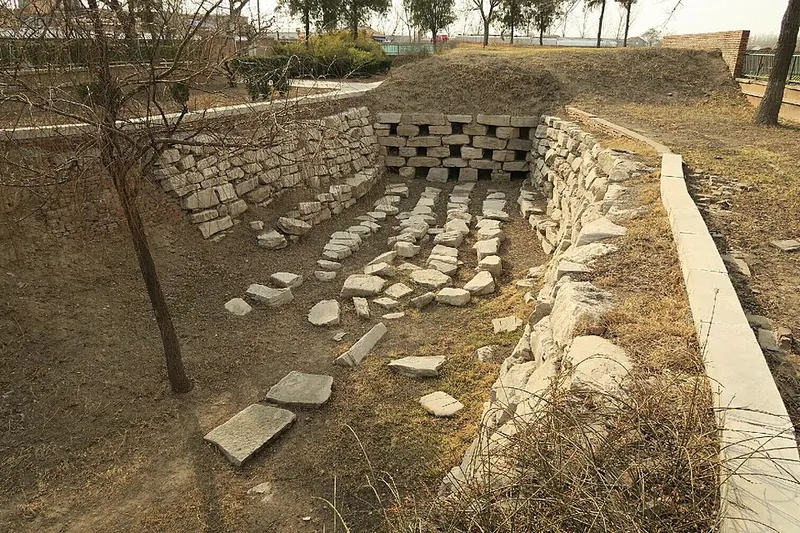
Its plan combined a larger city with a smaller palace enclosure, and the raised platform called Huangongtai still marks part of that royal centre. Excavated drainage works and the famous horse-sacrifice pits reveal the city’s engineering and elite rituals. Expect separated remains and protected archaeological areas, rather than a complete walled town with continuous streets to explore.
The walled city divided into a larger city and a smaller city, together covering fifteen square kilometers and pierced by eleven gates, with a moat built outside; the smaller city, which lay southwest of the larger city and served as the palace precinct, held three streets, and numerous further rammed-earth remains survive nearby. The Huangongtai platform (桓公台) is oval, measuring about 86 by 70 meters at its base and standing 14 meters high.
The larger, outer city served as the residential and production quarter, where seven streets and six workshop sites have been identified. Two tombs from the Spring and Autumn period survive within the larger city, and a burial ground in its northeast has identified twenty large and medium tombs, one of which has been excavated. The ruins of ancient Linzi were excavated in 1926 by Japanese archaeologists and again in 1964 by Chinese archaeologists.
What to look for
- Huangongtai, the surviving rammed-earth platform in the former palace area.
- The archaeological evidence for city walls, drainage and sacrificial-horse pits.
Location & getting there
Getting to Linzi
Arrange the final road journey to Qidu Town in Linzi District. Huangongtai lies southeast of Changhu Village; for the wider archaeological park use its signed Guhou Road approach. Check which protected remains are open, as the archaeological area and the modern Qi Culture Museum are separate places.
Combine your visit
A suggested sequence linking the specific features of this visit.
-
Huangongtai platform
Read the scale of the palace area through its surviving earthwork.
-
City-wall and drainage interpretation areas
Continue with the capital’s defensive and water-management systems where visitor access is provided.
This order is editorial. Confirm access and any transfers between stops; it does not establish a walking route, same-day connection or common admission ticket.

Find Linzi
齐国故城 · 淄博市
The pin marks the area, not the entrance.
More places nearby
Approximate straight-line distances between map pins, not travel distances.
Qingzhou Museum青州博物馆
26 km awayQingzhou Museum’s collection is especially rewarding for Buddhist sculpture and the material record of scholarly life. Figures recovered from the Longxing Temple hoard preserve delicate carving and traces of gilding and colour…
View guide →Qingzhou Ancient City青州古城
27 km awayQingzhou’s old-town visitor area centres on the streets of the former Nanyang city. Dongmen Street provides a lively commercial approach, while Ouyuan introduces a more intimate garden landscape of rockwork, unusual stones and…
View guide →China Ceramics and Glazed Glass Museum淄博陶瓷琉璃博物馆
33 km awayZibo Ceramics and Glass Museum follows two crafts closely associated with the city: pottery and porcelain, and liuli glass. Its ceramics range from early archaeological material to industrial and artistic production. The celadon…
View guide →Sources & visit information
The sources below support the place-specific description and arrival information. Suggested combinations are editorial planning ideas; confirm current opening, entry arrangements and transport services for your date.
- zh.wikipedia.org ↗
- wh.zibo.gov.cn ↗
- wh.zibo.gov.cn ↗
- www.amap.com ↗
- Ancient Linzi ↗
- Chinese Wikipedia: 临淄齐国故城 (revision 86786665, 2025-04-11) ↗
- English Wikipedia: Ancient Linzi (revision 1349746201, 2026-04-18) ↗
Visitor information adapted and edited from Wikipedia contributors, “Ancient Linzi” · CC BY-SA 4.0. Source revision 1349746201.
Background paragraphs translated and condensed from Wikipedia contributors, "临淄齐国故城", Chinese Wikipedia · CC BY-SA 4.0. Source revision 86786665.
Background paragraphs condensed from Wikipedia contributors, "Ancient Linzi", English Wikipedia · CC BY-SA 4.0. Source revision 1349746201.