

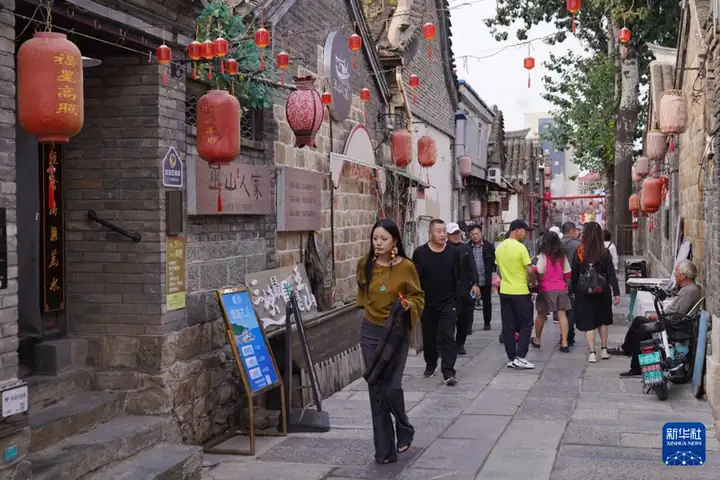
Photo adjustments
EXIF orientation normalized; resized without changing aspect ratio; converted to WebP. No subject edits.
Explore the region
About Suochengli Historic District
Yantai's municipal government dates the garrison to the thirty-first year of the Hongwu reign, 1398, when the Ming founder Zhu Yuanzhang established the Qishan Guard Battalion at the southern foot of Qishan against coastal raiders, with the walled garrison town following. In the twelfth year of the Shunzhi reign, 1655, the Qing abolished the guard system and the place passed into civilian hands as Qishan She of Fushan county. The quarter is described as the earliest origin of the city of Yantai and one of the best-preserved Ming and Qing garrison towns in China, with more than two hundred heritage courtyards. It covers 173 mu with a planned building area of 65,000 square metres, of which 240 courtyards have been kept and repaired.
Restoration has followed a 'repair as old' and minimal-intervention approach carried out through small-scale works. More than thirty thousand old city bricks were used on the restored wall, and the roughly three-hundred-metre western wall has been turned into a landscape belt with twelve interpretive points. The quarter's declared themes are the origin of Yantai, the history of coastal defence against pirate raids, and Jiaodong folk culture. In 2025 the Ministry of Housing and Urban-Rural Development placed the Qishan Garrison historic quarter on its second national list of replicable practice in the protection and use of historic districts, and the quarter is also rated a national night-time cultural tourism consumption cluster and a national tourism leisure block.
What to look for
- The Xuanhua Gate, the entrance through which visitors walk into the old garrison town
- The Qishan Garrison History and Culture Exhibition Hall in courtyard No. 9 of Ximenli South Lane, a typical Jiaodong courtyard house, with sections on history, folk custom and dialect
- Shiyan Street inside the west gate, twelve courtyards over some 1,500 square metres given to seventeen intangible heritage crafts such as Yantai paper-cutting, wool embroidery, Laizhou writing brushes and gourd carving
- The restored western wall, about three hundred metres long, laid out as a landscape belt of twelve story points
- The Jiaodong intangible heritage centre, which combines exhibition rooms, working workshops and teaching space in reused traditional courtyards
Location & getting there
Getting to Suochengli Historic District
Identify the main visitor approach and any separately managed houses, museums or performances. Ask before entering residential spaces or photographing residents.
- Search for 所城里 with 烟台市 and 芝罘区.

Find Suochengli Historic District
所城里 · 芝罘区
No reliable map pin yet: search by the Chinese name.
Sources & visit information
The linked sources support the identity and background described in this introduction. Opening hours, admission, activity availability and exact arrival arrangements have not been comprehensively checked. Confirm current visitor information with the venue; the original catalogue locality and editorial review flag are retained.