


Explore the region
About Wufeng Mountain
The five peaks are named, from west to east, Yingxian (also called Juxian), Wangxian, Huixian, Zhixian and Qunxian. The historic buildings stand on the sunny southern foot below them, facing south and stepping up the slope, and include the Dongzhen Abbey, the Qingdi Palace, the Chaoyang Caves, the Lingguan Hall, the Ying'en Pavilion and the remains of a travelling palace of the Ming Prince of De. The abbeys are traditionally divided into a southern and a northern one: the southern, also called Xuandu Guan, served as the Prince of De's incense hall, while the northern is the Dongzhen Abbey. The hill lies about 22 kilometres from the built-up area of Jinan and has long been grouped with Mount Tai and Lingyan as one of the three outstanding sites of central Shandong.
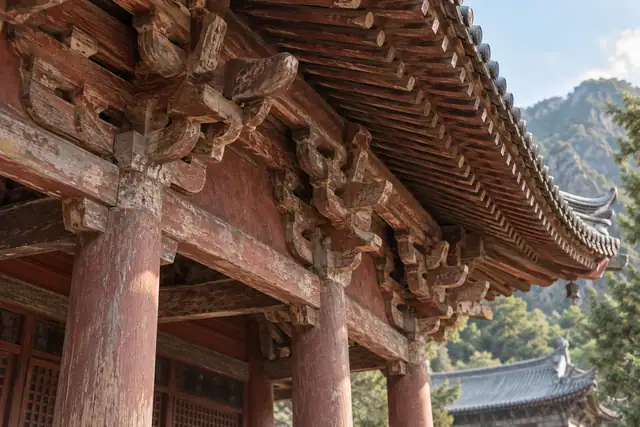
Dongzhen Abbey, also known as Shenxu Gong or simply the North Abbey, was founded in the Tai'he era of the Jin dynasty, between 1201 and 1208, by the Quanzhen Daoists Qiu Zhiyuan and Fan Zhiming. The Yuan court granted it the title Huguo Shenxu Gong, and the Ming Wanli emperor renamed it Baoguo Longshou Gong, had the 480 cases of the complete Daoist Canon issued and carved here, and built a Nine-Lotus Bodhisattva hall and a stone archway in honour of his mother. What still stands includes the spirit screen, a timber archway, the Jade Emperor Hall with its east and west side halls, the Bixia Palace, the Longshou Gong stone archway and the ruins of the Sanyuan Hall; the spirit screen and the timber archway are Yuan-dynasty survivals. On 7 December 2006 the Shandong provincial government listed the Wufeng Shan Dongzhen Abbey in its third group of provincial cultural heritage protection units.
What to look for
- The five named peaks in their west-to-east row: Yingxian, Wangxian, Huixian, Zhixian and Qunxian
- The Yuan-dynasty spirit screen and timber archway at Dongzhen Abbey, the oldest structures still standing there
- The eulogy stele carrying the portrait of the Daoist master Cui, 3.2 metres high, set in the Wolong Pool east of the Xianting Bridge, one of several dozen steles of Jin to Qing date kept in the abbey
- The Ming-dynasty Qingdi Palace west of the Chaoyang Caves on Yingxian Peak, a three-courtyard compound of more than 6,000 square metres reached by 189 steps
- The Longshou Gong stone archway and the Bixia Palace, survivals of the Wanli court's patronage of the abbey
Location & getting there
Getting to Wufeng Mountain
Check which interiors and courtyards are accessible. Active places of worship and protected monuments may have different visitor rules.
- Search for 五峰山 with 济南市 and 长清区.
Find Wufeng Mountain
五峰山 · 长清区
No reliable map pin yet: search by the Chinese name.
Sources & visit information
The linked sources support the identity and background described in this introduction. Opening hours, admission, activity availability and exact arrival arrangements have not been comprehensively checked. Confirm current visitor information with the venue; the original catalogue locality and editorial review flag are retained.