

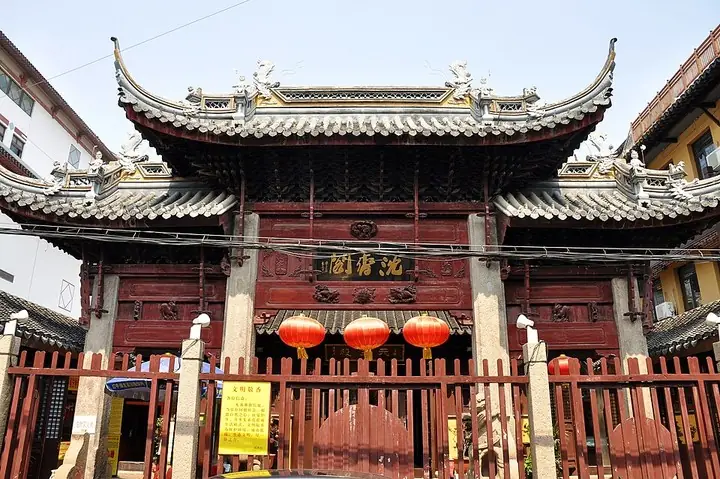
Photo adjustments
The exact downloaded source bytes are separately retained and hashed. Prepared JPEG is proportionally reduced to a maximum 720-pixel long edge; full frame retained, no subject alteration. Final website rendition: full frame retained, proportionally resized to at most 720 pixels and converted to WebP. No additional retouching or subject alteration. Card displays may crop the view.
Explore the region
About Chenxiang Ge Temple
Its quiet religious role contrasts with the nearby commercial streets around Yuyuan.
A carved wooden devotional figure on an upper floor is a distinctive feature identified in the travel source. The meaningful focus is the relationship between the temple’s worship spaces and this sculpture, rather than treating the precinct as a generic photo stop. Confirm whether the relevant hall is accessible and avoid areas reserved for residents or religious practice.
The temple originated in 1600, when the official Pan Yunduan (潘允端) recovered an agarwood statue of Guanyin from a sunken ship while overseeing Huai River works, and built a pavilion above a gate tower on his own property to house it. The original structure collapsed at the end of the Ming dynasty; it was rebuilt at its present site in 1801, and by the Tongzhi era had grown into a monastery renamed Ciyun Chan Temple (慈云禅院).
During the Cultural Revolution its statues, including the original Guanyin, were destroyed and the building was taken over as a factory. Religious activity resumed in 1983, when the State Council designated it a National Key Buddhist Temple in Han Chinese Areas, and full restoration, including a new agarwood Guanyin statue, was completed by 1994. In 1996 the temple was listed among China's Major National Historical and Cultural Sites, grouped with Yu Garden.
The temple faces south across three courtyards behind a stone gateway: the first holds the Heavenly Kings Hall with bell and drum towers, the second the Mahavira Hall, and the last the Ciyun Hall, above which the Chenxiang Guanyin Pavilion houses a jade-crowned agarwood-wood Guanyin carving seated with hands folded on its knees.
What to look for
- The Buddhist nunnery maintains a religious presence within the old-city neighbourhood.
- An upper-floor devotional statue is carved from rare wood.
Location & getting there
Getting to Chenxiang Ge Temple
Approach 338 Fuyou Road and check the temple’s visitor access before seeking the upper-floor hall.
Combine your visit
A suggested sequence linking the specific features of this visit.
-
Temple entrance and accessible courtyard
Begin with the religious precinct and its old-city setting.
-
Wooden devotional figure, if the hall is open
See the specifically documented carved statue without assuming access to every floor.
-
Fuyou Road Mosque福佑路清真寺
Compare another religious tradition on the same old-city road.
This order is editorial. Confirm access and any transfers between stops; it does not establish a walking route, same-day connection or common admission ticket.
Find Chenxiang Ge Temple
沉香阁 · 黄浦区
The pin marks the area, not the entrance.
More places nearby
Approximate straight-line distances between map pins, not travel distances.
Yuyuan Garden 豫园
Less than 1 km awayYuyuan Garden began as a Ming-period private garden created by Pan Yunduan for his father. It occupies a compact but intricate sequence of halls, rockeries, ponds and corridors beside Shanghai’s City God Temple.
View guide →City God Temple 上海城隍庙
Less than 1 km awayShanghai’s City God Temple is a Taoist religious precinct beside Yuyuan Garden. Its history connects the worship of local protective deities with the growth of the old city.
View guide →Fuyou Road Mosque 福佑路清真寺
Less than 1 km awayFuyou Road Mosque developed from a Muslim community that raised funds for a permanent prayer place in 1870. The building combines a traditional Qing-style exterior and interior arrangement with Islamic religious functions.
View guide →Sources & visit information
The sources below support the place-specific description and arrival information. Suggested combinations are editorial planning ideas; confirm current opening, entry arrangements and transport services for your date.
- en.wikivoyage.org ↗
- Shanghai/Old City ↗
- Chinese Wikipedia: 沉香阁 (revision 85315961, 2024-12-15) ↗
- English Wikipedia: Chenxiang Pavilion (revision 1371670946, 2026-08-27) ↗
Visitor information adapted and edited from Wikivoyage contributors, listing “Chenxiang Ge Temple” · CC BY-SA 4.0.
Background paragraphs translated and condensed from Wikipedia contributors, "沉香阁", Chinese Wikipedia · CC BY-SA 4.0. Source revision 85315961.
Background paragraphs condensed from Wikipedia contributors, "Chenxiang Pavilion", English Wikipedia · CC BY-SA 4.0. Source revision 1371670946.