


Photo adjustments
Proportionally resized and converted to WebP without cropping, retouching or changing the photographed subject.
City & district guides
About Qiqushan Temple
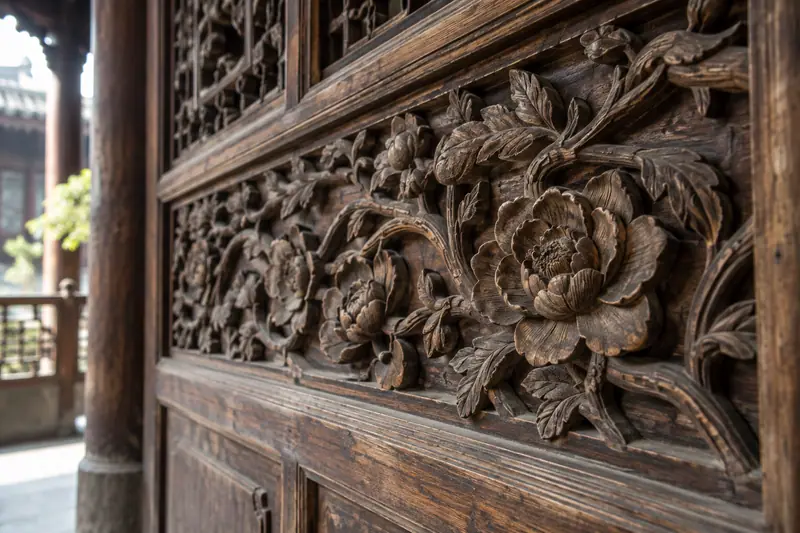
Its halls step with the hillside instead of following a single rigid axis, creating changing views of tiled roofs, raised corners and carved timberwork. The complex is associated with Wenchang worship, and the surrounding ancient cypresses connect it with the tree-lined Shu Road landscape. Look at the relationship between buildings and slope before moving closer to the architectural details.
The temple was first built in the Jin dynasty as a shrine to Zhang Yazi (张亚子), known as Yazi Ci (亚子祠). After Zhang Yazi was canonized as Wenchang Dijun (文昌帝君) in the early Yuan dynasty, the shrine was rebuilt as Wenchang Gong (文昌宫), and most of the surviving buildings date from the Yuan, Ming and Qing dynasties. The complex was listed among Sichuan's re-confirmed first-batch provincial cultural relic protection units on 7 July 1980, and it was announced as a fourth-batch Major Historical and Cultural Site Protected at the National Level (全国重点文物保护单位) on 20 November 1996.
Beside the temple stand more than 20,000 ancient cypress trees, described as the largest area of cypress forest in China. Buildings from the Yuan dynasty include Pantuoshi Hall (盘陀石殿); Ming-dynasty structures include Jiaqing Hall (家庆堂), Tianzun Hall (天尊殿) and Guixiang Hall (桂香殿); Qing-dynasty additions include the Main Hall (正殿) and Baichi Tower (百尺楼). The complex includes palace-style buildings in its northern part and smaller, garden-style buildings in the south, with staggered, layered pavilions and carved roof beams.
What to look for
- The staggered halls and pavilions follow the contours of the ridge.
- Carved beams and roof corners can be compared across the temple buildings.
- Old cypress trees surround the temple and continue the Shu Road landscape.
Location & getting there
Getting to Qiqushan Temple
Use Qiqushan Scenic Area on Cuiyunlang Road, north of Zitong town, as the road arrival point. The temple is on the mountain above the county town; arrange the final transfer to the scenic-area entrance.
Combine your visit
Suggested order for the visit:
-
Temple approach
Read the hillside arrangement of the roofs.
-
Main halls
Examine the carved timber and temple spaces.
-
Cypress-lined paths
Finish with the trees around the complex.
This is an editorial sequence of named spaces or places. It does not imply a verified walking connection or promise opening, ticket availability or a journey time.
Find Qiqushan Temple
七曲山大庙 · 绵阳
The pin marks the area, not the entrance.
More places nearby
Approximate straight-line distances between map pins, not travel distances.
Jiangyou Li Bai Memorial李白纪念馆
45 km awayJiangyou’s Li Bai Memorial is a garden museum beside the Changming River, with halls built in a Tang-inspired architectural style. The displays move from the poet’s life to the written and painted works created around his…
View guide →Shengzhong Lake升钟湖
55 km awayShengzhong Lake is a reservoir landscape with wooded slopes and an indented shoreline. The most useful first visit concentrates on the dam-side visitor area, where the lake’s water-management role remains visible. Hailuo Square…
View guide →Jianmen Pass剑门关
67 km awayJianmen Pass occupies a narrow break in the steep cliffs of Dajian Mountain. The landscape explains its defensive role on the old Shu Roads more clearly than a timeline alone: the rock walls form the gateway, with the built gate…
View guide →Sources & visit information
The sources below support the place-specific description and arrival information. Suggested combinations are editorial planning ideas; confirm current opening, entry arrangements and transport services for your date.
- Qiqushan Temple ↗
- Qiqushan Scenic Area: official website ↗
- Chinese Wikipedia: 七曲山大庙 (revision 86588216, 2025-03-27) ↗
- English Wikipedia: Qiqushan Temple (revision 1366854296, 2026-07-30) ↗
Visitor information adapted and edited from Wikipedia contributors, “Qiqushan Temple” · CC BY-SA 4.0. Source revision 1366854296.
Background paragraphs translated and condensed from Wikipedia contributors, "七曲山大庙", Chinese Wikipedia · CC BY-SA 4.0. Source revision 86588216.
Background paragraphs condensed from Wikipedia contributors, "Qiqushan Temple", English Wikipedia · CC BY-SA 4.0. Source revision 1366854296.