

Entry & permits for Tibet (Xizang)
Foreign tourists need Tibet entry approval, commonly called a Tibet Travel Permit, and an organised visit arranged through a specialist travel agency in China. Confirm your approved route before booking transport. Requirements differ for Taiwan residents and for travellers using mainland or Hong Kong/Macao Chinese resident documents; check the document guide before you book.
Check the travel-document requirements →Policy scope verified: 2026-09-06. UK FCDO: China regional travel advice ↗ State Council Taiwan Affairs Office: Tibet entry approval ↗ Xizang Department of Culture and Tourism: Medog border permit notice ↗
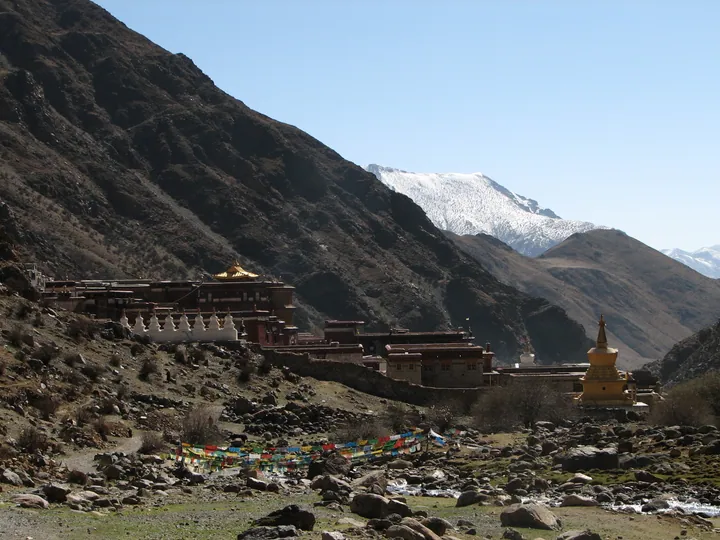
Photo adjustments
Full frame retained; proportionally resized and converted to WebP. No retouching or changes to the photographed subject. Card displays may crop the view.
Explore the region
About Tsurphu Monastery
Tsurphu Monastery (楚布寺) is the main monastery of the Karma Kagyu (噶玛噶举派) school of Tibetan Buddhism and the traditional seat of the Karmapa lamas. It lies in Gurum (古荣), Doilungdêqên District (堆龙德庆区), about 70 km west of Lhasa, on the upper Chubu River (楚布河).
The buildings stand mid-valley and face south, hemmed in by high mountains, about 28 km up the Dowo Lung valley on the north side of the river. English Wikipedia puts the altitude at about 4,300 m; Xinhua gives about 4,600 m. The main building's original walls were up to 4 m thick, and the monks' quarters lay to the east.
Düsum Khyenpa (杜松虔巴, 1110-1193), the first Karmapa, made offerings to the local protector deities here in 1159 and came back in 1189 to establish his principal seat; Chinese Wikipedia dates the founding to 1187. The community eventually numbered about 1,000 monks. In 1966, during the Cultural Revolution, the complex was wholly destroyed. Rangjung Rigpe Dorje, the 16th Karmapa, started rebuilding it in 1980 and died in 1981. Ogyen Trinley Dorje, recognised as the 17th Karmapa, was enthroned at Tsurphu and lived here until his flight to India in 2000.
Two yearly rituals draw pilgrims. On the 11th day of the fourth Tibetan month, monks and believers carry a satin appliqué image of Sakyamuni, 26 m wide, from the great Buddha hall (大佛殿) up the protector mountain Magala (玛嘎拉神山), above 4,700 m, and spread it down the slope. The abbot, Zhandui (占堆), told Xinhua in 2013 that it is the largest appliqué in Tibet; Xinhua put the custom of the display at more than 500 years old. At the Li Taqin (立塔钦, "raising the prayer-flag pole") rite in June 2016, Xinhua reported tens of thousands of worshippers.
What to look for
- The great Buddha hall (大佛殿), where the giant Sakyamuni appliqué is kept between displays
- The yearly unrolling of the 26 m wide Sakyamuni appliqué thangka on the 11th day of the fourth Tibetan month
- Magala (玛嘎拉神山), the monastery's protector mountain, rising above 4,700 m
- The Li Taqin (立塔钦) rite, the raising of the prayer-flag pole, which draws large crowds
- The main building's massive walls, originally up to 4 m thick
Location & getting there
Getting to Tsurphu Monastery
- Search for 楚布寺 with 拉萨市 and 堆龙德庆区.
Find Tsurphu Monastery
楚布寺 · 堆龙德庆区
No reliable map pin yet: search by the Chinese name.
Sources & visit information
Written from the linked sources and checked sentence by sentence against quoted extracts by a separate reviewer on 2026-09-23. Opening hours, admission and access arrangements are not covered; confirm current visitor information with the site.
- 楚布寺 - 维基百科,自由的百科全书 ↗
- Tsurphu Monastery - Wikipedia ↗
- 西藏噶玛噶举派主寺——楚布寺 ↗
- 西藏噶玛噶举派主寺楚布寺举行展佛仪式 ↗
- 西藏楚布寺举行“立塔钦”宗教仪轨 ↗
Some facts checked against Wikipedia contributors, "楚布寺" · CC BY-SA 4.0.
Some facts checked against Wikipedia contributors, "Tsurphu Monastery" · CC BY-SA 4.0.