

Entry & permits for Tibet (Xizang)
Foreign tourists need Tibet entry approval, commonly called a Tibet Travel Permit, and an organised visit arranged through a specialist travel agency in China. Confirm your approved route before booking transport. Requirements differ for Taiwan residents and for travellers using mainland or Hong Kong/Macao Chinese resident documents; check the document guide before you book.
Check the travel-document requirements →Policy scope verified: 2026-09-06. UK FCDO: China regional travel advice ↗ State Council Taiwan Affairs Office: Tibet entry approval ↗ Xizang Department of Culture and Tourism: Medog border permit notice ↗
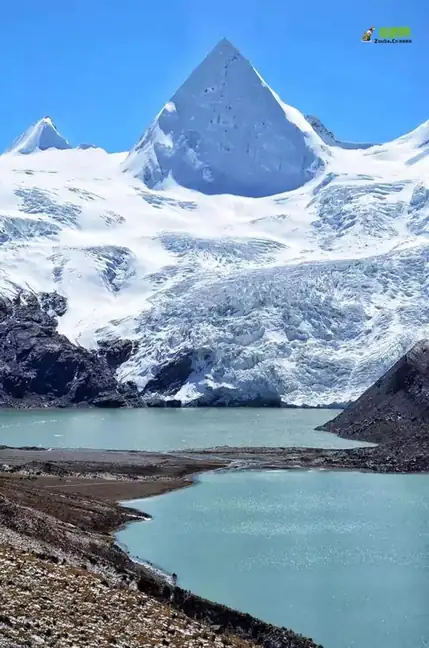
Photo adjustments
EXIF orientation normalized; resized without changing aspect ratio; converted to WebP. No subject edits.
Explore the region
About Sapu Sacred Mountain Visitor Area
Tibet Daily's feature describes Sapu as not one mountain but a group of thirteen snow mountains standing together, with peaks above 6,000 metres ranged around the main summit, and as the boundary mountain between Biru and Bianba counties and the watershed between the Nujiang and Yarlung Tsangpo basins. A glacier falls from the main peak, Sapu Gangri, to the terminal moraine lake Samu Tso, a vertical drop of more than 2,200 metres. The largest of the glaciers is the main-peak glacier on the north slope, about six kilometres long, whose ice tongue reaches the foot of the mountain and has left glacial erosion landforms and the lake itself.
Samu Tso has its surface above 4,700 metres and is divided into two basins: the outer is the main lake and the inner is an ice lake called Gangxiangtong Tso, both reaching sixty to seventy metres deep, and together they are the largest in area and the easiest to reach of the more than ten lakes in the Sapu group. In summer the outer basin thaws completely while broken ice floats on the inner one and the surrounding meadows carry wild flowers; in winter both freeze over into a blue-ice surface that visitors can walk out on. The outer basin is now the core zone of the Sapu scenic area.
The full name of the mountain is Sapu Gonglagabu — the Nagqu municipal entry transliterates it Sapu Gunlagabu — and legend makes it the wisdom sacred mountain of the southern world. In the local Tibetan 萨 means snow leopard and 普 the deepest place, and the feature says Sapu is named for the snow leopards that often appear in its valley. The peaks are named as a household: reading from left to right, Sapu's wife Xuemo, his adopted son Cuotuotaze, his second son Gesangtacuo, his eldest son Dongwei Peak, Sapu himself as Sapu Gangri, his daughter Beiwei Peak, and the general, the physician and the steward.
The catalogue calls this record an open visiting area, and the sources define that only in part. The peaks were found and publicised by experienced outdoor photographers in 2017 and became a popular destination through 2018 and 2019; the Sapu scenic area was rated a national 3A-grade tourist scenic area in 2020, and in 2024 its roads and related facilities were comprehensively upgraded and its reception capacity markedly increased. No cited source lists which routes or sections of the scenic area are open, and none is claimed here.
What to look for
- The thirteen-peak group, with summits above 6,000 metres ranged around the main peak Sapu Gangri
- The main-peak glacier on the north slope, about six kilometres long, with its ice tongue running down to the foot of the mountain
- Samu Tso, the moraine lake at the glacier's end, whose outer basin is the scenic area's core zone
- The inner ice lake Gangxiangtong Tso, with broken ice floating on it in summer and a blue-ice surface in winter
- The peaks read as a family group, from the wife Xuemo at one end to the daughter Beiwei Peak and the general, physician and steward at the other
Location & getting there
Getting to Sapu Sacred Mountain Visitor Area
Check weather, trail access and the last return service. A mountain or forest area is not one entrance, and a map’s central pin may be far from the trailhead.
- Search for 萨普神山开放游览区 with 那曲市 and 比如县.
Find Sapu Sacred Mountain Visitor Area
萨普神山开放游览区 · 比如县
No reliable map pin yet: search by the Chinese name.
Sources & visit information
The linked sources support the identity and background described in this introduction. Opening hours, admission, activity availability and exact arrival arrangements have not been comprehensively checked. Confirm current visitor information with the venue; the original catalogue locality and editorial review flag are retained.