

Entry & permits for Tibet (Xizang)
Foreign tourists need Tibet entry approval, commonly called a Tibet Travel Permit, and an organised visit arranged through a specialist travel agency in China. Confirm your approved route before booking transport. Requirements differ for Taiwan residents and for travellers using mainland or Hong Kong/Macao Chinese resident documents; check the document guide before you book.
Check the travel-document requirements →Policy scope verified: 2026-09-06. UK FCDO: China regional travel advice ↗ State Council Taiwan Affairs Office: Tibet entry approval ↗ Xizang Department of Culture and Tourism: Medog border permit notice ↗
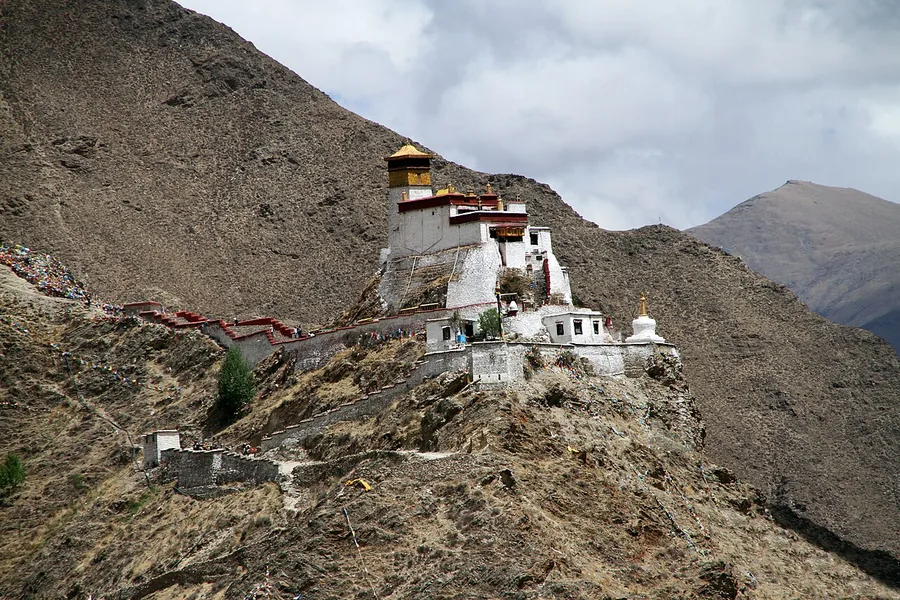
Photo adjustments
Proportionally resized and converted to WebP without cropping, retouching or changing the photographed subject.
Explore the region
About Yumbulagang
Tibetan tradition connects it with the first kings and the beginnings of settled agriculture; the surviving palace-temple has been reconstructed after twentieth-century destruction. A narrow tower dominates the rear, while shrine rooms and platforms occupy the lower buildings. Murals tell the stories of the first ruler, first building and first field. The hilltop position gives these traditions a visible setting in the farmland below.
The fifth Dalai Lama (第五世达赖喇嘛) converted the palace into a temple housing a statue of Shakyamuni (释迦牟尼). It became a Tibet Autonomous Region Cultural Relics Protection Unit in 1962. Restoration after 1982 was followed by further work beginning in November 2017 to reinforce wooden foundations and repair cracked walls.
The ground floor includes a 33-square-metre entrance hall and an adjoining covered platform, with a shrine behind. Above it, a platform enclosed on three sides by low walls precedes a corridor around a courtyard. During the fifth Dalai Lama's period, a four-sided pyramidal golden roof was added to the tower.
What to look for
- The tower and gilded roof above the reconstructed palace-temple.
- The murals of early Tibetan traditions and the view over the Yarlung fields.
Location & getting there
Getting to Yumbulagang
Head to Yumbulagang on Tashi Tsering hill in Changzhu, south of Tsedang in Nedong District.
- The final approach rises from the valley floor to the hilltop; plan the climb separately from the road journey.
Combine your visit
Suggested order for this visit:
-
Hillfoot approach
Look up at the tower’s relationship with the ridge.
-
Palace-temple shrines
Follow the royal and agricultural traditions in the images and murals.
-
Open terrace viewpoint
Finish with the cultivated valley below.
This is an editorial sequence based on the features described in the sources. Confirm access locally; no walking time, shared admission or guaranteed interior access is implied.
Find Yumbulagang
雍布拉康 · 山南
The pin marks the area, not the entrance.
More places nearby
Approximate straight-line distances between map pins, not travel distances.
Tradruk Temple 昌珠寺
6 km awayTradruk, known locally as Changzhu Temple, belongs to the early religious landscape of the Yarlung Valley. Its columned assembly hall is surrounded by smaller shrines and a circumambulatory passage. The temple is especially…
View guide →Samye 桑耶寺
35 km awaySamye’s plan represents a Buddhist universe in built form. The central Utse hall stands for Mount Meru, with surrounding temples, four differently coloured stupas and a circular enclosure completing the composition. Founded…
View guide →Ganden Monastery 甘丹寺
75 km awayGanden occupies a natural amphitheatre high on Wangbur Mountain in Dagze, northeast of Lhasa. Tsongkhapa founded it in 1409, and the monastery remains closely associated with his teaching and the Gelug tradition. Rebuilt…
View guide →Sources & visit information
The linked encyclopedia sources support background and place descriptions. Current opening hours, ticket prices, booking rules and transport schedules have not been independently verified for this guide. Confirm them with the venue or operator before travelling.
Visitor information adapted and edited from Wikipedia contributors · CC BY-SA 4.0. Source revision 92583214.
Background paragraphs translated and condensed from Wikipedia contributors, "雍布拉康", Chinese Wikipedia · CC BY-SA 4.0. Source revision 92583214.
Background paragraphs condensed from Wikipedia contributors, "Yungbulakang Palace", English Wikipedia · CC BY-SA 4.0. Source revision 1366934331.