

Photo adjustments
Full frame retained; proportionally resized and converted to WebP. No retouching or changes to the photographed subject. Card displays may crop the view.
Explore the region
About Jingzhen Octagonal Pavilion
Jingzhen Octagonal Pavilion (景真八角亭) is the ordination hall of Jingzhen Temple (景真寺), a Theravada Buddhist temple in Jingzhen Village (景真村), Mengzhe Town (勐遮镇), Menghai County (勐海县), in Xishuangbanna (西双版纳), Yunnan.
The hall was built in 1701, the fortieth year of the Kangxi reign and year 1063 of the Dai calendar. In 1853 the rest of Jingzhen Temple was destroyed and only the ordination hall survived; the other temple buildings standing today are reconstructions. The pavilion was repaired in 1978 and again in 1993, and in 1988 the State Council placed it in the third group of national key heritage sites. The Menghai County government counts it as one of the county's two nationally protected sites, with Manduan Temple (曼短佛寺).
An article by the Yunnan Institute of Urban and Rural Planning and Design tells how the abbot of Jingzhen's central temple built the hall in honour of Shakyamuni, modelling it on 'Kazhonghan' (卡钟罕), a gold-thread cap the Buddha wore. The pavilion is known as 'Bosu Jingzhen' (波苏景真) and praised as 'the crown of the lotus'. The hall stands on a raised terrace by the water under bodhi trees, and Dai epics and tales such as 'Zhao Shutun and Nanmuruona' (召树屯与南穆若娜) and 'Hulu Xin' (葫芦信) are linked to the place.
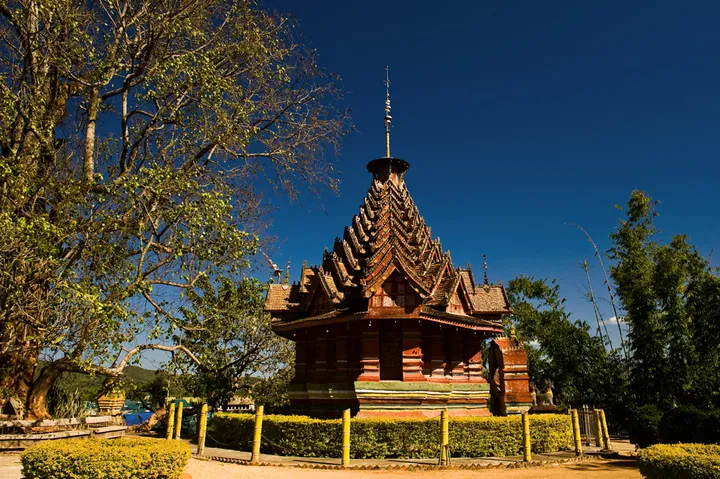
The pavilion is 15.42 metres tall and 8.6 metres wide and has four parts: base, body, roof and finial. The base and body are brick, built on a cross-shaped plan with stepped corners, and doors open on all four sides. Above the doors a round timber eave carries a conical roof of eight groups of gabled roofs rising in eleven tiers, its stacked eaves resembling a lotus. At the top is a 4-metre iron finial sheathed in silver flower ornaments. East of the pavilion, on the shore of a lake called Jinhu (金湖), a tourism project that broke ground in January 2013 had completed a Buddhist culture museum and a palm-leaf scripture museum by the time the planning institute described it in 2018.
What to look for
- The 1701 ordination hall, the only building of Jingzhen Temple to survive 1853
- The conical roof of eight groups of gabled roofs in eleven tiers
- The 4-metre iron finial sheathed in silver flower ornaments
- The brick body on a cross-shaped plan, with doors on all four sides under a round timber eave
- The raised waterside terrace and its bodhi trees
- The Buddhist culture and palm-leaf scripture museums by Jinhu (金湖) to the east
Location & getting there
Getting to Jingzhen Octagonal Pavilion
- Search for 景真八角亭 with 西双版纳傣族自治州 and 勐海县.
Find Jingzhen Octagonal Pavilion
景真八角亭 · 勐海县
No reliable map pin yet: search by the Chinese name.
Sources & visit information
Written from the linked sources and checked sentence by sentence against quoted extracts by a separate reviewer on 2026-09-23. Opening hours, admission and access arrangements are not covered; confirm current visitor information with the site.
Some facts checked against Wikipedia contributors, "景真八角亭" · CC BY-SA 4.0.
Some facts checked against Wikipedia contributors, "Jingzhen Octagonal Pavilion" · CC BY-SA 4.0.