

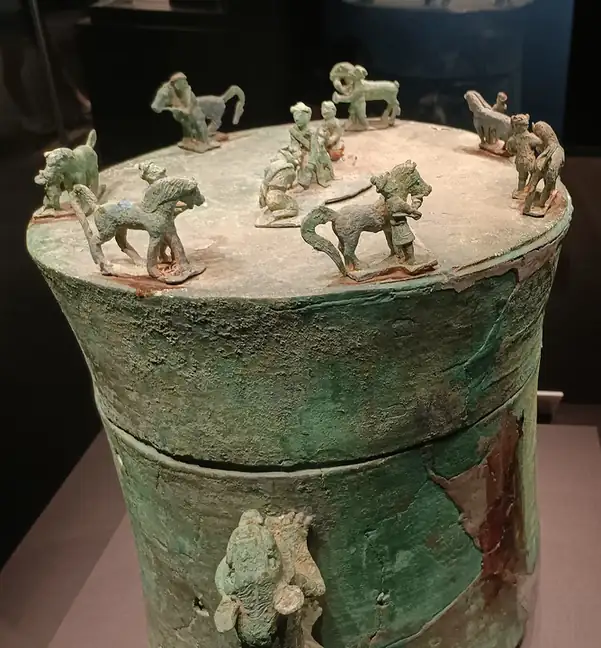
Photo adjustments
EXIF orientation normalized; resized without changing aspect ratio; converted to WebP. No subject edits.
About Lijiashan Bronze Museum
The bronzes came out of the hill in two large campaigns. In January 1972 a five-man team led by Zhang Zengqi moved onto Lijiashan at 1,840 metres, and by mid-May had opened 27 tombs on the flat ground at the top, recovering more than 1,300 objects in bronze, iron, gold, jade and stone, agate, turquoise and malachite; the graves run from the end of the Warring States period to the beginning of the Eastern Han. When villagers digging silicate ore on the south-western slope turned up more bronzes in early 1991, a joint team from the provincial institute of cultural relics and archaeology and the Yuxi and Jiangchuan relics offices excavated 1,100 square metres between December 1991 and April 1992, clearing 58 tombs and lifting 2,395 bronzes, among them drums, cowrie containers, bronze figures and chime bells, with gold scabbards, bracelets and belts. That season was named one of China's ten major archaeological discoveries of 1992. Counting the later smaller digs, 87 tombs have been excavated at Lijiashan and more than 4,000 bronze objects recovered, more than ten of the tombs large enough to match the Shizhaishan cemetery at Jinning in scale and grave goods.
The museum was set up from January 1993 and formally opened on 19 October 1994. It occupies 3,665.9 square metres with 1,459.4 square metres of usable floor space, laid out as a north-facing courtyard compound in Ming and Qing style under yellow glazed tile, with a dug pool inside and seven exhibition rooms on two floors. The collection is drawn chiefly from the Lijiashan graves and takes in cowrie containers, finely cast bronze drums, chime bells, buckle ornaments of many shapes, weapons carrying the animal motifs the district calls bionic, quantities of bronze farm tools and gold and jade ornaments. The basic display is the Lijiashan Ancient Dian Bronze Culture Exhibition, with standing exhibitions on Jiangchuan fish culture and on General Tang Huaiyuan, and more than sixty temporary shows of science, painting and calligraphy and sculpture have been mounted since opening. The museum was assessed as a national third-grade museum and a national science-popularisation education base in 2009, and had earlier been named a provincial patriotic education base. The ox-and-tiger bronze table found at Lijiashan is not held here: it stands in the Yunnan Provincial Museum, 43 centimetres high and 76 centimetres long, a standing ox whose back forms the tray, a tiger biting its tail from behind and a small ox on the crossbar between the legs.
What to look for
- The three-horsemen bronze drum, 46.2 centimetres high with a face 39.7 centimetres across, its centre carrying a twelve-rayed sun pattern and its face three saddled riders in high helmets and tiger-skin robes, with a calf among them.
- The same drum's casting history: the museum's director reports that composition testing shows the drum and its riders were not made in one campaign, the drum coming first and the horsemen later.
- Cowrie containers from the Dian graves, the vessel type the district singles out as carrying strong ethnic character, shown with bronze drums and chime bells.
- The bronze buckle ornaments and the animal-motif weapons the district describes as bionic, together with the bronze farming tools recovered in quantity.
- The building itself: a north-facing Ming and Qing style courtyard compound roofed in yellow glazed tile, with a dug pool in the court and seven exhibition rooms over two floors.
Location & getting there
Getting to Lijiashan Bronze Museum
Confirm the venue or campus, reservation channel and exhibition calendar. A museum name may cover more than one building.
- Search for 李家山青铜器博物馆 with 玉溪市 and 江川区.

Find Lijiashan Bronze Museum
李家山青铜器博物馆 · 江川区
No reliable map pin yet: search by the Chinese name.
Sources & visit information
The linked sources support the identity and background described in this introduction. Opening hours, admission, activity availability and exact arrival arrangements have not been comprehensively checked. Confirm current visitor information with the venue; the original catalogue locality and editorial review flag are retained.