

Photo adjustments
Full frame retained; EXIF orientation normalized, proportionally resized to at most 800 pixels and converted to WebP. No generated pixels or subject changes. Cards may crop the display.
Explore the region
About Weibao Mountain
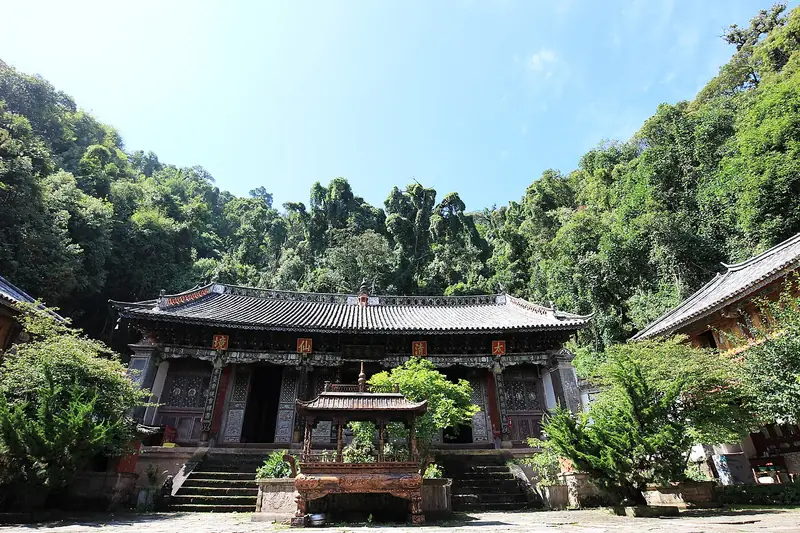
Weibao Mountain (巍宝山) is a Daoist mountain about 10 km south of the county town of Weishan Yi and Hui Autonomous County (巍山彝族回族自治县) in Dali prefecture, Yunnan. Its temples lie in forest on a ridge running northeast to southwest, rising to 2,509 m, and the county takes its name from the mountain.
The scenic area covers 19.4 km². Chinese Wikipedia gives its forest cover as 84%, with pangolins and flying squirrels among the wildlife. The Weishan county government points to thousand-year-old groves of high-mountain chinquapin (高山栲), Ming-dynasty cypress groves and a Ming camellia 18.43 m tall. The forest has been a national forest park since November 1992. The name is said to come from the belief that the mountain held a precious aura.
The mountain is counted as the cradle of the Nanzhao (南诏) kingdom: in the Tang, Xinuluo (细奴逻) moved from Ailao (哀牢) to the Mengshe plain (蒙舍川) and farmed and herded on the mountain before founding the state of Da Meng (大蒙国). In 714 his grandson Shengluopi (盛逻皮) built the Xunshan Hall (巡山殿) to honour him. The county government says Daoists have lived here since the Han. In the late Ming and early Qing it became a formal Daoist community, drawing Daoists from Mount Wudang (武当山) in Hubei and Mount Qingcheng (青城山) in Sichuan, and by the Qianlong reign it had 22 temples.
Most surviving buildings date from the early Qing, with a few from the Ming. The Yunnan government listed the old building complex in December 1987, and Changchun Cave (长春洞) became a national key cultural relic protection unit in May 2006. Weishan Old Town and Weibao Mountain were jointly rated an AAAA tourist attraction in 2014. An 11 km footpath links the whole mountain, and from the first to the fifteenth day of the second lunar month the traditional Weibao Mountain Fair (巍宝山会) brings people up to honour ancestors, dance and sing antiphonal songs.
What to look for
- Xunshan Hall (巡山殿), also called the Tuzhu Temple (土主庙), first built in 714 to honour the Nanzhao founder Xinuluo
- Wenchang Palace (文昌宫), originally named Longtan Hall (龙潭殿) as a place to pray for rain, with a willow by its dragon pool
- Doumu Pavilion (斗姥阁) on the summit, dividing the front-mountain and back-mountain temple groups
- Changchun Cave (长春洞), the lowest-lying temple, singled out by the Dali Wenlv tourism site for its architecture, painting and carving
- Qingxia Palace (青霞宫), set in a chair-shaped hollow with osmanthus trees
- Peihe Tower (培鹤楼) and Sanqing Hall (三清殿) on the back of the mountain
- The Ming camellia, 18.43 m tall, and the Ming cypress groves
Location & getting there
Getting to Weibao Mountain
- Search for 巍宝山 with 大理白族自治州 and 巍山彝族回族自治县.
Find Weibao Mountain
巍宝山 · 巍山彝族回族自治县
No reliable map pin yet: search by the Chinese name.
Sources & visit information
Written from the linked sources and checked sentence by sentence against quoted extracts by a separate reviewer on 2026-09-23. Opening hours, admission and access arrangements are not covered; confirm current visitor information with the site.
Some facts checked against Wikipedia contributors, "巍宝山" · CC BY-SA 4.0.