

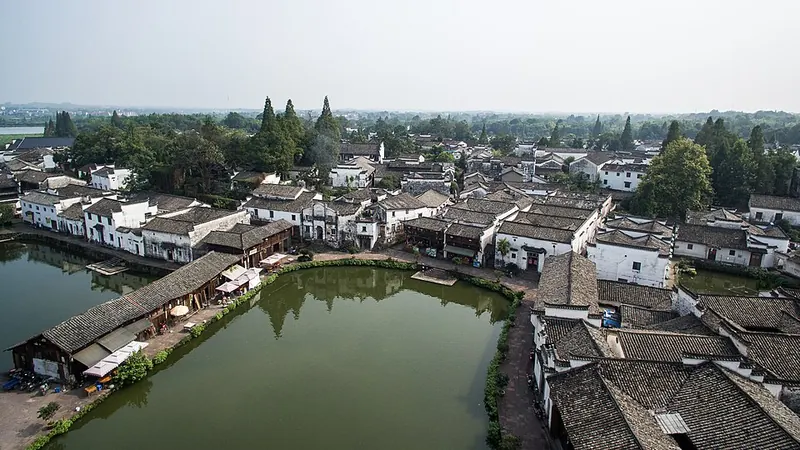
Photo adjustments
Full frame retained; proportionally resized and converted to WebP. No retouching or changes to the photographed subject. Card displays may crop the view.
City & district guides
About Zhuge Village
Elaborate ancestral halls and residences reflect the prosperity of local families, including wealth linked with the medicinal-herb trade. The Prime Minister’s ancestral hall and Dagong Hall give the village’s lineage culture concrete architectural form. Residents traditionally identify with Zhuge Liang’s descendants, but that genealogy is contested. Focus on the surviving buildings and spatial layout, treating the lineage account as local tradition.
The settlement was founded during the Yuan dynasty under the name Gaolong. By the middle of the Ming dynasty, the predominance of families with the Zhuge surname had led to its present name. Villagers began trading in medicinal herbs during the Ming period. It contains about 350 houses and a population of roughly 2,500. In 1996, its residential buildings were jointly designated with those of nearby Changle Village (长乐村) as a Major Historical and Cultural Site Protected at the National Level. The two villages lie about two kilometres apart. Zhuge Village also holds national AAAA tourist attraction status.
What to look for
- Zhong Pond and radiating lanes form the village’s distinctive symbolic layout.
- The Prime Minister’s ancestral hall and Dagong Hall preserve substantial lineage architecture.
Background & history
Zhuge Village or Zhugecun (traditional Chinese: 諸葛村; simplified Chinese: 诸葛村; pinyin: Zhūgě Cūn) is a historic village located in Zhuge town (诸葛镇), Lanxi, Jinhua, Zhejiang Province, China. Originally called Gaolong (高隆), the village changed its name to Zhuge during the Ming Dynasty due to the prevalence of the Zhuge surname among the villagers. The residents claim they are the descendants of the famed Shu Han chancellor Zhuge Liang of the 3rd century CE. The village was designated a national heritage site in 1996, and contains relics which are 700 years old.
Excerpt from Wikipedia: Zhuge Village · Wikipedia contributors · CC BY-SA 4.0. Selected introductory sentences; formatting simplified. Background information, not current visitor-service advice.
Location & getting there
Getting to Zhuge Village
Approach Zhuge Village in Zhuge town, Lanxi, near the boundaries with Jiande and Longyou, and leave vehicle access at the village’s public visitor approach before entering the lanes.
Combine your visit
A suggested sequence linking the specific features of this visit.
-
Zhong Pond
Begin with the centre of the village’s spatial arrangement.
-
Dagong Hall
Examine one of the substantial communal buildings.
-
Prime Minister’s ancestral hall
Connect the architecture with the lineage tradition surrounding Zhuge Liang.
This order is editorial. Confirm access and any transfers between stops; it does not establish a walking route, same-day connection or common admission ticket.
Find Zhuge Village
诸葛八卦村 · 金华市
The pin marks the area, not the entrance.
More places nearby
Approximate straight-line distances between map pins, not travel distances.
Longyou Caves龙游石窟
24 km awayThe Longyou Caves are large artificial sandstone chambers near Shiyan Beicun on the Qu River. Their tall supporting pillars and surfaces covered in regular angled tool marks make the labour of excavation visible. Although often…
View guide →Shuanglong Cave双龙洞
32 km awayShuanglong Cave on Jinhua’s North Mountain is distinctive for the low water passage between its outer and inner chambers. Visitors enter the narrow section lying flat in a small boat, under staff direction, before reaching the…
View guide →Tianning Temple Main Hall金华天宁寺
38 km awayTianning Temple’s surviving main hall stands on a slope above the Wu River in Jinhua. The square, three-bay building has a single-eaved hip-and-gable roof and a timber frame that preserves elements from both Song and Yuan…
View guide →Sources & visit information
The sources below support the place-specific description and arrival information. Suggested combinations are editorial planning ideas; confirm current opening, entry arrangements and transport services for your date.
- en.wikipedia.org ↗
- mg.changzhou.gov.cn ↗
- 诸葛村 ↗
- Chinese Wikipedia: 诸葛村 (revision 92234489, 2026-04-10) ↗
Visitor information adapted and edited from Wikipedia contributors, “诸葛村” · CC BY-SA 4.0. Source revision 92234489.
Background paragraphs translated and condensed from Wikipedia contributors, "诸葛村", Chinese Wikipedia · CC BY-SA 4.0. Source revision 92234489.